

What Play Is The Lion King Based On
You're sitting in the dark of a theater, watching a giraffe puppet stilt-walk down the aisle, and somewhere in the back of your mind you're thinking: I kn
You’re sitting in the dark of a theater, watching a giraffe puppet stilt-walk down the aisle, and somewhere in the back of your mind you’re thinking: I know this story from somewhere deeper than Disney.
Pizza Chef Pretend Play Kit
15-page pizza pretend play kit: build-your-own pizza, restaurant role play, chef hat, menu, and certificate.
You’re right. The Lion King didn’t arrive fully formed from an animation studio in Burbank. It has roots that stretch back centuries, through one of the most performed plays in the English language, and further still into ancient myth and oral storytelling traditions that predate Shakespeare himself.
If you’ve ever wondered what play The Lion King is based on, the answer opens up a surprisingly rich world of storytelling, adaptation, and the timeless power of drama to teach children about life, loss, identity, and courage.
Key Takeaways:
- The Lion King (1994) is widely acknowledged to draw heavily from Shakespeare’s Hamlet, sharing its core plot structure, character archetypes, and themes
- Disney’s animated film also draws inspiration from ancient Egyptian mythology (specifically the story of Osiris and Horus) and Bambi (1942)
- The Broadway musical adaptation, directed by Julie Taymor and opened in 1997, transformed the story into a landmark piece of theatrical art
- The story’s themes (identity, grief, responsibility, justice) make it deeply relevant for children’s learning and development
- Understanding the source material helps parents and educators use The Lion King as a genuine teaching tool
!Silhouette of Pride Rock at sunset with theatrical lighting
The Shakespeare Connection: Why The Lion King Is Essentially Hamlet
The most direct answer to “what play is The Lion King based on” is Hamlet by William Shakespeare, written around 1600.
The structural parallels are so close that film scholars and literature teachers regularly use both texts side by side. Here’s how the characters map across:
| The Lion King Character | Hamlet Character | Role in the Story |
|---|---|---|
| Simba | Prince Hamlet | The prince who must reclaim his throne |
| Mufasa | King Hamlet (the ghost) | The murdered father who guides the hero |
| Scar | King Claudius | The uncle who murders the king and seizes power |
| Sarabi | Queen Gertrude | The mother who remains in the usurper’s court |
| Nala | Ophelia / Horatio (hybrid) | The companion who urges Simba to return |
| Timon and Pumbaa | Rosencrantz and Guildenstern | Comic companions who distract the hero |
| Rafiki | The Ghost / The Gravedigger | The wise figure who reveals truth |
The core plot beats are nearly identical: a king is murdered by his ambitious brother, the prince flees in guilt and confusion, the prince is visited by his father’s spirit, and ultimately the prince must return to confront the usurper and restore justice.
“Shakespeare’s Hamlet is essentially the story of a young man paralyzed by grief and self-doubt who must eventually choose action over avoidance. The Lion King translates this into a form accessible to children without losing the emotional weight.” - Dr. Laurie Osborne, Professor of English, Colby College
Disney’s directors Rob Minkoff and Roger Allers have acknowledged the Hamlet influence in multiple interviews, though the studio initially pitched the film as “Bambi in Africa.” The Hamlet framework gave the story its dramatic spine.
The key takeaway: The Lion King is a child-accessible retelling of Hamlet’s central conflict between grief, responsibility, and identity.
Beyond Shakespeare: The Older Roots of the Story
Hamlet itself didn’t appear from nowhere. Shakespeare adapted it from earlier sources, including the Scandinavian legend of Amleth, recorded in the 12th-century Gesta Danorum (Deeds of the Danes) by Saxo Grammaticus. That story also features a prince whose father is murdered by his uncle, who then must feign madness to survive.
But The Lion King’s creative team also drew from Egyptian mythology, specifically the myth of Osiris, Isis, and Horus. In that myth:
- Osiris (the king) is murdered by his jealous brother Set
- His body is scattered and lost
- His son Horus must grow up, reclaim his birthright, and defeat Set to restore order to the kingdom
The parallels to Mufasa, Scar, and Simba are striking. According to the British Museum’s resources on Egyptian mythology, the Osiris myth was one of the most widely told stories in the ancient world, representing the cycle of death, resurrection, and cosmic order.
The Lion King sits at the intersection of at least three major storytelling traditions:
-
Ancient Egyptian mythology (Osiris/Horus cycle)
-
Scandinavian legend (the Amleth saga)
-
Shakespearean tragedy (Hamlet, c. 1600)
Pro Tip: When using The Lion King as a teaching tool with children, you can trace these story threads across cultures to show how the same human concerns (justice, loss, identity) appear in every civilization’s stories.
The key takeaway: The Lion King draws from at least 2,000 years of storytelling tradition, not just one source.
How Julie Taymor’s Broadway Musical Deepened the Source Material
When The Lion King opened on Broadway at the New Amsterdam Theatre on November 13, 1997, director and designer Julie Taymor didn’t just adapt the film. She reached back into the theatrical traditions that Shakespeare himself would have recognized: puppetry, masked performance, ritual staging, and visible stagecraft.
Taymor made a specific choice to show the puppeteers operating the animal figures in plain sight rather than hiding them. This decision was rooted in Japanese Bunraku puppet theater, where the craft of storytelling is itself part of the spectacle.
The Broadway production also expanded the African musical traditions in the score, working with composer Hans Zimmer and South African musician Lebo M to ground the show in authentic cultural music rather than generic “African sound.”
“The conceit of the show is the celebration of the theatrical event itself. I want you to see the puppeteer. I want you to see the actor’s face as well as the mask. That duality is what theater is about.” - Julie Taymor, speaking to the Kennedy Center
The Broadway musical has now run for over 25 years, making it one of the longest-running shows in Broadway history and one of the highest-grossing theatrical productions ever staged.
The key takeaway: The Broadway adaptation took the Shakespeare/Disney foundation and added layers of theatrical artistry that made it a genuinely original piece of theater.
What This Means for Children’s Learning and Development
This is where the story gets genuinely interesting for parents and educators.
The reason The Lion King resonates so deeply with children (and adults) isn’t because Disney is good at marketing. It’s because the story’s themes are archetypal. They show up across cultures and centuries because they address something real about human development:
-
Identity: Who am I when I’m separated from my family and origins?
-
Grief: How do you carry loss without being destroyed by it?
-
Responsibility: What do you owe to the people and places that formed you?
-
Courage: Can you act when you’re afraid and uncertain?
These are exactly the questions children begin wrestling with during early childhood and preschool years. Drama and story-based play are one of the most effective ways children process these emotional themes in a safe context.
Research from the American Academy of Pediatrics consistently supports the role of imaginative and dramatic play in children’s social-emotional development. When a child acts out being Simba returning to Pride Rock, they’re not just playing. They’re rehearsing courage.
This connects directly to broader principles of play-based learning. For a much deeper look at how story, drama, and play intersect in child development, the The Ultimate Guide to Play-Based Learning for Children is worth reading in full.
The key takeaway: The Lion King’s themes work pedagogically because they address universal developmental questions children are already asking.
How Story-Based Play Connects to Real Learning
Understanding the source material behind The Lion King points toward a bigger question: how do children learn through story and dramatic play?
Here’s a simple comparison of how different story formats support different kinds of learning:
| Story Format | Best For | Age Range | Learning Type |
|---|---|---|---|
| Animated film | Emotional engagement, visual learning | 3-8 years | Receptive/passive |
| Picture book retelling | Language development, discussion | 2-6 years | Interactive |
| Dramatic play / role-play | Emotional processing, empathy | 3-7 years | Active/embodied |
| Theater performance | Cultural appreciation, narrative structure | 5+ years | Observational |
| Curriculum integration | Cross-subject learning | 4-8 years | Structured |
For preschool-age children specifically, dramatic play based on familiar stories (including films like The Lion King) gives children a narrative framework to explore complex emotions. They already know the characters, so cognitive load is low, freeing up space for emotional exploration.
If you’re thinking about how to structure this kind of learning intentionally, Play Based Learning For Preschoolers: A Parent’s Guide walks through practical approaches you can use at home or in a classroom setting.
Cost and Accessibility: Experiencing The Lion King Across Formats
| Format | Approximate Cost | Accessibility |
|---|---|---|
| Disney+ streaming (animated film) | $8-14/month (subscription) | Widely available |
| Broadway ticket (New York) | $80-$350 per ticket | Limited by location |
| Touring production ticket | $40-$150 per ticket | Varies by city/season |
| Picture book adaptations | $8-$15 | Universal |
| School/community theater production | Free-$25 | Variable |
| Drama curriculum based on the story | $0-$50 | Teacher/parent-dependent |
The story itself is free. Shakespeare’s Hamlet is in the public domain and available through Project Gutenberg at no cost. The Lion King’s theatrical DNA is accessible at every price point.
Frequently Asked Questions
Is The Lion King directly based on Hamlet?
Disney has never officially confirmed a direct one-to-one adaptation, but the structural and character parallels are so extensive that literary scholars and the filmmakers themselves have acknowledged the connection in interviews. The core plot (prince, murdered father, usurping uncle, exile, return) follows Hamlet closely enough that it’s standard practice to teach them together in secondary school English curricula.
Are there other differences between The Lion King and Hamlet?
Several significant ones. Hamlet ends as a tragedy: nearly every major character dies, including Hamlet himself. The Lion King is a restorative narrative: Simba reclaims the throne, Scar is defeated, and balance returns. The tone shift reflects Disney’s adaptation for a family audience, but it also aligns more closely with the Egyptian Osiris myth (where Horus succeeds) than with Shakespeare’s ending.
Is The Lion King appropriate for young children despite its dark themes?
Most child development professionals suggest the film is appropriate from around age 5-6 for most children, though individual sensitivity to Mufasa’s death varies. The story’s darkness is balanced by its resolution, and research suggests that encountering grief and loss in story form helps children develop emotional resilience. What Is Play Based Assessment? A Comprehensive Overview covers how educators observe and support children’s emotional responses during story-based activities.
Can The Lion King be used as part of a preschool curriculum?
Yes, and it’s frequently used in early childhood settings. The story supports discussions about family, loss, identity, and justice. Drama activities, puppet play, and retelling exercises based on familiar narratives like The Lion King fit naturally into play-based curriculum frameworks. For a structured approach to this, Play Based Preschool Curriculum: Key Elements And Benefits provides practical guidance for educators.
What makes The Lion King different from other Disney adaptations?
Most Disney films adapt relatively straightforward fairy tales (Cinderella, Sleeping Beauty, The Little Mermaid). The Lion King is unusual in being a composite of tragedy, mythology, and oral storytelling traditions that predate recorded literature. That depth is part of what makes it resonate differently, and why educators find it more pedagogically rich than simpler source material.
The Bigger Picture
The Lion King works because it’s telling a story humans have been telling each other for thousands of years: the child who loses their father and must find the courage to become who they were meant to be.
Shakespeare understood this. Ancient Egyptian priests understood this. Julie Taymor understood this. And children, without knowing any of that history, feel it instinctively when they watch Simba run through the rain toward Pride Rock.
That instinct, that emotional recognition of a story that speaks to something true, is exactly what play-based learning tries to nurture. When children have space to act out these stories, retell them, argue about them, and feel them, they’re doing something educationally profound.
For a complete look at how story, drama, and play intersect in child development across all ages, read the The Ultimate Guide to Play-Based Learning for Children for the full picture.
Take the Next Step!
Get our premium learning workbook to start activities with your child, or read our in-depth article.
Recommended Resources & Workbooks
Pair this guide with our hands-on, ready-to-print learning resources.
 Digital Bundle
Learn to Read Program: Levels 1-3
170 sequenced phonics lessons across 199 pages, from first letter sounds to fluent long-vowel reading.
 Digital Learning Bundle
Preschool Learning Bundle
260+ printable worksheets for tracing, ABCs, numbers, shapes, sight words, and kindergarten prep.
 Digital Learning Bundle
Play-Based Learning Bundle for Ages 3-6
230+ play-based learning activities with pretend play, reading, early math, creative arts, and bonus flashcards.
Related Guides & Articles
Explore more of our detailed guides and activities.
The Ultimate Guide to Play-Based Learning for Children
What I found con
What Is Play Based Assessment? A Comprehensive Overview
Play based assessment is one of those terms you hear thrown around in early childhood education circles, but rarely gets the detailed explanation i...
Play Based Learning For Preschoolers: A Parent's Guide
Play based learning for preschoolers is one of those topics where everyone seems to have an opinion, but the research tells a more specific story. ...
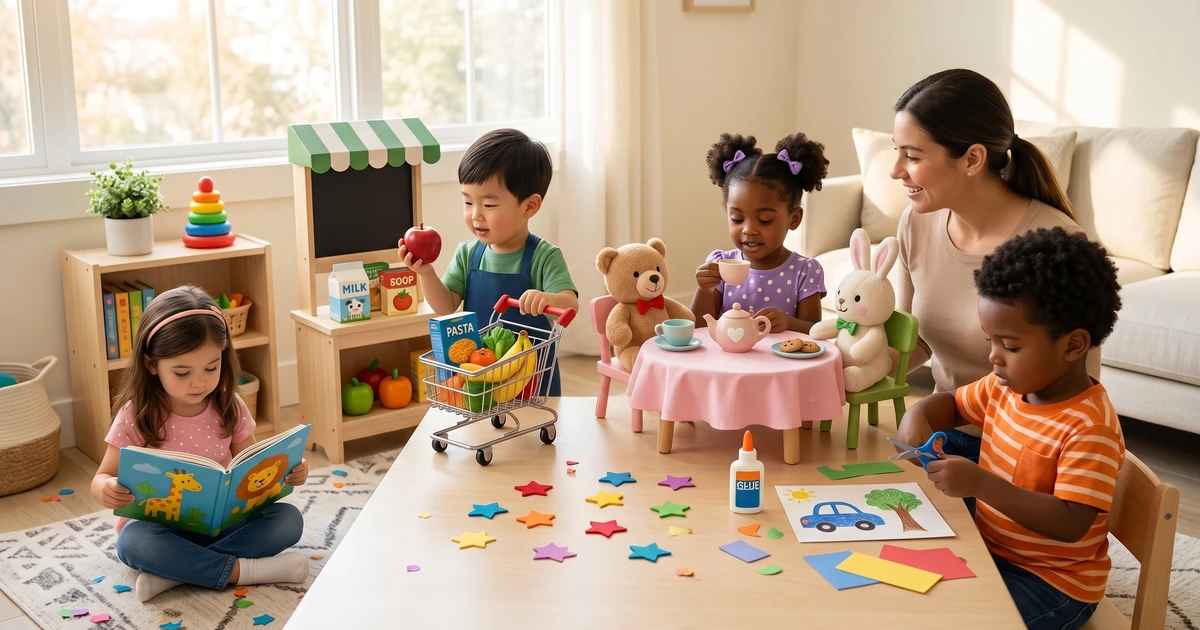
Play Based Preschool Curriculum: Key Elements And Benefits
The term play based preschool curriculum gets used a lot these days, but what does it actually mean in practice? After spending 40+ hours researchi...