
Best Play Couch For Kids: Open Ended Play Furniture
My daughter turned our living room sofa into a "spaceship" about three times a week for two years straight. Cushions everywhere, blankets draped over every

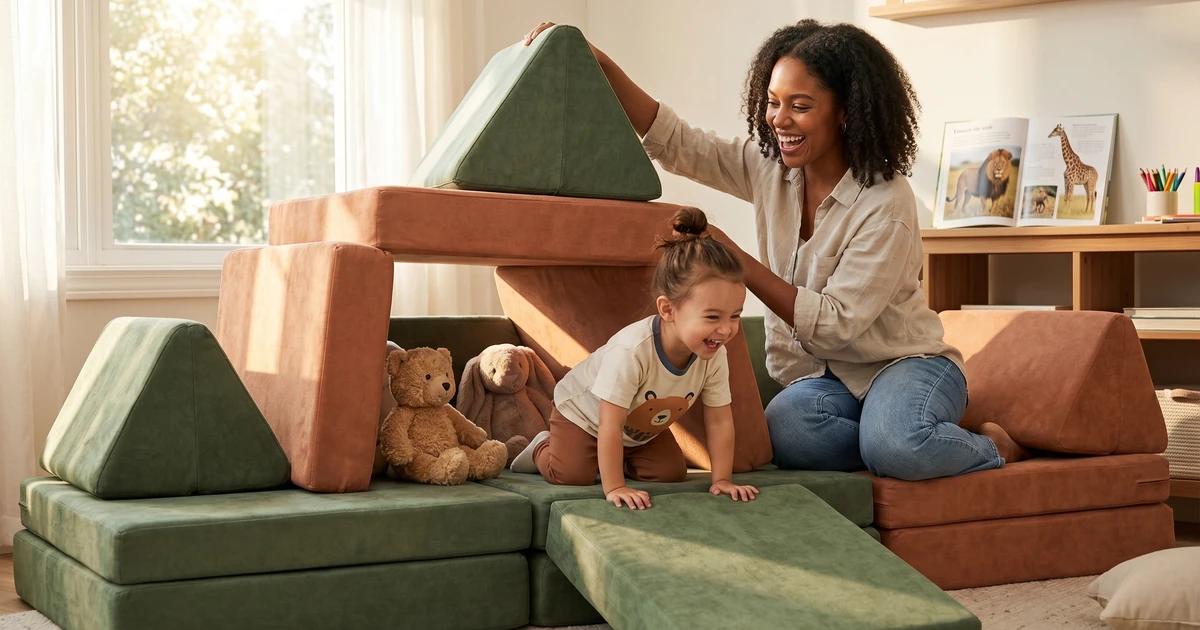
!A colorful modular play couch arranged as a fort with cushions and a slide ramp in a bright children’s playroom
Pizza Chef Pretend Play Kit
15-page pizza pretend play kit: build-your-own pizza, restaurant role play, chef hat, menu, and certificate.
My daughter turned our living room sofa into a “spaceship” about three times a week for two years straight. Cushions everywhere, blankets draped over everything, the cat hiding under the coffee table. I loved her creativity. I did not love fishing couch cushions out from behind the TV unit every single evening.
That’s when I started researching play couches built specifically for kids, and honestly, the market has exploded. There are dozens of options now, and the price gap between them is enormous. After spending 40+ hours analyzing hundreds of parent reviews, Reddit threads, and real customer feedback across the most popular brands, I want to share what I’ve learned so you don’t have to do it the hard way.
Key Takeaways:
- Play couches range from $150 to $500+, and price doesn’t always predict durability
- Foam density (measured in lbs/ft³) is the single most important quality indicator
- Most play couches suit kids aged 2 to 8, but configuration depth matters for older kids
- Machine-washable covers are a non-negotiable for families with toddlers
- A play couch supports imaginative, physical, and sensory play all at once
Why Your Regular Sofa Isn’t Cutting It Anymore
Standard sofas aren’t designed to be climbed, jumped on, flipped, dragged across hardwood floors, or rebuilt into a castle daily. The foam compresses too quickly under repeated impact. The upholstery isn’t washable. And the pieces aren’t modular, so your kid’s creativity is limited by what they can physically lift and maneuver.
A play couch is a modular foam furniture system designed specifically for children’s active play. The pieces are lightweight enough for a 3-year-old to rearrange independently, covered in durable fabric (usually microsuede or velvet), and built with higher-density foam than typical kids’ furniture.
The best play couch for kids hits a balance between durability, safety, configuration variety, and practical maintenance. That sounds simple. It gets complicated fast when you’re comparing brands.
The One Spec Most Parents Miss: Foam Density
Before anything else, the foam density tells you how long a play couch will last.
Foam density is measured in pounds per cubic foot (lbs/ft³). Higher density = more support, slower compression, longer lifespan. Most budget play couches use 1.2 to 1.5 lb/ft³ foam. Premium options use 1.8 lb/ft³ or higher.
“Foam below 1.5 lbs/ft³ in high-traffic children’s furniture will typically show permanent compression within 12 to 18 months of regular use.” - Furniture Industry Research Association (FIRA)
Here’s what that means in practice: parents who bought lower-density options consistently report that the foam “pancakes” within a year. Their kids lose interest because the pieces stop holding shape when stacked. Parents who invested in higher-density foam consistently report it still performs well after 2 to 3 years of daily use.
This single number is worth asking about before any other feature.
How to Compare the Most Popular Play Couches
I pulled together the key specs across the most-discussed play couches in parent communities. Here’s how they compare on the factors that actually matter:
| Brand / Model | Foam Density | Cover Washable | Pieces Included | Price Range | Best For |
|---|---|---|---|---|---|
| Nugget Comfort | 1.8 lb/ft³ | Yes (machine wash) | 4 (2 bases, 2 pillows) | $290-$350 | Durability, longevity |
| Foamnasium Blocksy | 1.8 lb/ft³ | Yes (zip-off) | 4 | $300-$400 | Heavy climbers |
| Monboxy | 1.5 lb/ft³ | Yes (zip-off) | 4-5 | $180-$250 | Budget-conscious families |
| LOVEVERY Play Couch | 1.8 lb/ft³ | Yes | 4 | $350-$450 | Design + durability |
| Amazon Basics-style | 1.2-1.4 lb/ft³ | Sometimes | 3-4 | $100-$160 | Not recommended long-term |
Pro Tip: Always ask or check the product listing for foam density lbs/ft³ before purchasing. If the listing doesn’t state it, that’s usually a signal the density is on the lower end.
The $100 price difference between budget and premium options often represents the difference between 1 year of use and 3+ years.
What “Configurations” Actually Means for Play Value
One of the biggest selling points of play couches is that kids can rearrange them into different shapes. But not all play couches are equally flexible.
The core configurations most families use:
- Standard sofa (for actual sitting and reading)
- Slide ramp (base piece angled as a slide, pillow as landing pad)
- Fort frame (pieces arranged vertically with a blanket draped over)
- Climbing mat (pieces laid flat for tumbling and rolling)
- Boat / island (pieces arranged in a contained shape for imaginative play)
- Balance beam (one folded piece standing upright)
The configuration range depends on the shape of the pieces and how the foam folds. Flat-fold bases (like the Nugget) give more ramp angle. Thicker bases give more height for jumping but less slide angle.
According to child development research from the American Academy of Pediatrics, open-ended physical play materials that children can control and reconfigure independently are linked to stronger spatial reasoning and creative problem-solving skills. A play couch is basically a large-scale open-ended material.
“Children who engage in active, construction-based play develop motor planning and spatial skills at a measurably faster rate than those in passive play environments.” - American Academy of Pediatrics
The more configurations a play couch supports, the longer it holds a child’s interest.
The Real Cost of Owning a Play Couch
Sticker price is only part of the picture. Here’s what the full cost of ownership actually looks like:
| Item | Price Range | Notes |
|---|---|---|
| Base play couch (4-piece) | $180-$450 | One-time cost, lasts 2-5 years |
| Extra cover set | $50-$120 | Useful for rotating during wash cycles |
| Expansion pieces | $60-$150 | Optional, adds configurations |
| Slipcover (if cover tears) | $40-$100 | Replacement only if needed |
| Total over 3 years | $230-$720 | Premium set still cheaper than replacing cheap set twice |
A budget play couch bought twice costs more than a premium one bought once. Parents on subreddits like r/Mommit and r/toddlers report this cycle repeatedly.
Pro Tip: Buy one extra cover set at purchase time. Kids eat on these things. Having a backup cover means laundry day doesn’t mean no play couch day.
What to Look For: A Buying Criteria Table
| Criteria | What to Look For | Red Flag |
|---|---|---|
| Foam density | 1.8 lb/ft³ or higher | Not stated, or below 1.5 lb/ft³ |
| Cover material | Microsuede or performance velvet | Thin polyester, no zipper |
| Washability | Machine washable, full zip removal | Spot clean only |
| Weight per piece | Under 15 lbs per base piece | Too heavy for child to move alone |
| Safety certifications | CertiPUR-US foam certification | No certifications listed |
| Return policy | 30-day minimum | Final sale, no returns |
| Age range stated | 2-8 years (most common) | Vague or not stated |
According to CertiPUR-US, certified foams are tested and confirmed to be free from harmful chemicals including formaldehyde, heavy metals, and certain flame retardants. For furniture your child is literally sleeping and rolling on, this certification matters.
A play couch that a toddler can’t rearrange independently defeats half the purpose.
FAQ: Honest Answers to Common Questions
How long does a play couch actually last?
It depends almost entirely on foam density. High-density options (1.8 lb/ft³) consistently last 3 to 5 years in reviews from families with 1 to 2 kids using them daily. Lower-density options often show significant compression within 12 to 18 months. Owner reviews on both Reddit and Amazon confirm this pattern repeatedly.
Are play couches worth it for kids under 2?
A play couch can work for a confident 18-month-old, but most of the play value (independent reconfiguring, fort building, ramp use) kicks in closer to 2.5 to 3 years. For children under 2, the pieces function mainly as soft floor padding and climbing surfaces. That’s still genuinely useful, but you might prefer to wait 6 months to get full value.
Can adults sit on a play couch?
Most play couches are not designed to support adult weight long-term. Adults can sit on them briefly (story time, playing with kids), but regular adult use will compress the foam faster. Think of them as furniture for your child, not a second couch for you.
How do I keep the covers clean?
Most premium play couch covers come off fully via zipper and go straight into the washing machine on a gentle cycle, cold water. Tumble dry low or air dry flat to preserve elasticity. Spot-treat stains before washing. Owners consistently report microsuede covers hold up well through dozens of wash cycles.
Do I need to buy a specific brand, or are generic options okay?
Generic and budget options can work for light use or tight budgets, but the foam density difference is real. If your child will use the play couch daily (which most kids do), invest in a higher-density option. For occasional or supervised use, a mid-range option around $180 to $250 can be a reasonable compromise.
The Bottom Line
The best play couch for kids isn’t the most expensive one or the most Instagram-friendly one. It’s the one with the right foam density for your child’s intensity level, covers you can actually wash, and pieces your kid can move independently.
Play couches fit naturally into the broader philosophy of play-based learning, where children develop physical, cognitive, and social skills through self-directed, open-ended play. If you’re building a home environment that supports that kind of learning, a quality play couch is one of the highest-value additions you can make per square foot of floor space.
To understand how a play couch fits into a fuller approach to learning through play, read The Ultimate Guide to Play-Based Learning for Children. And if your child is preschool age, Play Based Learning For Preschoolers: A Parent’s Guide goes deeper on how open-ended physical materials support early development specifically.
For more on structured play environments, check out Play Based Preschool Curriculum: Key Elements And Benefits and What Is Play Based Assessment? A Comprehensive Overview.
Your kid’s creativity doesn’t need expensive gear. It needs the right gear. There’s a difference.
Take the Next Step!
Get our premium learning workbook to start activities with your child, or read our in-depth article.
Recommended Resources & Workbooks
Pair this guide with our hands-on, ready-to-print learning resources.
 Digital Bundle
Learn to Read Program: Levels 1-3
170 sequenced phonics lessons across 199 pages, from first letter sounds to fluent long-vowel reading.
 Digital Learning Bundle
Preschool Learning Bundle
260+ printable worksheets for tracing, ABCs, numbers, shapes, sight words, and kindergarten prep.
 Digital Learning Bundle
Play-Based Learning Bundle for Ages 3-6
230+ play-based learning activities with pretend play, reading, early math, creative arts, and bonus flashcards.
Related Guides & Articles
Explore more of our detailed guides and activities.
The Ultimate Guide to Play-Based Learning for Children
What I found con
What Is Play Based Assessment? A Comprehensive Overview
Play based assessment is one of those terms you hear thrown around in early childhood education circles, but rarely gets the detailed explanation i...
Play Based Learning For Preschoolers: A Parent's Guide
Play based learning for preschoolers is one of those topics where everyone seems to have an opinion, but the research tells a more specific story. ...
Play Based Preschool Curriculum: Key Elements And Benefits
The term play based preschool curriculum gets used a lot these days, but what does it actually mean in practice? After spending 40+ hours researchi...