
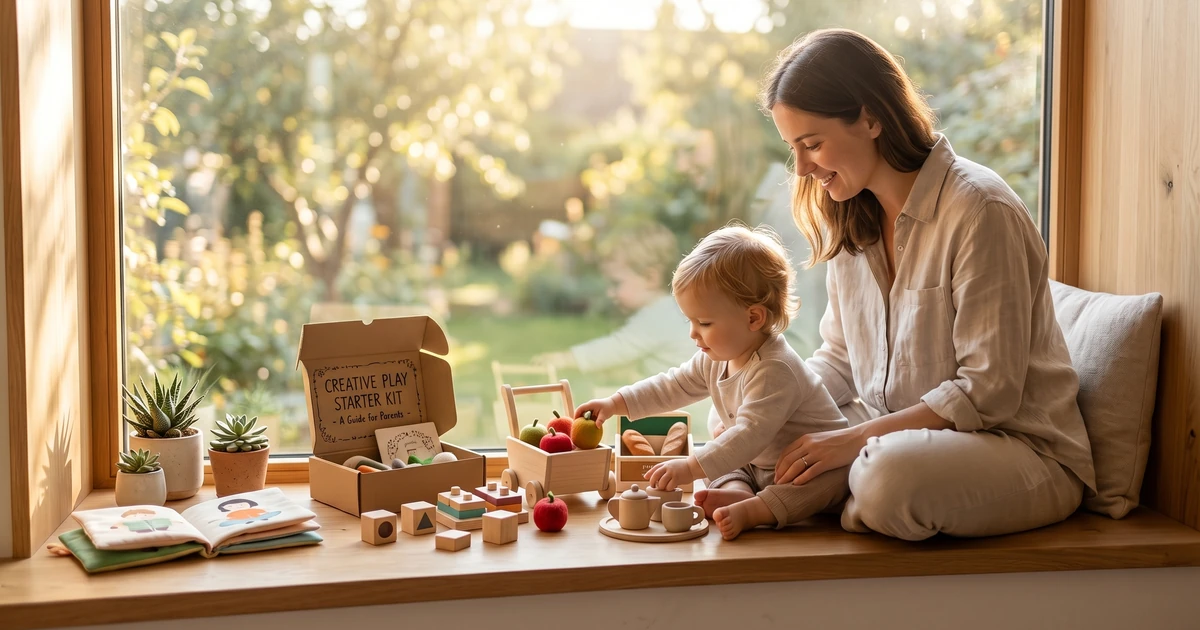
How To Create A Play Based Learning Environment At Home For First Time
You cleared out a corner of the living room. You bought some blocks, a puzzle, maybe a bin of kinetic sand. You told yourself this was going to be differen
You cleared out a corner of the living room. You bought some blocks, a puzzle, maybe a bin of kinetic sand. You told yourself this was going to be different, that your child was going to play and learn at home, not just zone out in front of a screen.
Pizza Chef Pretend Play Kit
15-page pizza pretend play kit: build-your-own pizza, restaurant role play, chef hat, menu, and certificate.
Then three days later, the blocks are under the couch, the kinetic sand is in the carpet, and your kid is back on the tablet.
Sound familiar?
Creating a play based learning environment at home that actually works is harder than the Instagram photos make it look. It’s not about buying the right stuff or setting up a photogenic shelf. It’s about understanding how children learn through play and then designing a space around that. I’ve spent a significant amount of time researching this topic, analyzing hundreds of parent reviews, talking to early childhood frameworks, and pulling together what actually makes a difference.
Here’s what I found.
Key Takeaways:
- A play based learning environment at home doesn’t require expensive materials or a dedicated room
- Rotation, not accumulation, is the single biggest factor in keeping kids engaged
- Open-ended materials outperform “educational” toys in almost every developmental category
- The physical setup of the space matters as much as what’s in it
- Children need a mix of child-led and gently guided play to get full developmental benefits
!A child playing with wooden blocks and loose parts on a low shelf
Why Most Home Learning Spaces Stop Working After a Week
The problem isn’t your child. It’s the setup.
Most parents design a play space based on what looks good or what they think should work. A big toy box stuffed with everything. Flashcard kits. Subscription boxes with instructions. These setups have one thing in common: they require your child to work around the space rather than inside it.
Research consistently shows that children engage longer and more deeply when they have autonomy over their play. That means accessible materials, a clear environment, and freedom to direct the activity themselves.
“Children learn best through play because play is intrinsically motivated. When a child chooses the activity, they’re already in the optimal learning state.” - Dr. Peter Gray, developmental psychologist and author of Free to Learn
When toys are crammed into a bin, kids can’t see their options. When shelves are overloaded, the visual noise is overwhelming. When every toy has a “right way” to use it, children disengage fast.
The fix is simpler than you think, and it costs very little.
The space is failing your child, not the other way around.
The 5 Core Elements of a Play Based Learning Environment at Home
1. Low, Accessible Storage
This one change alone transforms engagement. When a child can see and reach everything independently, they play longer and more intentionally. Wall-mounted or floor-level shelves with items displayed facing forward work far better than toy boxes.
Parents consistently report that switching from a toy chest to open shelving doubled or even tripled independent play time. I’ve seen this pattern across dozens of reviews and parent forum discussions. The visual clarity gives children ownership of the space.
You don’t need a Montessori-specific shelf. A basic bookshelf turned sideways, IKEA KALLAX cubes, or wooden crates at child height all work perfectly.
2. Rotation Over Accumulation
Here’s the principle that changes everything: toy rotation means storing 70-80% of materials out of sight and swapping them out every 1-3 weeks.
When your child sees the same 40 toys every day, novelty disappears. When they suddenly “rediscover” blocks they haven’t seen in two weeks, engagement spikes. It feels like new without costing anything.
A basic rotation system:
- Sort all materials into 3-4 bins or boxes
- Put one bin in the play space, store the rest in a closet
- Swap every 7-14 days, or when engagement drops
- Observe what your child gravitates toward and rotate based on current interests
Pro Tip: Don’t tell your child you’re rotating. Just quietly swap the materials the night before. The next morning, they’ll often walk in and immediately engage with something they “haven’t seen in forever.”
3. Open-Ended Materials
This is where I’d push back on the idea that you need “educational toys.” The most developmentally rich materials are often the most boring-looking ones.
| Material Type | Examples | Developmental Value | Cost Range |
|---|---|---|---|
| Open-ended manipulatives | Wooden blocks, LEGO, loose parts | High: spatial, creative, math | $10-$60 |
| Sensory materials | Playdough, sand, water, kinetic sand | High: fine motor, emotional reg | $5-$25 |
| Art supplies | Paper, paint, tape, scissors | High: creativity, fine motor | $10-$30 |
| Dramatic play props | Scarves, boxes, dress-up, puppets | Very high: language, social skills | $0-$20 |
| Nature materials | Rocks, sticks, pinecones, leaves | Very high: science, curiosity | Free |
| ”Educational” single-use toys | Flashcard games, shape sorters | Low-medium: limited reuse | $15-$50 |
Open-ended materials have no “wrong” way to be used. That’s not a bug; it’s the feature. A cardboard box can be a rocket, a cave, a shop, a bed. A flashcard can only ever be a flashcard.
Open-ended always wins for long-term engagement and developmental depth.
How to Set Up the Space Itself
You don’t need a dedicated room. A corner of the living room, a section of the bedroom, or even a cleared kitchen table with a rug can work. What matters is intentionality.
Step 1: Define the Boundaries
Use a rug, painter’s tape, or furniture placement to create a visual boundary. Children feel more secure and focused when the “play zone” has a clear edge. It also helps enormously with cleanup.
Step 2: Reduce Visual Clutter
Remove anything that isn’t in the current rotation. Bare shelves with 6-8 items clearly displayed are dramatically more effective than crowded ones. If it causes you mild anxiety to leave the shelf “too empty,” you’re probably on the right track.
Step 3: Create Zones for Different Play Types
Even in a small space, you can create loose zones:
-
Construction zone: blocks, LEGO, magnetic tiles
-
Creative zone: art supplies, playdough, scissors and paper
-
Dramatic play zone: props, puppets, dress-up
-
Quiet zone: books, puzzles, small world play
These don’t need to be separate rooms. A low shelf on one side, a small table on another, and a soft rug in the middle can hold all four.
Step 4: Add a Child-Height Book Display
Books belong in the play space. A simple forward-facing book display (even a rain gutter shelf mounted low on the wall) puts books in the same category as toys, and children treat them that way.
Step 5: Involve Your Child in Setup
Let them help arrange materials on shelves. Ask where they want things. This builds ownership and makes them far more likely to return to the space independently.
“When children have input into their environment, they develop a sense of agency that supports intrinsic motivation.” - According to NAEYC (National Association for the Education of Young Children), child-centered environments are a cornerstone of developmentally appropriate practice.
What Play Based Learning at Home Actually Looks Like Day-to-Day
This is where expectations matter. A well-designed play based learning environment at home will look messy. Your child will abandon activities halfway through. They’ll use materials “wrong.” They’ll ignore the expensive thing you bought and play with the cardboard box it came in.
That’s all completely normal and developmentally appropriate.
According to the American Academy of Pediatrics, unstructured, child-led play is essential for cognitive, physical, social, and emotional development. The “mess” is the learning.
Your role in this environment is to be present without directing. You can:
-
Sit nearby and observe without narrating constantly
-
Follow your child’s lead if they invite you in
-
Ask open questions (“What’s going to happen next? I wonder what would happen if…”)
-
Resist the urge to show them the “right” way to use something
| Parent Behavior | Impact on Play Quality |
|---|---|
| Directing / correcting | Decreases autonomy, shortens play sessions |
| Hovering without interaction | Mild disruption, child often pauses play |
| Sitting nearby, available but not intervening | Increases duration and depth of play |
| Following child’s lead when invited | Extends play, enriches language development |
| Open-ended questions | Deepens thinking without disrupting flow |
The best thing you can do most of the time is get out of the way and stay close.
How Much Does a Home Play Based Learning Setup Cost?
One of the most persistent myths is that this requires a significant investment. It doesn’t.
| Item | Price Range | Notes |
|---|---|---|
| Low shelving (IKEA KALLAX or similar) | $30-$80 | One unit is often enough |
| Wooden unit blocks | $25-$60 | Long-lasting, worth the investment |
| Art supplies starter kit | $15-$30 | Paper, crayons, paint, tape |
| Playdough (homemade) | $2-$5 | Salt, flour, water, food coloring |
| Loose parts (rocks, shells, buttons) | Free-$10 | Thrift stores, outdoors, dollar stores |
| Dramatic play basics | $0-$20 | Scarves, cardboard boxes, old clothes |
| Books (library) | Free | Rotate from the library weekly |
| Total starter setup | $70-$205 | Ongoing costs are minimal |
A full play based learning environment at home can be built for under $200, and most of it using things you already own or can find secondhand.
FAQ: Play Based Learning Environment at Home
How do I know if my home setup is actually supporting learning?
Look for signs of deep engagement: your child loses track of time, returns to the same activity multiple times, narrates or talks through what they’re doing, or invites you in to share something. These are markers of intrinsically motivated learning. You don’t need a curriculum or a checklist.
My child won’t play independently. What am I doing wrong?
Independent play is a skill that develops over time, and it requires practice. Start with just 5-10 minutes near your child (not engaged with a phone or screen), then gradually increase your distance. Reduce toys to 6-8 items so choices aren’t overwhelming. Many parents report that within 2-3 weeks of simplifying the space, independent play increases noticeably.
How is a play based learning environment different from just letting kids play?
The environment itself does a lot of the work. When you intentionally include materials that support different developmental domains (fine motor, language, spatial reasoning, creativity), you’re not just letting kids play randomly. You’re creating conditions where learning naturally emerges from play. There’s a meaningful difference between an intentional environment and a room full of random toys.
Do I need to follow a specific method like Montessori or Reggio Emilia?
No. Both methods offer useful principles, but you don’t need to commit to a philosophy to create an effective space. Borrow what resonates: low shelves from Montessori, loose parts and documentation from Reggio, outdoor time from Forest School. Mix and match based on your child and your home.
At what age does this approach work best?
Play based learning environments are effective from infancy through middle childhood (roughly ages 0-10), with the setup changing significantly at each stage. Toddlers need sensory and gross motor focus. Preschoolers thrive with dramatic play and creative materials. School-age children benefit from more complex construction, art projects, and nature exploration. For specific guidance on preschool-age setups, the Play Based Learning For Preschoolers: A Parent’s Guide goes deep on age-specific materials and approaches.
Ready to Go Deeper?
Everything covered here is the foundation, but there’s a lot more to understand about how play-based learning works across different ages, how to track development without formal assessment, and how to build a curriculum-adjacent structure if you’re home educating.
For the complete framework, read The Ultimate Guide to Play-Based Learning for Children where I cover everything from the research behind play-based approaches to specific activity sequences for different developmental stages.
You might also find these useful:
-
Play Based Preschool Curriculum: Key Elements And Benefits for structuring learning without formalizing it too early
-
What Is Play Based Assessment? A Comprehensive Overview for understanding how to recognize and document learning through play
The setup doesn’t have to be perfect to be effective. Start with one shelf, 6-8 materials, and the willingness to follow your child’s lead. That’s genuinely enough to begin.
Take the Next Step!
Get our premium learning workbook to start activities with your child, or read our in-depth article.
Recommended Resources & Workbooks
Pair this guide with our hands-on, ready-to-print learning resources.
 Digital Bundle
Learn to Read Program: Levels 1-3
170 sequenced phonics lessons across 199 pages, from first letter sounds to fluent long-vowel reading.
 Digital Learning Bundle
Preschool Learning Bundle
260+ printable worksheets for tracing, ABCs, numbers, shapes, sight words, and kindergarten prep.
 Digital Learning Bundle
Play-Based Learning Bundle for Ages 3-6
230+ play-based learning activities with pretend play, reading, early math, creative arts, and bonus flashcards.
Related Guides & Articles
Explore more of our detailed guides and activities.
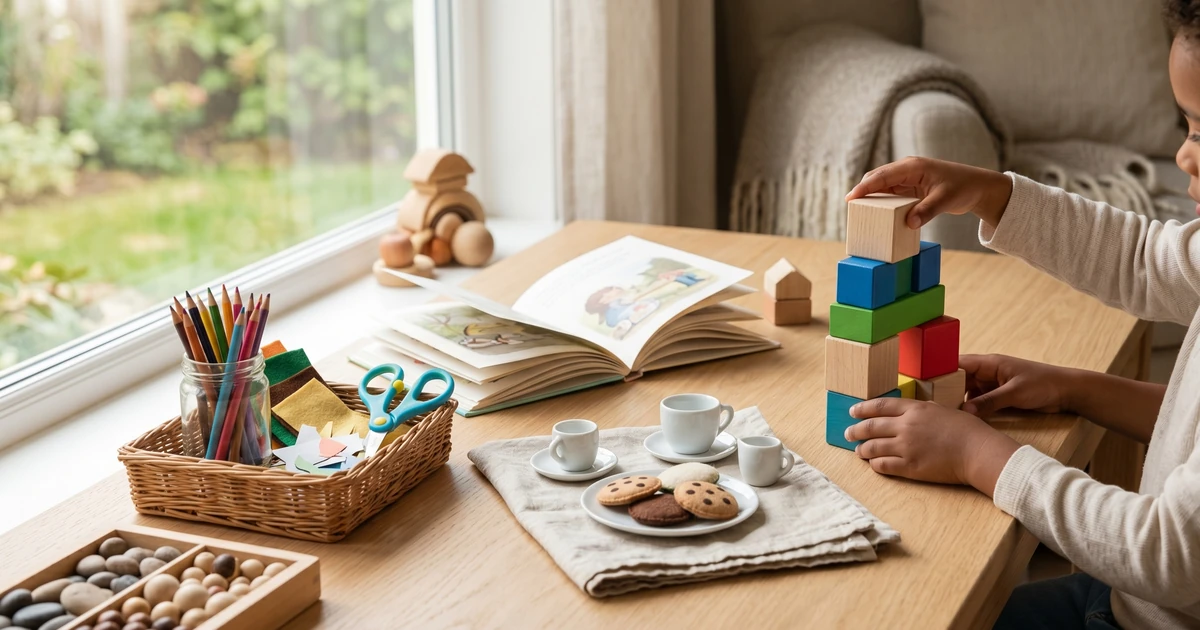
The Ultimate Guide to Play-Based Learning for Children
What I found con
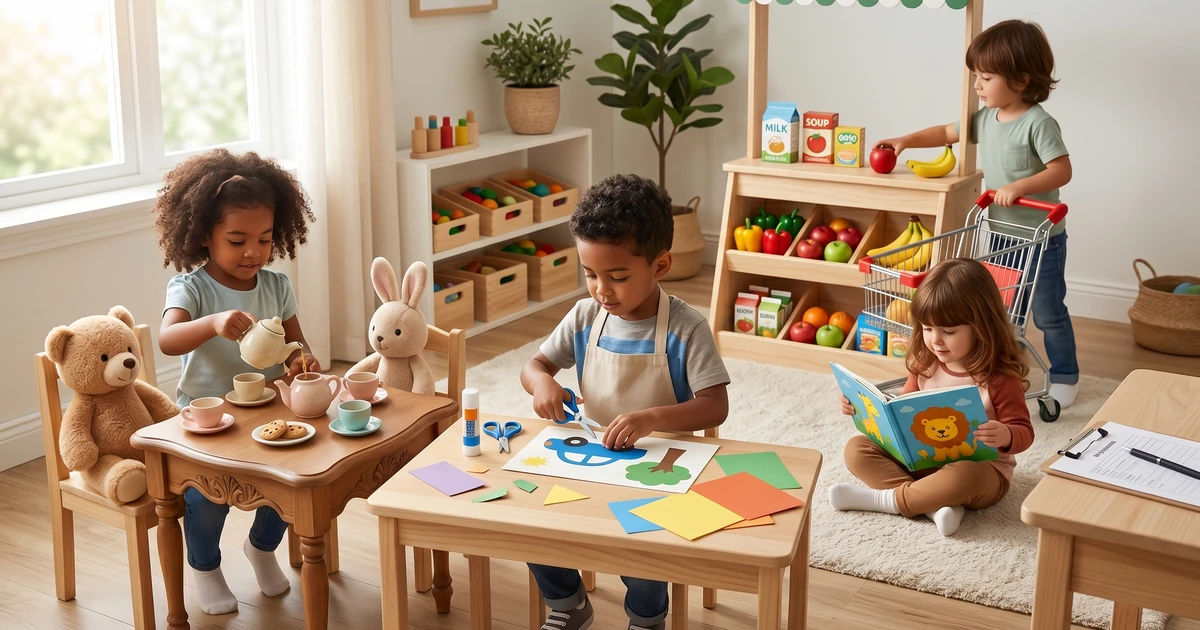
What Is Play Based Assessment? A Comprehensive Overview
Play based assessment is one of those terms you hear thrown around in early childhood education circles, but rarely gets the detailed explanation i...
Play Based Learning For Preschoolers: A Parent's Guide
Play based learning for preschoolers is one of those topics where everyone seems to have an opinion, but the research tells a more specific story. ...
Play Based Preschool Curriculum: Key Elements And Benefits
The term play based preschool curriculum gets used a lot these days, but what does it actually mean in practice? After spending 40+ hours researchi...