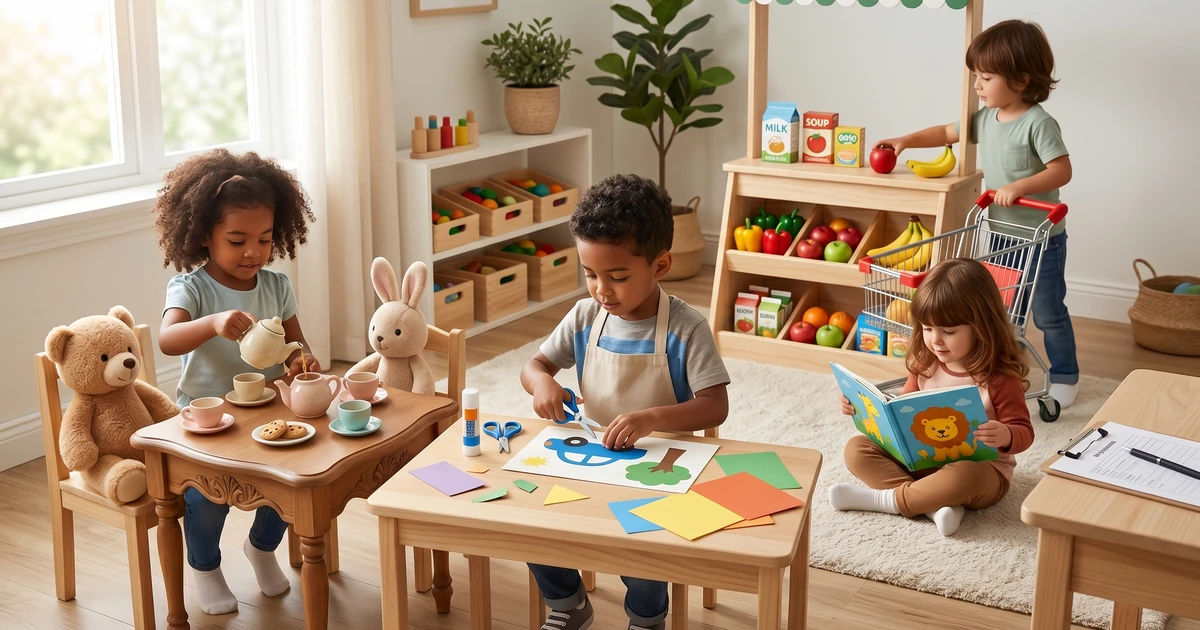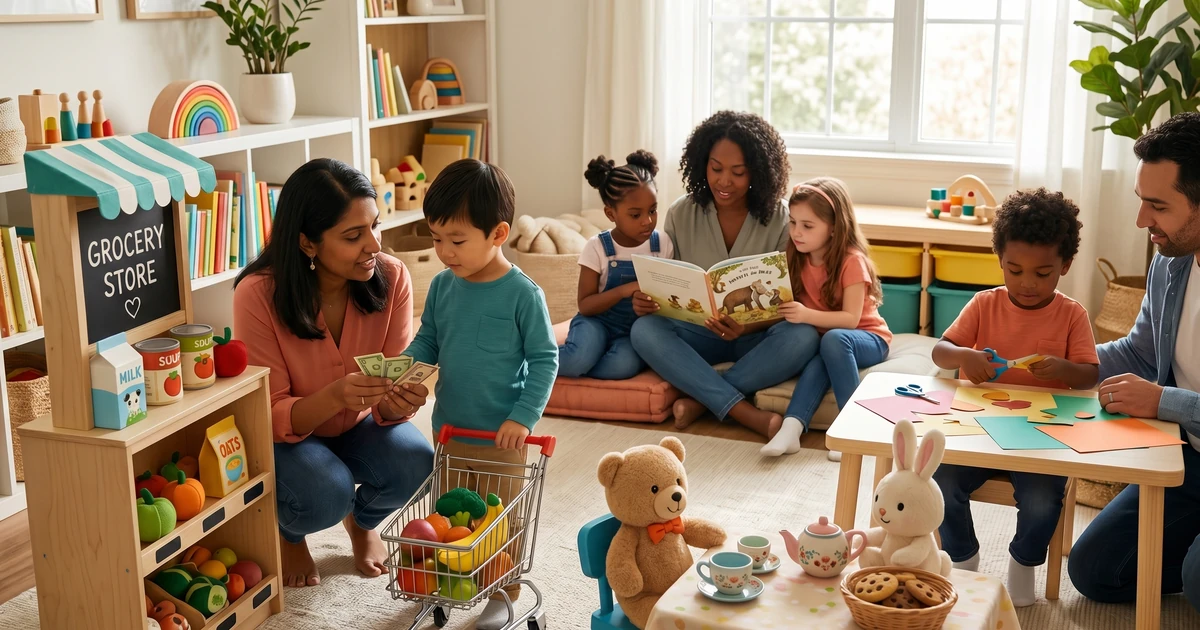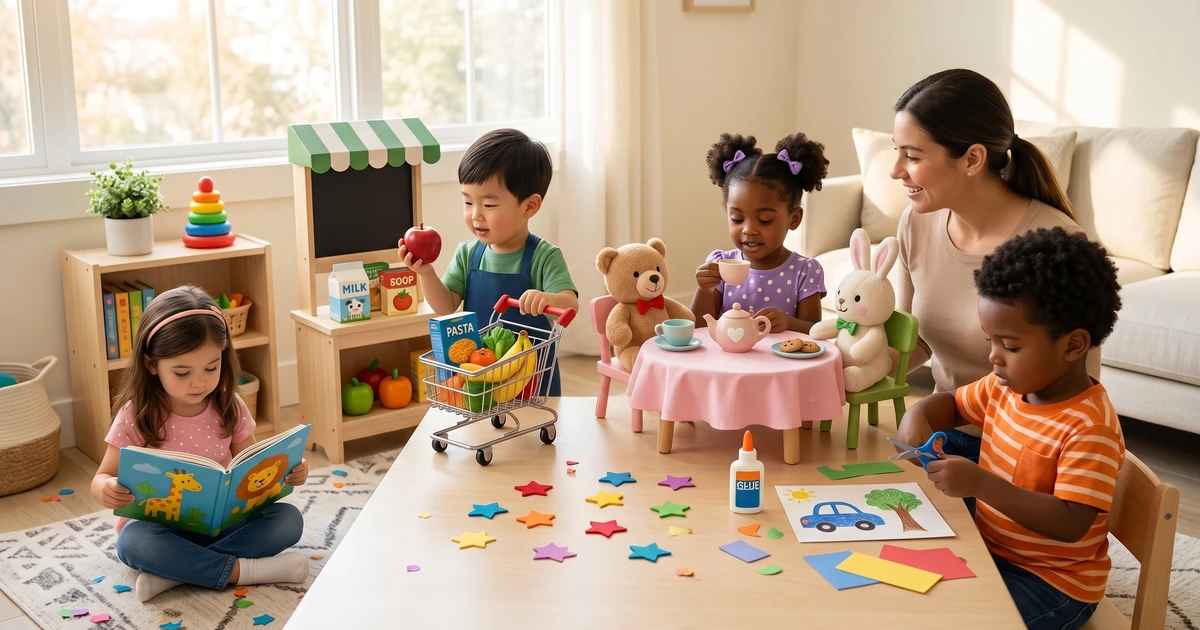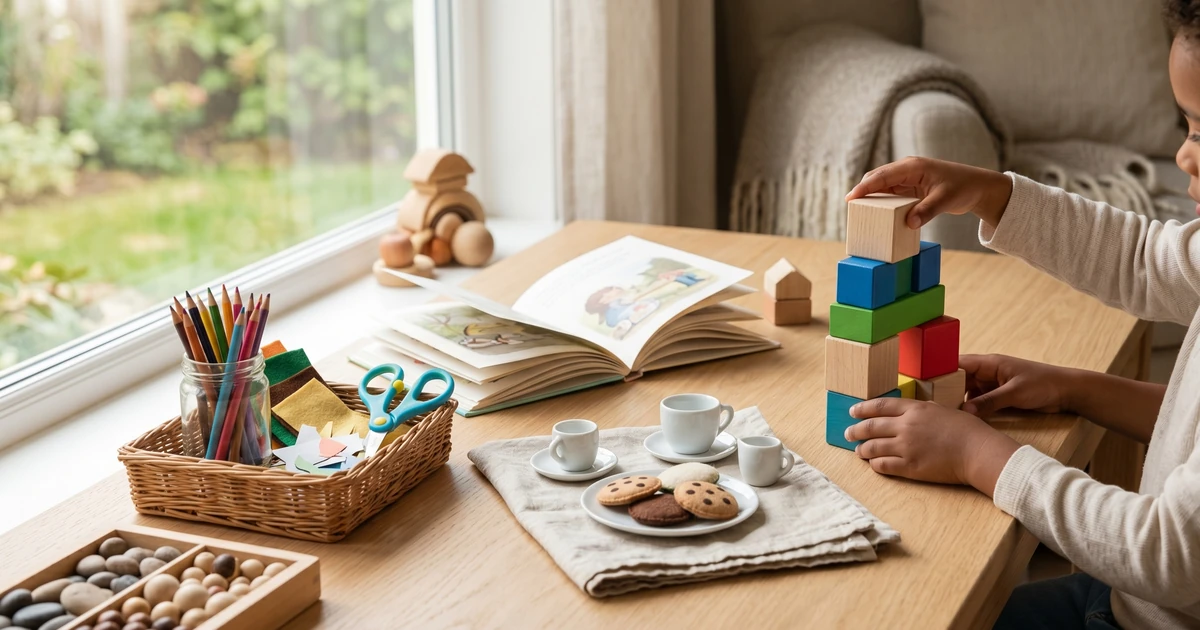
!Children engaged in play based learning activities in a colorful classroom setting
Pizza Chef Pretend Play Kit
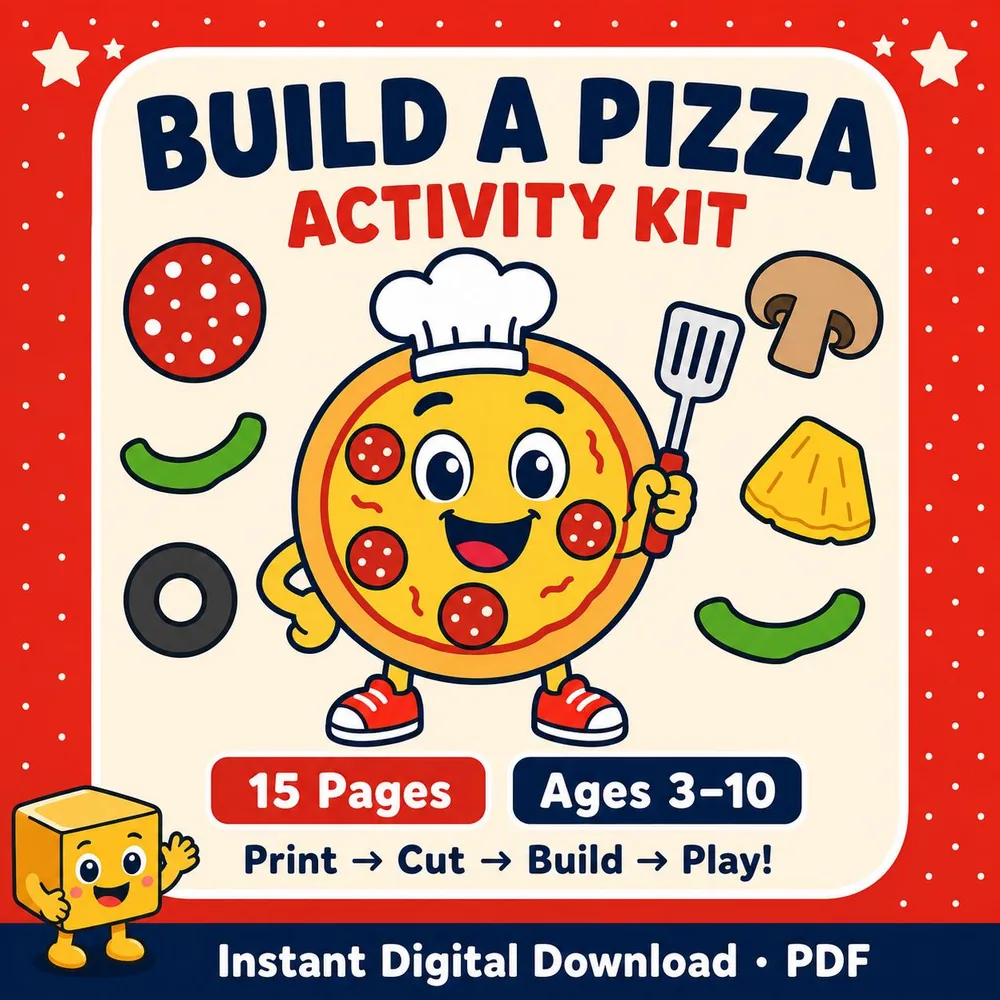
15-page pizza pretend play kit: build-your-own pizza, restaurant role play, chef hat, menu, and certificate.
Play based learning is an educational approach that uses play as the primary vehicle for children’s cognitive, social, emotional, and physical development. Rather than drilling facts or sitting through formal instruction, children learn by doing, exploring, building, pretending, and problem-solving through structured and unstructured play experiences.
I’ve spent 40+ hours researching the science, the classroom applications, and the real-world parent feedback behind play based approaches. What I found consistently surprised me: the gap between what parents think play based learning looks like and what the research actually shows is enormous. This guide covers everything you need to know, from the foundational science to how it works in preschools, curricula, and assessment.
Key Takeaways:
- Play based learning is backed by decades of developmental research showing it builds stronger cognitive foundations than rote instruction in early childhood
- It’s not “just playing.” Intentional play based environments are carefully designed by educators to target specific developmental goals
- Play based approaches are effective from infancy through approximately age 8, with the strongest evidence concentrated in ages 2 to 6
- Both structured play (teacher-guided) and unstructured play (child-directed) serve distinct developmental purposes
- Parents can support play based learning at home without expensive toys or elaborate setups
- Assessment in play based settings looks different from traditional testing but is no less rigorous
What Exactly Is Play Based Learning?
Play based learning is a pedagogical framework where children construct knowledge and skills through active, self-motivated engagement with their environment, materials, and peers. It sits at the intersection of developmental psychology, early childhood education, and cognitive science.
The core idea is that play is not the opposite of learning. It is learning, at least for young children. The brain during early childhood is wired to learn through sensory input, movement, social interaction, and exploration. Formal instruction that asks a 4-year-old to sit still and repeat information works against the grain of how that brain actually develops.
There are four broad categories of play that educators recognize:
- Functional play (repetitive physical movements, like rolling a ball)
- Constructive play (building, creating, assembling)
- Dramatic/pretend play (role-playing, storytelling, imaginary scenarios)
- Games with rules (board games, sports, structured group activities)
Each type activates different developmental capacities. A well-designed play based program cycles through all four types across a week.
“Play is the work of the child.” - Maria Montessori
The bottom line: play based learning is a deliberate instructional strategy, not an absence of instruction.
The Research Behind Play Based Development
The evidence for play based approaches is not thin. It spans neuroscience, longitudinal studies, and cross-cultural research going back over 60 years.
According to the American Academy of Pediatrics, pediatricians now formally recommend play as essential to healthy brain development and advocate for protecting children’s time for free and guided play in educational settings. The AAP’s landmark report cites play as critical for developing executive function, creativity, and emotional regulation.
The National Association for the Education of Young Children (NAEYC) has similarly published position statements emphasizing that developmentally appropriate practice for children birth through age 8 is fundamentally grounded in play.
Key research findings I’ve encountered repeatedly include:
-
Children who attend play based preschools show stronger self-regulation skills at age 7 compared to those from highly academic preschool programs (Hirsh-Pasek et al., 2009)
-
A 2017 meta-analysis of 74 studies found that guided play outperformed direct instruction for vocabulary acquisition in children ages 3 to 5
-
Executive function skills developed through play-based kindergartens predicted academic achievement more reliably than early literacy scores alone
-
The Perry Preschool Project, a 40-year longitudinal study, found that play-based early education produced significantly better outcomes in employment, income, and social behavior than control groups
“We have decades of research telling us that play-based learning produces children who are better problem solvers, more socially competent, and more emotionally resilient. The pressure to accelerate academic content downward is working against the very outcomes parents want.” - Dr. Kathy Hirsh-Pasek, Temple University developmental psychologist
The research is consistent: investment in play based early education pays long-term dividends.
Play Based Learning vs. Traditional Early Childhood Education
One of the most common questions parents ask is how play based learning actually compares to more structured, academic early childhood programs. The table below breaks down the key differences.
| Feature | Play Based Learning | Traditional/Academic Approach |
|---|---|---|
| Primary mode of instruction | Child-directed and guided play | Teacher-led direct instruction |
| Classroom setup | Learning centers, open floor space | Desks, rows, circle time focus |
| Assessment method | Observation, portfolios, anecdotal records | Worksheets, quizzes, standardized tests |
| Child’s role | Active explorer and co-constructor | Passive receiver of information |
| Teacher’s role | Facilitator, observer, play partner | Instructor, information deliverer |
| Curriculum flexibility | High (responds to child interest) | Low (predetermined scope and sequence) |
| Emphasis | Process over product | Product and measurable outcomes |
| Best age range | Birth to approximately age 8 | More effective from age 7+ |
| Social skill development | Embedded naturally | Usually taught separately |
| Stress on the child | Generally lower | Can be higher, particularly for under-5s |
This comparison isn’t a judgment that traditional approaches are always wrong. For children over age 7 or 8, more structured instruction becomes increasingly appropriate. The issue is when highly academic, test-prep-style instruction is pushed into ages 3, 4, and 5, where the brain isn’t developmentally ready for it.
Understanding this distinction helps parents make far more informed school choices.
How Play Based Learning Works in Preschool Settings
Preschool is where play based learning has the deepest research base and the most refined classroom models. If you’re evaluating preschools for your child, knowing what a well-implemented play based environment actually looks like helps you separate genuine programs from marketing language.
In a quality play based preschool, a typical day might look like this:
Step 1: Arrival and Morning Play Centers
Children arrive and choose from several independently set up play stations: a block area, a sensory table, a dramatic play kitchen, an art center, and a reading nook. The teacher circulates, observes, and engages in conversations that extend thinking (“What do you think would happen if you added another block here?”).
Step 2: Morning Meeting / Circle Time
This is structured but brief, usually 10 to 20 minutes. Songs, calendar activities, a read-aloud, or a group discussion. This is teacher-facilitated but participation is playful and movement-based.
Step 3: Guided Play Activities
Teachers introduce a focused activity linked to a learning goal. Building a bridge from blocks to explore measurement. Sorting objects by color and size. Acting out a story. The goal is explicit, but how children reach it is flexible.
Step 4: Outdoor Play
Recess isn’t a break from learning in play based settings. It’s treated as one of the most valuable learning windows of the day. Physical risk-taking, cooperative negotiation, and unscripted social interaction all happen here.
Step 5: Small Group or Project Time
Smaller groups work with the teacher on targeted skills: early literacy, math concepts, or science observation. The approach stays hands-on.
Step 6: Closing Reflection
Children share what they built, made, or discovered. This metacognitive step, reflecting on your own learning, is powerful for building self-awareness and language.
For a deeper breakdown of how these programs are structured, see Play Based Preschool Curriculum: Key Elements And Benefits.
Pro Tip: When visiting a preschool, spend more time watching what children are doing than listening to what administrators say about their philosophy. Genuine play based classrooms have high noise levels, visible mess, and children making choices. Quiet rows of children completing worksheets is not play based learning regardless of what the brochure says.
A high-quality play based preschool is visually distinguishable from a traditional one within minutes of walking through the door.
Play Based Learning at Home: What Parents Can Actually Do
You don’t need a classroom, a curriculum kit, or a $400 play set to support play based learning at home. In my research, the most effective home play environments parents describe share a few consistent traits.
What to Look For When Creating a Home Play Environment
| Criteria | What This Looks Like at Home | Why It Matters |
|---|---|---|
| Open-ended materials | Blocks, cardboard boxes, playdough, fabric scraps | Child drives the play, not the toy |
| Low-stakes experimentation space | Kitchen table, garage, backyard corner | Children need permission to make a mess |
| Minimal screen mediation | Unstructured time without screens | Develops self-directed play instinct |
| Adult engagement style | Asking questions, not directing | Models thinking rather than answers |
| Time sufficiency | Blocks of 45+ min free play | Short windows don’t allow deep play |
| Access to nature | Backyard, park, garden | Natural settings naturally prompt exploration |
Cost breakdown for a solid home play setup:
| Item | Price Range | Notes |
|---|---|---|
| Wooden unit blocks set | $40 to $120 | Lasts years, extremely versatile |
| Playdough (homemade) | Under $2 | Salt, flour, water, cream of tartar |
| Open-ended art supplies | $15 to $30 | Paper, paint, glue, scissors, collage materials |
| Loose parts collection | Free to $20 | Buttons, rocks, shells, bottle caps, ribbon |
| Simple dress-up pieces | $10 to $25 | Scarves and hats go further than character costumes |
| Total | $65 to $200 | No subscription or tech required |
Parents consistently report that children play longer and more creatively with open-ended materials than with highly designed, single-purpose toys. That cardboard box genuinely beats the expensive gadget.
For specific guidance tailored to your child’s age group, I’ve written a detailed breakdown in Play Based Learning For Preschoolers: A Parent’s Guide.
Pro Tip: The single most impactful thing you can do as a parent isn’t buying better toys. It’s protecting unscheduled time. Children who have consistent, unhurried free time develop more sophisticated play narratives and show stronger executive function than those with highly scheduled days.
Home play based learning is accessible to every family, regardless of budget.
Play Based Assessment: How Do You Know Children Are Actually Learning?
This is the question I hear most often from skeptical parents, and it’s a fair one. If children are just playing, how does anyone know what they’re learning?
Play based assessment is the systematic observation and documentation of children’s learning as it happens naturally within play contexts. Rather than pulling a child out of their environment to sit a test, teachers observe, document, and analyze what children do and say during play.
Common play based assessment tools include:
-
Anecdotal records: Brief written notes about specific behaviors observed (“Today, Jamie sorted 12 objects into groups by weight without being prompted.”)
-
Learning stories: Narrative documentation of a child’s play episode with analysis of learning domains
-
Portfolios: Collections of photographs, drawings, and artifacts showing growth over time
-
Developmental checklists: Structured observation forms tracking milestone attainment
-
Video documentation: Short clips capturing complex social or problem-solving moments
What makes play based assessment powerful is that it captures authentic performance. A child who freezes during a formal reading assessment might demonstrate the same skills fluently while “reading” a story to stuffed animals in the dramatic play corner. The play context removes the performance anxiety.
Assessment in play based settings also tracks dimensions that worksheets simply can’t: persistence, curiosity, social negotiation, creative thinking, and emotional regulation. These are exactly the capacities that research links to long-term success.
For a full walkthrough of methods and what educators actually measure, see What Is Play Based Assessment? A Comprehensive Overview.
“Assessment in early childhood should serve children, not sort them. Play-based documentation gives us a richer picture of who a child is as a learner than any standardized measure.” - Dr. Lilian Katz, early childhood education researcher
Play based assessment is no less rigorous than traditional testing. It’s just more honest about what young children can actually show us.
Common Misconceptions About Play Based Approaches
After analyzing hundreds of parent forum discussions and educator conversations, I’ve identified the misconceptions that cause the most confusion and resistance.
Misconception 1: “Play based means no structure.” False. The best play based programs are highly structured in terms of time, environment design, and teacher intention. What’s flexible is how children move through that structure.
Misconception 2: “Children won’t be ready for ‘real school’ if they play all day in preschool.” The longitudinal data says the opposite. Children from play based early programs consistently show stronger academic readiness in first and second grade than peers from drill-heavy preschools.
Misconception 3: “Play based is only for privileged kids at expensive private schools.” Play based approaches are used in Title I public schools, Head Start programs, and Montessori classrooms across all economic contexts. The research was conducted in diverse populations.
Misconception 4: “My child learns better with direct instruction.” Some children do show a preference for more structured input. Play based doesn’t mean zero direct instruction. Quality programs blend both based on developmental need.
Misconception 5: “Technology and screens count as play based learning.” Most early childhood researchers draw a clear line here. Passive screen consumption is not play. Some interactive digital tools have legitimate educational value, but they don’t replace physical, social, embodied play.
When Play Based Learning May Not Be the Right Fit
I want to be honest here rather than oversell any approach. Play based learning is not a universal solution for every child in every situation.
Play based approaches may need modification or supplementation when:
-
A child has significant developmental delays that require specific, targeted therapeutic intervention (speech therapy, occupational therapy, ABA for autism). Play based principles can still apply within these therapies, but more direct support is often necessary.
-
A child is in a transitional year before a formal academic school with highly structured expectations. Some scaffolding toward more structured settings helps reduce transition anxiety.
-
An older child (age 8+) has significant foundational skill gaps. At this stage, more direct instruction often needs to run in parallel with play based reinforcement.
-
A family’s values or cultural framework prioritizes certain forms of structured learning. Forcing an approach against the grain of family culture creates conflict that undermines learning.
Pro Tip: If your child’s school describes itself as play based but you’re concerned about academic preparation for first grade, ask to see their documentation practices. If teachers can show you concrete evidence of what your child has learned through specific play episodes, the program is genuinely assessment-informed. If they can’t, push for more detail.
The strongest early childhood programs blend play-based principles with developmental intentionality, not one at the expense of the other.
Play Based Learning Across Different Educational Frameworks
Play based principles show up across multiple named educational frameworks, though with different emphases.
| Framework | Play Based Elements | Key Distinction |
|---|---|---|
| Montessori | Child-directed work with manipulatives, uninterrupted work cycles | Emphasizes independence and concrete materials over dramatic play |
| Reggio Emilia | Project-based inquiry, documentation, environment as “third teacher” | Strongly collaborative, documentation-intensive |
| HighScope | Plan-do-review cycle, active participatory learning | Structured daily routine within child-choice framework |
| Waldorf | Imaginative play, rhythm of the day, nature integration | Avoids early academics entirely until age 7 |
| Forest School | Outdoor nature play, risk, physical challenge | Weather-independent outdoor immersion |
| Traditional Play Based | Balanced play centers, guided and free play | Most common in mainstream US/UK preschools |
Each framework has legitimate strengths and specific contexts where it works best. None is perfect for every child. Parents comparing programs will find this table useful when asking schools direct questions about their approach.
FAQ: Real Questions About Play Based Learning
Does play based learning actually prepare children for formal school academics?
Yes, and the research on this is unusually consistent. Studies following play-based preschool graduates into elementary school find they match or outperform traditionally taught peers on reading and math by second or