
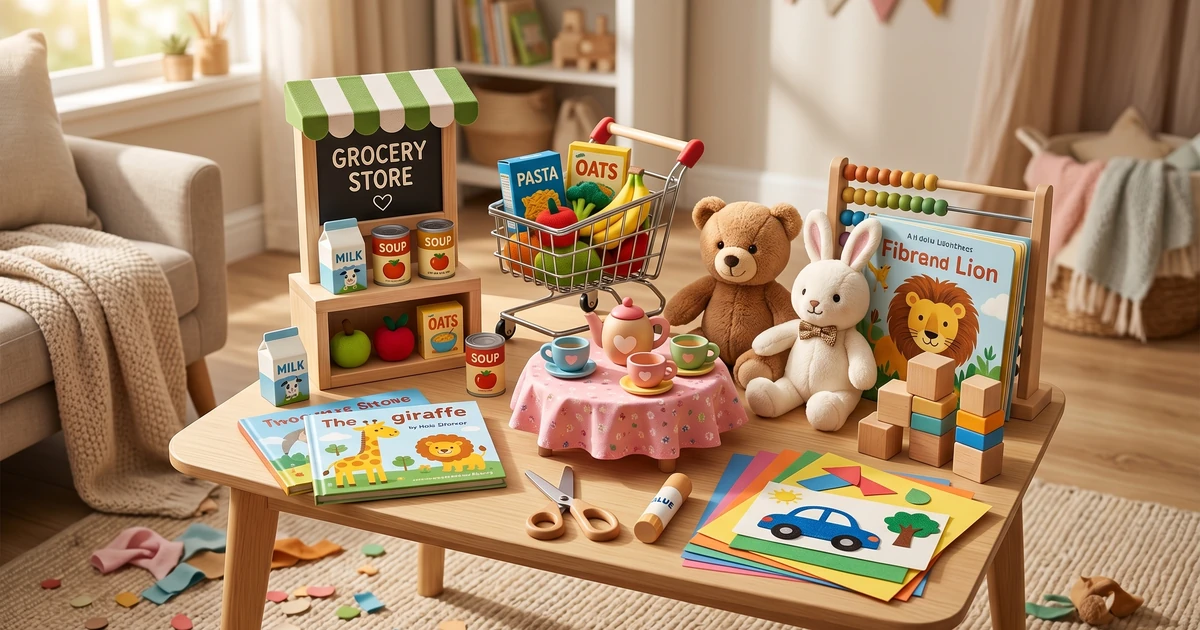
Gift Ideas For Preschoolers That Encourage Creative Play
You've stared at the toy aisle for twenty minutes. Half the options look like plastic junk that'll break in a week. The other half say "educational" on the
You’ve stared at the toy aisle for twenty minutes. Half the options look like plastic junk that’ll break in a week. The other half say “educational” on the box but look about as exciting as a math worksheet. And you’re just trying to find something a four-year-old will actually love.
Pizza Chef Pretend Play Kit
15-page pizza pretend play kit: build-your-own pizza, restaurant role play, chef hat, menu, and certificate.
Sound familiar? Picking gift ideas for preschoolers creative play is genuinely tricky, and it’s not because you don’t know kids. It’s because the toy market is flooded with products that look impressive on the shelf but collect dust within days of being unwrapped.
I’ve spent a lot of time digging into this. After analyzing hundreds of parent reviews, early childhood educator recommendations, and child development research, I’ve pulled together what actually works and why. No fluff. No sponsored nonsense. Just honest guidance for anyone trying to give a gift that matters.
Key Takeaways:
- The best creative play gifts for preschoolers are open-ended, meaning they don’t have one “right” way to use them
- Age-appropriate doesn’t mean dumbed-down. Preschoolers can handle surprisingly complex materials when supervised
- Gifts under $30 often outperform expensive electronic toys in terms of play time and developmental value
- Durability matters more than novelty. Parents consistently rate longevity as their top factor in gift satisfaction
- Creative play gifts support language, fine motor skills, emotional expression, and problem-solving simultaneously
!A happy preschooler painting at a craft table surrounded by colorful art supplies
Why Preschoolers Actually Need Creative Play (Not Just “Fun” Toys)
Creative play is any unstructured, imaginative activity that lets a child direct their own experience. That’s painting with their hands, building a city out of cardboard tubes, acting out a story with felt animals, or turning a pile of wooden blocks into a spaceship.
According to the American Academy of Pediatrics, unstructured play is essential for healthy brain development in early childhood. It builds executive function, creativity, and social-emotional skills that structured screen time simply can’t replicate.
What does that mean practically? It means a $12 set of beeswax crayons will often do more for a three-year-old’s development than a $60 talking robot that only has twelve pre-programmed responses.
“Play is not a break from learning. It is how children learn.” - Dr. Stuart Brown, National Institute for Play
The gifts that genuinely get used are the ones that give children control. Preschoolers are at a stage where autonomy matters enormously to them. They want to make things, change things, and own the outcome. Gifts that support that instinct tend to stick around for years. Gifts that talk back, follow scripts, or limit choices often get abandoned fast.
The single best predictor of a gift’s success is how open-ended it is.
The 5 Categories That Consistently Win With Preschoolers
After going through hundreds of parent reviews and educator recommendations, five categories come up again and again as the most-loved, most-used gifts for this age group.
1. Art and Mark-Making Supplies
Crayons, watercolors, finger paints, chalk, dot markers. These are classics for a reason. Owners report that quality matters significantly here. Washable, non-toxic paints with good pigment get far more use than cheap sets that produce muddy colors.
What to look for:
-
Washable and non-toxic certified
-
Chunky grip design for small hands
-
At least 8-12 colors in the set
-
Includes paper or a sketchbook (so the child can start immediately)
2. Building and Construction Sets
Wooden blocks, magnetic tiles, interlocking bricks, foam builders. These are the toys that parents consistently describe as “still being played with three years later.” According to the National Association for the Education of Young Children, block play specifically supports spatial reasoning, early math concepts, and collaborative problem-solving.
Magnetic tiles tend to get the strongest reviews from parents of 3-6 year olds. They’re forgiving enough for small hands but complex enough to grow with the child.
3. Dramatic Play Kits
Doctor sets, kitchen accessories, animal figurines, puppet sets, small world play items. Preschoolers between ages 3 and 5 are in what developmental psychologists call the “symbolic play” stage. They’re making sense of the world by acting it out.
Owners consistently report that simple figurine sets get more imaginative use than elaborate playsets with fixed storylines. A set of 12 woodland animals will spark more creative play than a fully scripted playset with one predetermined story.
4. Sensory and Process Art Materials
Kinetic sand, playdough sets, sensory bins, moldable foam. Process art is about the making, not the product. Preschoolers love the physical sensation of squishing, pouring, molding, and mixing. Parents report that these gifts are especially popular with kids who struggle to sit still for traditional activities.
Pro Tip: Pair any sensory material gift with a simple silicone mat or tray. Parents consistently say this small addition makes the gift 10x more welcome in the home because cleanup becomes manageable.
5. Creative Kits With Open-Ended Outcomes
Craft kits that don’t dictate a single outcome work far better than those with one prescribed finished product. Think: pom-pom sets, foam sticker sheets, googly eye collections, or simple weaving looms. These materials let the child decide what they’re making.
Kits with a single “correct” finished product (build this exact robot) tend to frustrate preschoolers who want creative control, and parents note that these get abandoned quickly if the child can’t achieve the “right” result independently.
How to Choose by Age Within the Preschool Window
“Preschooler” covers ages 3 through 5, and there’s a meaningful developmental gap within that range. A gift perfect for a just-turned-3-year-old can feel babyish to a 5-year-old heading to kindergarten.
| Age | Fine Motor Stage | Best Gift Focus | What to Avoid |
|---|---|---|---|
| 3 years | Chunky grip, large pieces | Finger paints, large blocks, playdough | Small parts, complex assembly |
| 4 years | Improving pincer grip | Dot markers, magnetic tiles, simple craft kits | Ultra-fiddly components |
| 5 years | Near-adult coordination | Colored pencils, detailed building sets, weaving | Toys marketed for 2-year-olds |
“Children don’t all develop at the same pace, but the 3-5 age range is when fine motor skills explode in development. Gifts that match that trajectory keep children challenged without overwhelming them.” - Early Childhood Education Specialist, NAEYC
Matching a gift to the specific child’s current developmental stage, not just their birthday, makes all the difference.
What Parents Actually Spend (And What’s Worth It)
Gift budgets vary a lot, so here’s an honest breakdown of what different price ranges typically get you in the creative play category.
| Price Range | What You Can Expect | Best Category at This Price |
|---|---|---|
| $10-20 | Single-material sets, basic art supplies | Crayons, dot markers, playdough sets |
| $20-40 | Mid-range craft kits, small figurine sets | Sensory kits, animal sets, watercolor sets |
| $40-70 | Starter building sets, quality dramatic play kits | Magnetic tiles (starter), puppet sets |
| $70-120 | Large building sets, complete art stations | Magnetic tile expanded sets, easels |
| $120+ | Full playsets, premium wooden toy collections | Kitchen sets, large block libraries |
The data is clear: parents consistently report the highest satisfaction in the $20-50 range. Above $70, satisfaction scores plateau and sometimes drop, often because expensive gifts create pressure to play with them “correctly.”
Pro Tip: Two or three $15-20 gifts from the art/sensory category will often be played with more than a single $60 electronic toy. Variety and openness beat novelty and price.
3 Common Gift Mistakes (And How to Avoid Them)
-
Buying age-inappropriate complexity. A craft kit that requires adult supervision for every step isn’t a gift for the child. It’s extra work for the parent. Look for gifts where the child can engage independently after the first setup.
-
Choosing novelty over longevity. Slime kits, pop-it toys, and trend-driven gifts get used for two days and forgotten. Open-ended materials like blocks, paint sets, and playdough get used for years.
-
Ignoring the home context. A giant sensory bin is a fantastic gift. But if the family lives in a small apartment, it may become a source of stress. Ask the parent if you can before gifting anything messy or large.
Frequently Asked Questions
What kinds of gifts are best for preschool-aged children who aren’t interested in art?
Not every preschooler loves drawing or painting, and that’s completely normal. Building sets, dramatic play kits (like animal figurines or doctor sets), and sensory materials like kinetic sand tend to appeal broadly across different play styles. Focus on open-ended materials rather than assuming art supplies are the only creative option.
How do I know if a gift is genuinely educational or just marketed that way?
Look at whether the toy allows the child to direct the play. Toys that talk back, follow scripts, or have one correct outcome are often marketed as educational but offer limited cognitive engagement. Genuinely developmental gifts give the child control, which is what builds executive function and creative thinking.
Is it better to give one big gift or several smaller ones?
For preschoolers specifically, several smaller gifts from different creative categories almost always outperform one large gift in terms of total play time. Variety extends creative possibilities and reduces the “I’ve already figured it out” plateau that happens quickly with single-function toys.
What’s a good gift for a preschooler who already has a lot of toys?
Consumables are your best bet. Art supplies, craft materials, playdough, and paint get used up and need replacing. Parents consistently appreciate these over yet another plastic toy that needs storage space. A quality set of watercolors or a bulk sketchbook is genuinely useful and won’t contribute to toy clutter.
Ready to Go Deeper?
The ideas above will get you pointed in the right direction, but there’s a lot more to understand about how creative play actually shapes a child’s development and how to build a gift-giving approach that supports long-term learning.
For everything you need to know about choosing play-based gifts with confidence, read the Play Based Learning For Preschoolers: A Parent’s Guide, which covers the full developmental picture behind why certain toys matter more than others.
You can also explore The Ultimate Guide to Play-Based Learning for Children for a broader look at how play drives learning across early childhood, or check out Play Based Preschool Curriculum: Key Elements And Benefits to understand what educators are prioritizing in the classroom right now. These are worth reading before your next gift purchase.
A good gift isn’t just a toy. It’s a few hundred hours of a child’s brain being built. That’s worth getting right.
Take the Next Step!
Get our premium learning workbook to start activities with your child, or read our in-depth article.
Recommended Resources & Workbooks
Pair this guide with our hands-on, ready-to-print learning resources.
 Digital Bundle
Learn to Read Program: Levels 1-3
170 sequenced phonics lessons across 199 pages, from first letter sounds to fluent long-vowel reading.
 Digital Learning Bundle
Preschool Learning Bundle
260+ printable worksheets for tracing, ABCs, numbers, shapes, sight words, and kindergarten prep.
 Digital Learning Bundle
Play-Based Learning Bundle for Ages 3-6
230+ play-based learning activities with pretend play, reading, early math, creative arts, and bonus flashcards.
Related Guides & Articles
Explore more of our detailed guides and activities.
The Ultimate Guide to Play-Based Learning for Children
What I found con
What Is Play Based Assessment? A Comprehensive Overview
Play based assessment is one of those terms you hear thrown around in early childhood education circles, but rarely gets the detailed explanation i...
Play Based Learning For Preschoolers: A Parent's Guide
Play based learning for preschoolers is one of those topics where everyone seems to have an opinion, but the research tells a more specific story. ...
Play Based Preschool Curriculum: Key Elements And Benefits
The term play based preschool curriculum gets used a lot these days, but what does it actually mean in practice? After spending 40+ hours researchi...