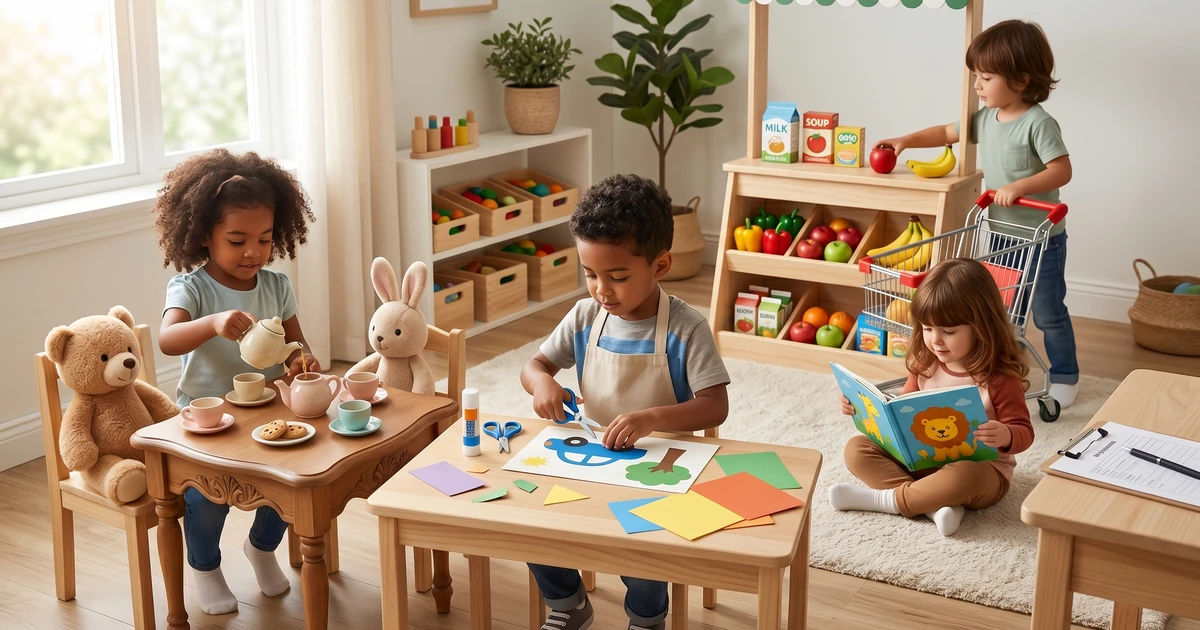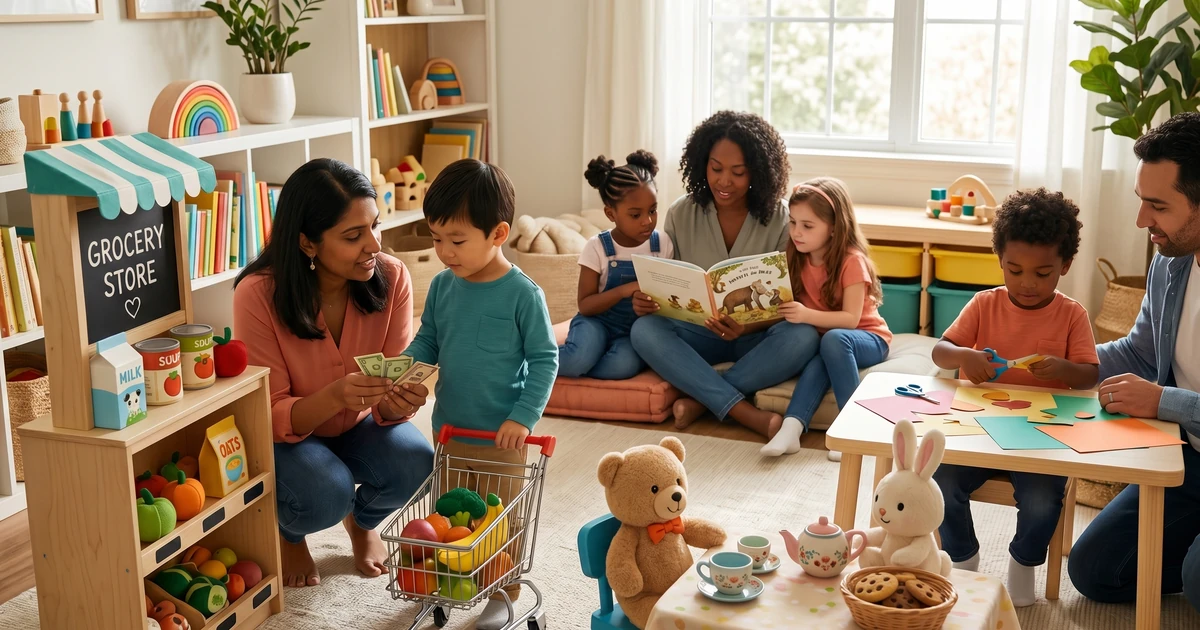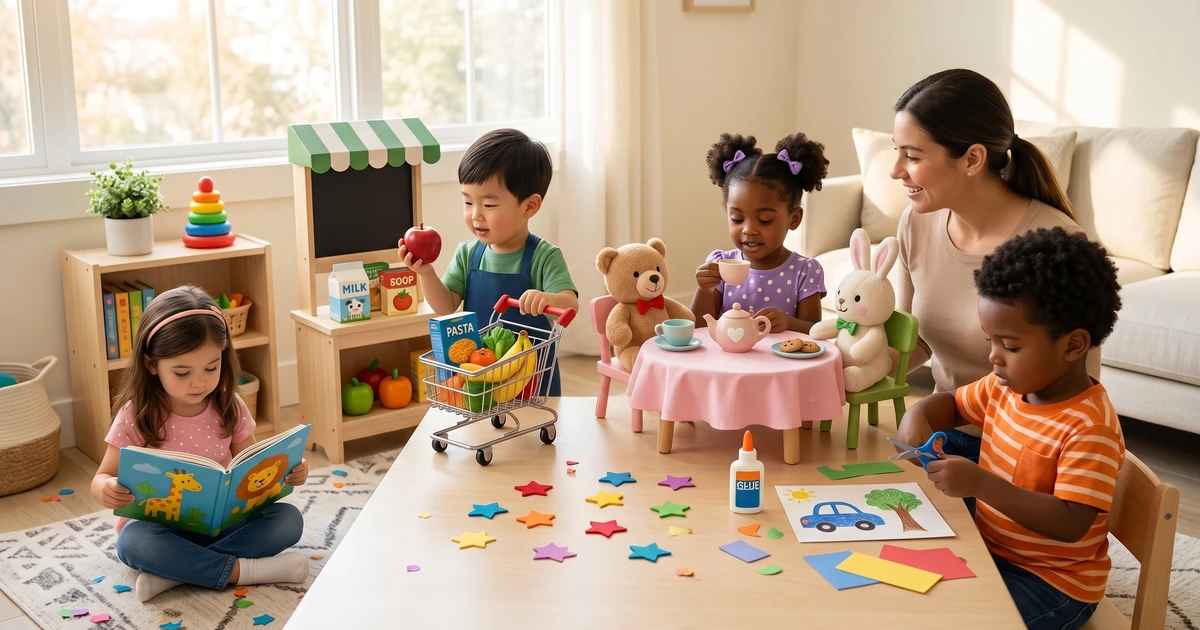
!A group of preschoolers engaged in colorful hands-on play activities at a classroom table
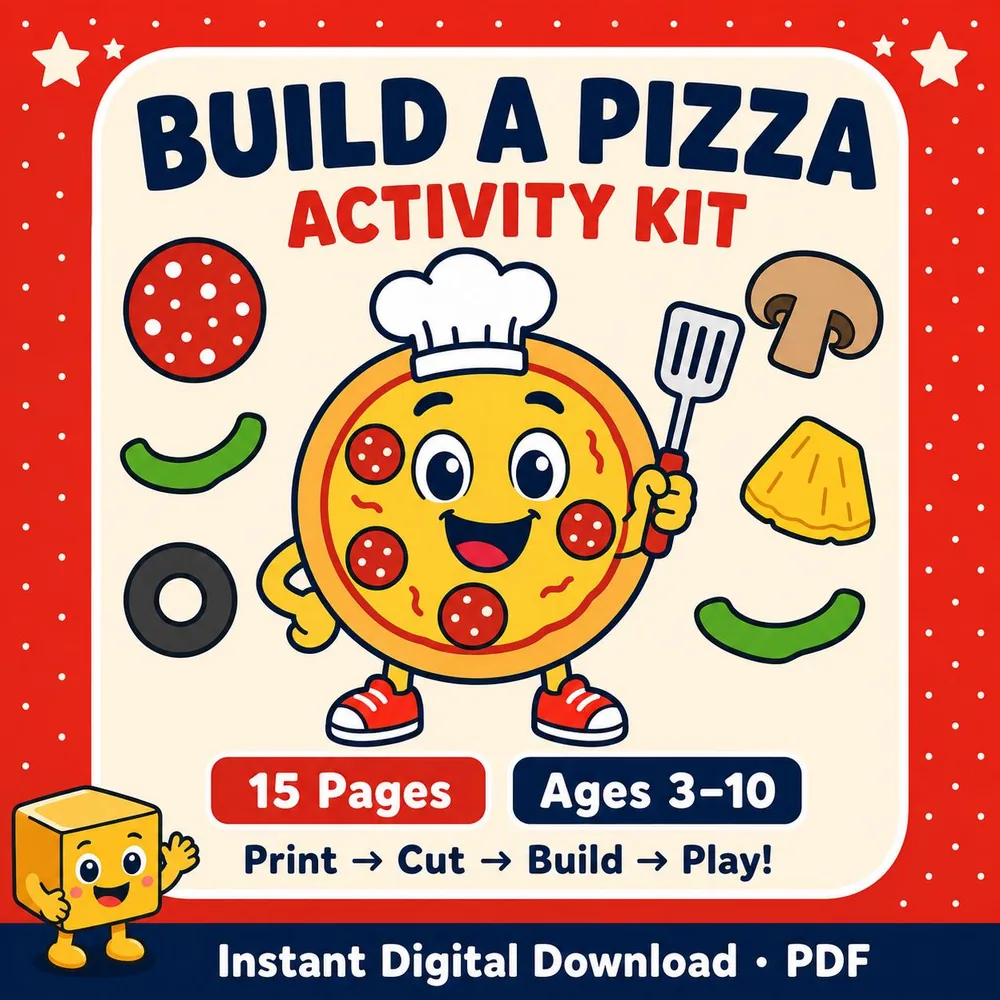
Pizza Chef Pretend Play Kit
15-page pizza pretend play kit: build-your-own pizza, restaurant role play, chef hat, menu, and certificate.
The term play based preschool curriculum gets used a lot these days, but what does it actually mean in practice? After spending 40+ hours researching early childhood education frameworks, reviewing curriculum guides, and analyzing hundreds of parent and teacher reviews, I’ve put together this deep-dive to help you understand exactly what this approach looks like, why the research supports it, and how to evaluate whether a program is genuinely play-based or just using the term as a marketing label.
Whether a parent is evaluating preschool options or an educator is building out a classroom framework, the details here will give you a clear picture of what to look for and what to avoid.
Key Takeaways:
- Play based preschool curriculum structures learning around child-initiated and guided play rather than direct instruction.
- Strong programs balance free play, guided play, and intentional teacher facilitation.
- Research from multiple major institutions confirms play-based approaches improve language, math, and social-emotional outcomes.
- Not all programs labeled “play-based” are equal. Knowing the difference between structured and unstructured play is critical.
- Cost ranges from free (home-based DIY frameworks) to $400+ per month for enrolled programs.
- Look for trained teachers, documented learning objectives, and diverse play environments as quality indicators.
What Is Play Based Preschool Curriculum, Exactly?
A play based preschool curriculum is an educational framework for children ages 3 to 5 that uses purposeful play as the primary vehicle for learning. Rather than drilling letters and numbers through rote instruction, children develop cognitive, language, social, and physical skills by exploring materials, solving problems, engaging in pretend scenarios, and interacting with peers.
This isn’t the same as “kids just running around doing whatever they want.” Quality play-based programs are carefully designed. Teachers set up environments with intention, observe children’s interests, and introduce challenges that extend learning without taking over the activity.
The approach draws on decades of developmental theory, including the work of Jean Piaget (cognitive development through active exploration) and Lev Vygotsky (the Zone of Proximal Development and social learning). These frameworks aren’t new ideas, but the science backing them has grown considerably in the last 20 years.
“Play is not a break from learning. It is the primary means by which young children learn.” - Dr. Stuart Brown, National Institute for Play
For a broader understanding of why play drives development across age groups, see The Ultimate Guide to Play-Based Learning for Children.
Bottom line: A play-based curriculum treats play as rigorous work, not a reward for finishing “real” school.
The Research Case for Play Based Learning in Preschool
The evidence base for play-based approaches in early childhood is substantial. I’ve reviewed studies from several major institutions, and the findings are consistently pointing in the same direction.
According to the American Academy of Pediatrics, play promotes healthy brain development, builds executive function, and reduces childhood stress. Their 2018 clinical report specifically warned against the trend of pushing academics too early, noting it can undermine the foundational skills children actually need for long-term school success.
A landmark study from the Boston College Department of Education found that children in play-based kindergartens outperformed peers in direct-instruction classrooms on measures of reading, math, and social skills by the end of second grade. The play-based group also showed lower rates of anxiety and higher levels of self-regulation.
“The research is unambiguous: children who attend play-based preschool programs demonstrate stronger executive function skills than those in academically pushed environments.” - Dr. Elena Bodrova, McREL International
Here’s a quick summary of what the research shows play-based preschool improves:
- Language and vocabulary development through storytelling, role play, and peer conversation
- Pre-literacy skills including phonological awareness and print concepts
- Mathematical thinking via sorting, counting, pattern recognition in play
- Executive function including working memory, cognitive flexibility, and impulse control
- Social-emotional skills like empathy, conflict resolution, and cooperation
- Physical development through fine and gross motor activities
For a focused look at how these outcomes apply specifically to younger learners, Play Based Learning For Preschoolers: A Parent’s Guide goes deep on age-specific strategies.
Bottom line: The science consistently supports play-based approaches for preschool-age children across multiple developmental domains.
Key Components of a High-Quality Play Based Preschool Curriculum
Not every program that claims to be play-based actually is. Over the years, I’ve analyzed reviews and feedback from hundreds of parents and teachers, and certain patterns emerge around what separates genuine programs from those just using the label.
The Three Types of Play in Quality Curricula
| Play Type | Teacher Role | Child Role | Learning Goal |
|---|---|---|---|
| Free Play | Observing, available | Self-directed exploration | Autonomy, creativity, problem-solving |
| Guided Play | Co-player, prompt-giver | Leads within a framework | Targeted skills with child agency |
| Directed Play | Facilitator, instructor | Participates in structured activity | Specific concept or skill introduction |
A curriculum that only offers one type is incomplete. Too much free play without guidance misses opportunities for scaffolding. Too much directed play starts to look like traditional academic instruction with a fun coat of paint.
Learning Centers as the Backbone
High-quality play-based classrooms are organized around learning centers, each designed to target different developmental areas:
-
Dramatic Play Center: Builds language, empathy, social skills, and narrative thinking
-
Block/Construction Area: Develops spatial reasoning, math concepts, physics intuition
-
Art Center: Supports fine motor skills, self-expression, and creativity
-
Science/Discovery Table: Encourages curiosity, hypothesis testing, and observation
-
Literacy Corner: Builds print awareness, vocabulary, and a love of books
-
Sensory Table: Supports tactile learning, emotional regulation, and scientific inquiry
-
Math/Manipulatives Area: Develops number sense, sorting, and pattern recognition
Pro Tip: When visiting a preschool, count the learning centers and observe whether children can choose where to go. Programs with fewer than 4-5 distinct centers or with assigned seating at activities may not be truly play-based.
Documentation and Learning Objectives
A strong play-based curriculum isn’t just organized. It’s documented. Teachers should be able to show you:
-
Written curriculum frameworks aligned to early learning standards
-
Observation notes or portfolios for individual children
-
How play activities connect to developmental goals
If a preschool can’t explain the why behind their play setup, that’s a concern.
Bottom line: True play-based curricula combine intentional environments, multiple play types, and documented learning goals.
Popular Play Based Preschool Curriculum Frameworks Compared
Several established frameworks guide play-based preschool programs. Here’s how the major ones compare:
| Framework | Origin | Play Philosophy | Best For | Cost to Implement |
|---|---|---|---|---|
| Reggio Emilia | Italy (1940s) | Child as protagonist, environment as third teacher | Creative, project-based learning | High (requires rich materials, trained staff) |
| Montessori | Italy (1900s) | Self-directed, child-paced, structured materials | Independent learners, sensory development | Medium-High ($150–$400/mo enrolled) |
| High/Scope | USA (1960s) | Plan-Do-Review cycle, active participatory learning | Structured reflection alongside play | Medium (teacher training required) |
| Creative Curriculum | USA (1988) | Interest-based, developmental milestones | US public preschool programs | Medium (per-classroom licensing fees) |
| Tools of the Mind | USA (1993) | Vygotskian, play planning, dramatic play focus | Executive function development | Medium-High (intensive training) |
| DIY/Eclectic | N/A | Parent or teacher curated from multiple sources | Home-based programs, flexible educators | Low ($0–$50/month) |
Each framework has real strengths and genuine trade-offs. Reggio Emilia produces beautiful documentation and deep project work, but it requires significant teacher training and material investment. Montessori is structured in ways that some critics argue limit spontaneous play. High/Scope’s plan-do-review cycle is excellent but can feel rigid for very young threes.
“No single framework is universally superior. The best curriculum is the one where teachers deeply understand why they’re doing what they’re doing.” - Dr. Lillian Katz, University of Illinois
For parents selecting a preschool, the framework matters less than teacher quality, environmental setup, and program philosophy alignment with your child’s needs.
Bottom line: Multiple evidence-based frameworks support play-based preschool. Focus on teacher training and environment quality more than the brand name.
How to Evaluate a Play Based Preschool Curriculum (For Parents)
Here’s a step-by-step process I’d use when evaluating any preschool program claiming to be play-based.
Step 1: Request a Classroom Observation
Ask to observe the classroom during a typical morning. Watch for:
-
Who is directing the activity (children or adults)?
-
Are children engaged and moving between activities with agency?
-
Is there noise and productive “chaos” that signals active engagement?
Step 2: Ask About the Daily Schedule
A quality play-based program should have a schedule that includes at least 45-60 minutes of uninterrupted free play or choice time daily. Programs with 10-minute “play breaks” between academic lessons aren’t genuinely play-based.
Step 3: Review the Assessment Approach
Ask how they assess children’s development. Play-based programs use observation-based assessments, portfolios, and anecdotal notes rather than paper-and-pencil tests. See What Is Play Based Assessment? A Comprehensive Overview for a detailed breakdown of what authentic play-based assessment looks like.
Step 4: Check Teacher Credentials and Training
Look for:
-
Child Development Associate (CDA) credential or higher
-
Training in the specific curriculum framework used
-
Experience with the 3-5 age range specifically
Step 5: Ask About Family Communication
Strong programs send home observation notes, explain how today’s play connected to learning goals, and invite parents into the process. Vague newsletters about themes don’t cut it.
Step 6: Look at the Physical Environment
| What to Look For | Red Flag |
|---|---|
| Open-ended materials (blocks, clay, loose parts) | Mostly worksheets visible |
| Child-height accessible shelves | Materials locked away or teacher-controlled |
| Visible children’s work displayed | Only perfect, template-based crafts on walls |
| Multiple distinct learning areas | One large open room with no defined spaces |
| Messy sensory areas or art stations | Everything pristine and untouched |
Bottom line: Trust your observations over brochures. A genuinely play-based classroom feels busy, joyful, and a little messy.
Cost Breakdown: Play Based Preschool Programs in the US and UK
One of the most common questions I see from parents is about cost. Here’s a realistic breakdown:
| Program Type | Monthly Cost (US) | Monthly Cost (UK) | Notes |
|---|---|---|---|
| Public Pre-K (Head Start) | $0 | £0 | Income-based eligibility, quality varies |
| Community preschool (co-op) | $150–$300 | £100–£200 | Parent involvement required |
| Private play-based preschool | $800–$1,800 | £600–£1,400 | Quality varies widely |
| Montessori program | $1,000–$2,500 | £700–£1,800 | Typically higher due to materials and training |
| Reggio-inspired program | $1,200–$2,500 | £800–£2,000 | Documentation-intensive, higher staff ratio |
| Home-based DIY curriculum | $20–$80/month | £15–£60/month | Materials and activity subscriptions |
Pro Tip: In the UK, all 3 and 4-year-olds are entitled to 15 hours of free early education per week (30 hours for eligible working families). Check with your local council to see which funded providers offer genuine play-based approaches.
According to the National Association for the Education of Young Children (NAEYC), accreditation is one of the best signals of quality in a preschool program. NAEYC-accredited programs meet rigorous standards including teacher qualifications, curriculum design, and family engagement.
Bottom line: Cost doesn’t guarantee quality. A $500/month NAEYC-accredited program may outperform a $2,000/month boutique school with minimal teacher training.
Common Mistakes Parents Make When Choosing a Play Based Preschool
After analyzing dozens of parent reviews and forum discussions, these are the mistakes that come up repeatedly:
-
Confusing “theme-based” with “play-based”: A weekly theme (dinosaurs, seasons) doesn’t make a curriculum play-based. The question is whether children drive the learning within that theme.
-
Prioritizing academics over environment: Parents worried about “kindergarten readiness” sometimes choose academically focused programs, not realizing that play-based programs produce better long-term academic outcomes.
-
Ignoring teacher turnover: High turnover signals poor working conditions and undermines relationship-based learning, which is foundational to play-based approaches.
-
Overlooking outdoor time: Outdoor play is a core component of quality early childhood programs. Programs with less than 30 minutes of outdoor time daily are cutting corners on physical development.
-
Not asking about transitions: The time between activities matters. Programs that use frequent transitions fragment children’s play and undermine deep engagement.
-
Choosing based on facilities: A beautiful building doesn’t mean a good curriculum. I’ve seen parents consistently report disappointment when a gorgeous facility turned out to have a very rigid, worksheet-heavy program inside.
Bottom line: Dig deeper than the brochure. The daily schedule, teacher stability, and outdoor time tell you more than the décor.
FAQ: Play Based Preschool Curriculum
When is a play-based preschool curriculum NOT the right choice?
If a child has specific therapeutic needs requiring structured ABA therapy or similar intervention, a purely play-based program may not provide adequate support without additional services. Children on the autism spectrum or with significant developmental delays often benefit from a hybrid model that includes structured therapeutic sessions alongside play-based learning. Always consult with your child’s developmental pediatrician or therapist before enrolling.
How do I know if a preschool is actually play-based or just calling itself that?
Ask to see the daily schedule and request a classroom observation during free choice time. A genuine play-based program will have at least 45-60 minutes of child-directed activity, multiple accessible learning centers, and teachers who can articulate why each area connects to developmental goals. If the classroom has rows of desks, visible worksheets, or a schedule dominated by circle time and teacher-led lessons, the “play-based” label is largely marketing.
Does a play based preschool curriculum prepare kids for kindergarten?
Yes, and multiple longitudinal studies support this. Children from play-based preschools consistently show stronger executive function, social skills, language development, and early literacy by kindergarten entry compared to peers from academically-focused programs. The concern that play-based learning delays academic readiness is not supported by the evidence. In fact, programs that push academics too early often create stress responses that interfere with learning.
What’s the difference between free play and guided play in a preschool curriculum?
Free play is entirely child-initiated with no adult agenda. The child chooses the activity, materials, and duration. Guided play introduces a learning goal but allows the child to lead within that framework. For example, a teacher might set up a water table with measuring cups and natural curiosity around volume, but the child decides how to explore it. Both types are valuable. A curriculum that only offers one is incomplete.
How much screen time is acceptable in a play based preschool curriculum?
According to the American Academy of Pediatrics, screen time for children ages 3-5 should be limited to 1 hour or less of high-quality programming per day, and should never replace hands-on play. In a play-based curriculum context, screens should be one tool among many, not a learning center in themselves. Programs that rely heavily on tablets or educational apps as primary learning tools are drifting away from play-based principles.
Can I implement a play based preschool curriculum at home?
Absolutely. A home