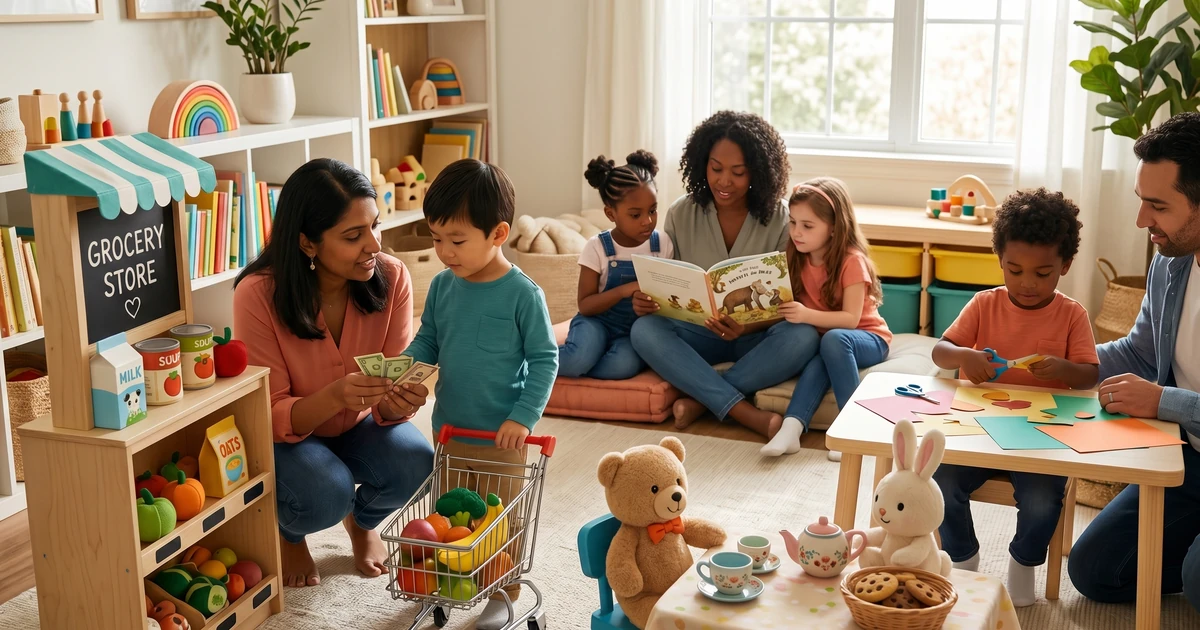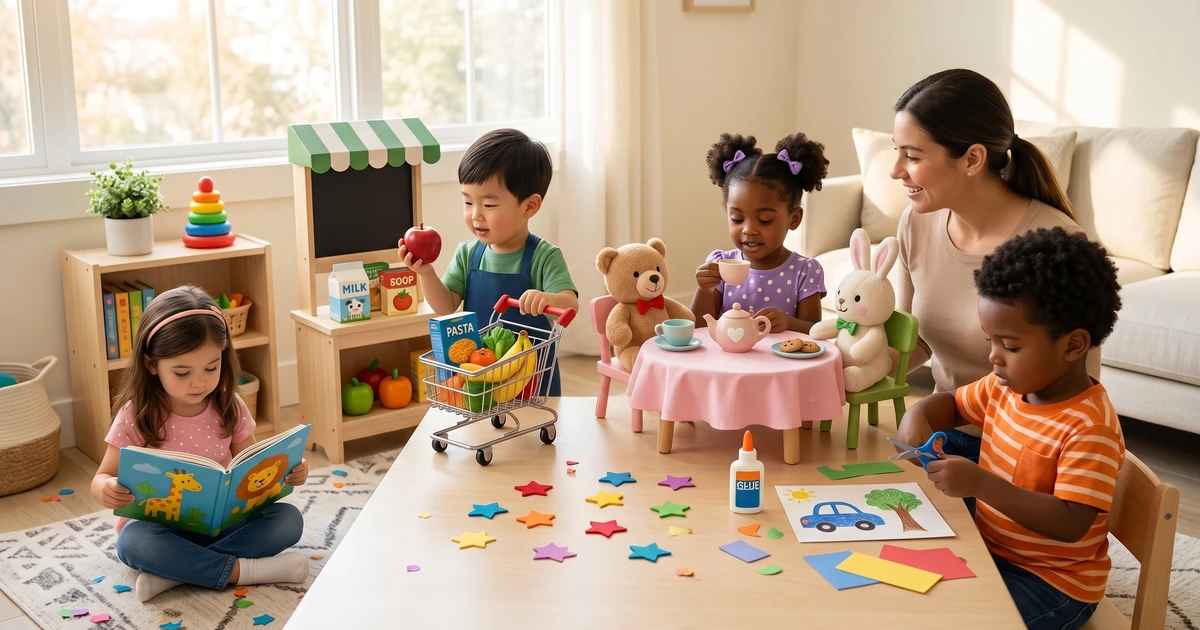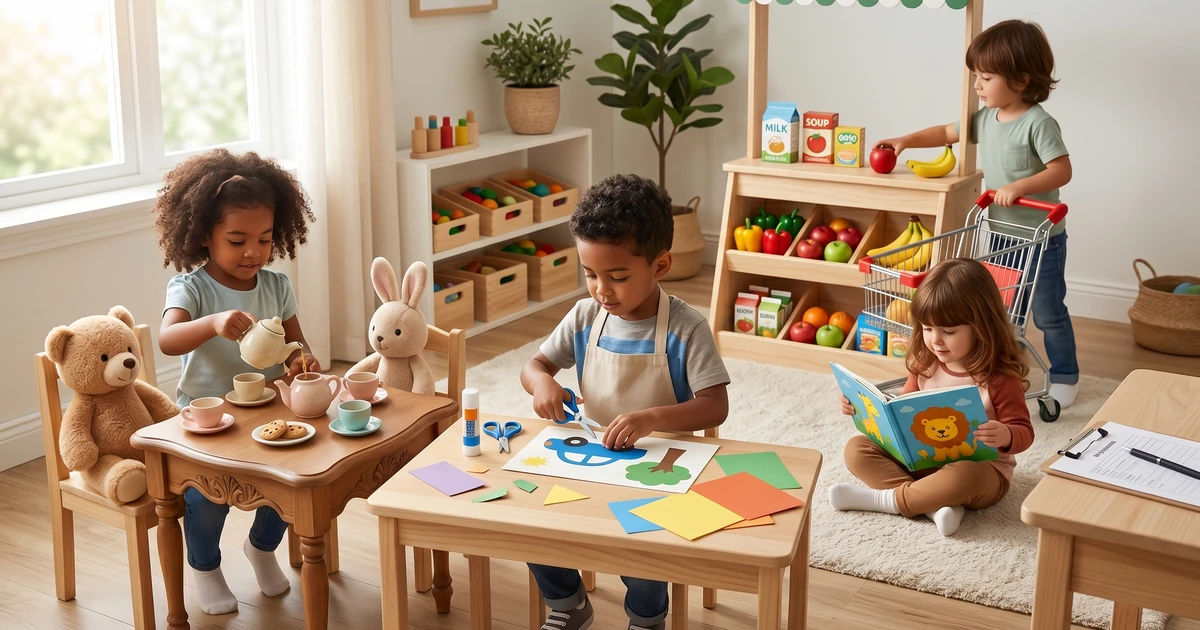
Play based assessment is one of those terms you hear thrown around in early childhood education circles, but rarely gets the detailed explanation it deserves. As someone who has spent 40+ hours researching early childhood evaluation methods, reading through educator reports, developmental psychology studies, and parent forums, I want to give you a genuinely useful breakdown of what this approach actually involves, how it differs from traditional testing, and what you should expect if your child’s school or therapist recommends it.
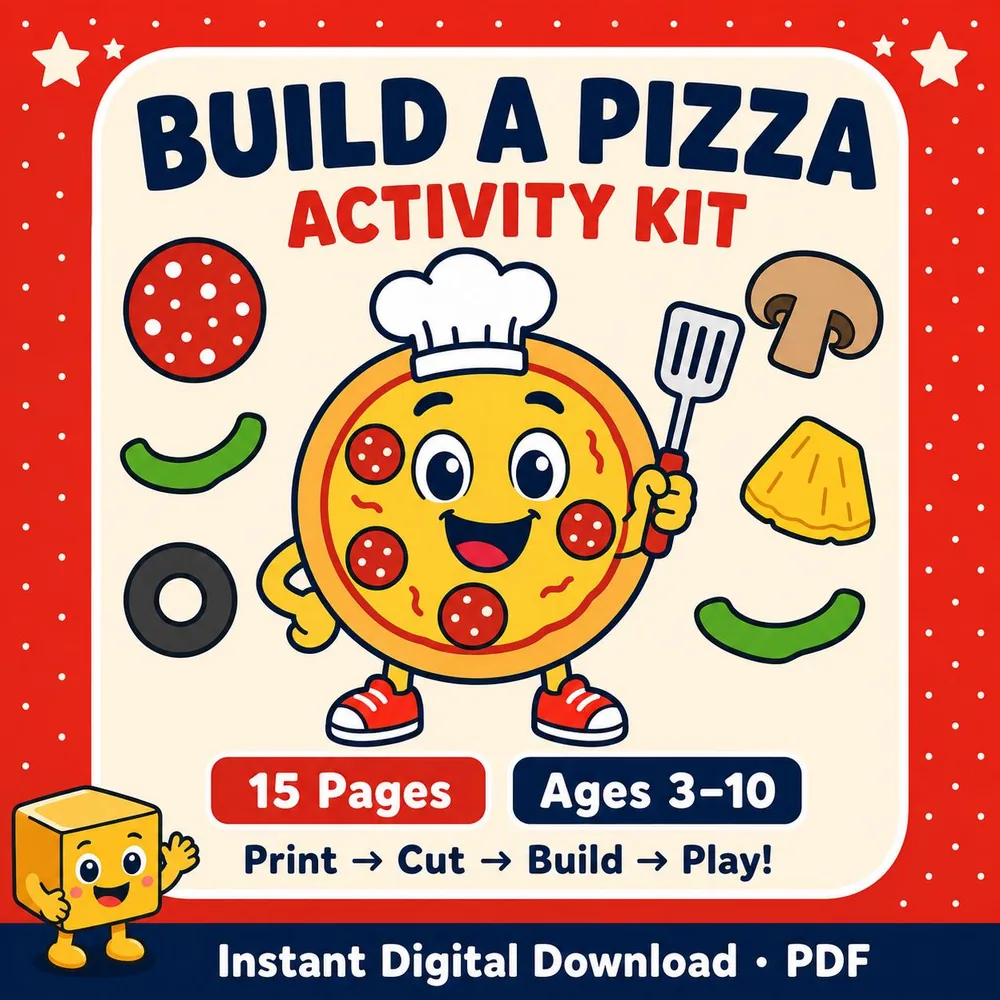
Pizza Chef Pretend Play Kit
15-page pizza pretend play kit: build-your-own pizza, restaurant role play, chef hat, menu, and certificate.
This page supports the broader topic covered in The Ultimate Guide to Play-Based Learning for Children, so if you want the full picture on how play-based approaches work across the board, that’s a great place to start.
Key Takeaways:
- Play based assessment evaluates children’s development through structured and unstructured play rather than formal tests
- It captures skills like problem-solving, language, and social development that standardized tests often miss
- Both educators and child psychologists use it for children ages 0-8, with the most common use being ages 2-5
- It’s used for developmental screening, special education eligibility, and curriculum planning
- Parents can actively participate in the process, which improves accuracy of results
- It is not a replacement for all formal evaluation, but it is often more accurate for young children than paper-based tests
!A young child playing with colorful blocks while an educator observes and takes notes
What Is Play Based Assessment, Exactly?
Play based assessment is a method of evaluating a child’s developmental skills, learning styles, and cognitive abilities by observing how they interact with toys, materials, and other people during play. Instead of sitting a four-year-old down with a worksheet or a structured question-and-answer format, an evaluator watches what the child naturally does during play, then draws conclusions from that observation.
The core idea is straightforward: children reveal far more about their actual abilities when they’re engaged in something they find meaningful. A child who freezes up in a formal testing room might demonstrate complex problem-solving skills within five minutes of being handed a set of building blocks.
According to the National Association for the Education of Young Children (NAEYC), assessment of young children should be developmentally appropriate, meaning it should fit how children actually think and behave, not how adults behave in evaluation settings.
Key domains typically assessed through play include:
- Cognitive development (problem-solving, cause and effect, memory)
- Language and communication (vocabulary, sentence structure, comprehension)
- Fine motor skills (grip, tool use, hand-eye coordination)
- Gross motor skills (balance, coordination, spatial awareness)
- Social-emotional development (sharing, turn-taking, emotional regulation)
- Adaptive behavior (self-care skills, independence)
- Creativity and imagination (pretend play, narrative building)
The bottom line: play based assessment treats play as data, not just fun.
How Play Based Assessment Differs from Traditional Testing
Most parents are familiar with standardized testing, even for young kids. Developmental screenings like the ASQ (Ages and Stages Questionnaire) or formal IQ testing involve structured tasks, timed responses, and scored answers. Play based assessment sits in a different category entirely.
Here’s a direct comparison so you can see where each approach works best:
| Feature | Play Based Assessment | Standardized Testing |
|---|---|---|
| Setting | Naturalistic (playroom, classroom, home) | Clinical or formal testing room |
| Child’s role | Active participant | Passive responder |
| Evaluator’s role | Observer and facilitator | Administrator and scorer |
| Stress on child | Low | Moderate to high |
| Flexibility | High (adapts to child) | Low (standardized conditions) |
| Best age range | 0-8 years | 5+ years (most reliable) |
| What it captures well | Social skills, creativity, real-world problem-solving | Academic readiness, specific cognitive scores |
| Parent involvement | Often encouraged | Usually excluded during testing |
| Time required | 45-90 minutes | 30-120 minutes |
| Scoring | Qualitative, observational | Quantitative, normed scores |
| Cost (private evaluation) | $300-$800 | $500-$2,500 |
“Young children show us what they know through play. A child who cannot tell you that she understands sequencing can demonstrate it perfectly when building a block tower or acting out a story.” - Dr. Sandra Petersen, child development researcher
The bottom line: standardized tests measure what a child can do under pressure; play based assessment measures what a child actually does when they’re comfortable and engaged.
When Is Play Based Assessment Used?
Play based assessment isn’t reserved for any single situation. In my research across educator forums, school psychology resources, and early intervention program documents, I found it comes up in several distinct contexts.
Common scenarios where it’s used:
- Early intervention referrals (ages 0-3, often through state-funded programs like Part C of IDEA)
- Preschool eligibility determination for special education services (ages 3-5)
- Kindergarten readiness screening
- Speech and language evaluations by SLPs (speech-language pathologists)
- Occupational therapy assessments for fine motor or sensory concerns
- Gifted program identification in some progressive districts
- Ongoing curriculum planning by classroom teachers
In the United States, the Individuals with Disabilities Education Act (IDEA) requires that evaluations for special education eligibility be conducted in a “variety of settings” using multiple methods. According to the U.S. Department of Education, play-based approaches are explicitly recognized as valid assessment tools within this framework.
Pro Tip: If your child has been referred for a developmental evaluation, ask specifically whether play based assessment will be part of the process. In some districts, parents have to request this approach, especially if the default is paper-based screening tools.
The bottom line: play based assessment is used across early intervention, preschool eligibility, therapy, and classroom planning, and parents can request it.
What Happens During a Play Based Assessment Session?
This is the question I see parents asking most often on early childhood education forums. They want to know what to expect before they bring their child in. Here’s a step-by-step breakdown based on standard practices reported by early childhood specialists and evaluation teams.
Step 1: Pre-Assessment Interview with Parents
Before the child ever enters the room, the evaluator typically spends 15-30 minutes talking with parents. They’re gathering background information: developmental history, concerns, what the child’s play looks like at home, favorite toys, and any behaviors that seem unusual. This context shapes what the evaluator looks for during the play session.
Step 2: Setting Up the Environment
The evaluation room is stocked with age-appropriate materials, usually organized into “play centers.” You might see a block area, art supplies, pretend play items (kitchen set, dolls, dress-up clothes), books, puzzles, and fine motor materials like beads or scissors. The setup isn’t random. Each item is chosen to elicit specific skills.
Step 3: Unstructured Play Observation
The child is invited to play freely while the evaluator observes. This phase lasts roughly 15-25 minutes. The evaluator is watching how the child explores the room, whether they initiate play independently, how they handle frustration, and what language they use spontaneously.
Step 4: Semi-Structured Play Tasks
The evaluator introduces specific activities to probe skills that didn’t naturally emerge. For example, if a child hasn’t spontaneously counted anything, the evaluator might introduce a game involving counting objects. These tasks are presented as play, not tests.
Step 5: Parent-Child Play Observation
Many play based assessments include a segment where the parent plays with the child while the evaluator observes. This reveals the child’s attachment behaviors, how they respond to redirection, and whether skills observed earlier are consistent across interaction partners.
Step 6: Peer Play Observation (Optional)
Some assessments, particularly for social-emotional concerns, include a structured playdate with a familiar peer or another child. Social skills like sharing, turn-taking, and conflict resolution are nearly impossible to assess without another child present.
Step 7: Post-Assessment Feedback Meeting
After the session, the evaluator compiles observations and shares findings with parents. In formal evaluation contexts, a written report follows within 30-60 days. The report describes what was observed, how it compares to developmental norms, and what supports or services might help.
The bottom line: a well-run play based assessment follows a clear structure, even though it looks informal from the outside.
Tools and Frameworks Commonly Used in Play Based Assessment
Evaluators don’t just wing it. There are recognized tools and frameworks that give structure to the observation process. Here are the most widely used ones:
| Assessment Tool | Age Range | What It Measures | Who Uses It |
|---|---|---|---|
| TPBA2 (Transdisciplinary Play-Based Assessment) | Birth-6 years | All developmental domains | Multi-disciplinary teams |
| PLAY (Play and Language for Autistic Youngsters) | 2-12 years | Play skills, autism features | SLPs, psychologists |
| SPACE (Systematic Play-Based Assessment) | 2-5 years | Social-emotional development | School psychologists |
| Linder’s Observation Guidelines | Birth-6 years | Cognitive, motor, social | Early intervention teams |
| Vineland Adaptive Behavior Scales | Birth-90 years | Daily living, communication | Psychologists (parent interview component) |
| Work Sampling System | Preschool-Grade 5 | Academic and developmental readiness | Classroom teachers |
TPBA2, developed by Toni Linder, is the most referenced formal framework in the literature I reviewed. It’s designed for teams (meaning an SLP, OT, psychologist, and teacher might all observe the same play session) and produces a detailed developmental profile rather than a single score.
“The transdisciplinary model allows each professional to see the same child behavior through a different lens. What the speech therapist hears in language play, the occupational therapist might interpret as a sensory response. Together, the picture is far more complete.” - Early intervention program coordinator (sourced from professional development materials)
The bottom line: recognizing the specific tool your evaluator uses helps you understand what they’re looking for and how to interpret their report.
How to Prepare Your Child (and Yourself) for a Play Based Assessment
Parents consistently report that preparation makes a significant difference, both in how comfortable children are during the session and in how useful the results end up being.
What to do before the assessment:
-
Bring your child’s favorite toy or comfort object. Most evaluators welcome familiar items because they reduce anxiety.
-
Schedule the session during your child’s best time of day. A child who naps at 1pm should not be evaluated at 12:45pm.
-
Don’t coach your child beforehand. Telling a child to “show them how smart you are” increases anxiety and can suppress natural behavior.
-
Bring a written list of your concerns. It’s easy to forget things in the moment.
-
Ask whether you’ll be in the room. Policies vary, and knowing in advance helps both you and your child prepare.
What the evaluator needs from you:
-
Honest, specific examples of behaviors you’ve observed at home
-
Medical history, including any prenatal complications, early hospitalizations, or diagnosed conditions
-
Information about the child’s primary language and home language environment
-
Any previous evaluations or reports
Pro Tip: Keep a two-week “play diary” before the assessment. Jot down quick notes about what your child plays with, how long they stay engaged, what frustrates them, and any language you notice. This information is gold for evaluators and often reveals patterns parents hadn’t consciously noticed.
The bottom line: low-key preparation from parents leads to more accurate results from the child.
Play Based Assessment and Children with Special Needs
This is where play based assessment genuinely shines. Children with autism spectrum disorder (ASD), developmental delays, sensory processing differences, or expressive language delays often perform poorly on standardized tests, not because they lack skills, but because the format doesn’t work for how their brains process information.
Reviews from parents of children with ASD consistently note that play based approaches revealed skills their children had that formal testing missed entirely. A child who scored in the “severe delay” range on a structured cognitive test demonstrated solid problem-solving and symbolic play during an unstructured session, which changed the entire direction of their educational plan.
That said, play based assessment alone isn’t always sufficient for special education eligibility determination. In most U.S. states, a formal diagnosis or eligibility category requires at least some standardized measurement. The strongest evaluations combine both approaches.
For children with:
-
Autism spectrum disorder: Play based assessment is especially useful for assessing play levels (functional, symbolic, pretend), social communication, and joint attention.
-
Language delays: Naturalistic observation captures spontaneous language far better than elicited responses in a formal setting.
-
Intellectual disabilities: Play based approaches reduce the floor effects common in standardized tests (where a child’s skills fall below the lowest measurable score).
-
Sensory processing differences: Observing how a child interacts with different textures, sounds, and materials during play reveals sensory patterns that interviews and questionnaires often miss.
For more on how play-based environments support children with diverse needs, see Play Based Preschool Curriculum: Key Elements And Benefits.
The bottom line: play based assessment is particularly valuable for children whose abilities are underrepresented by standard testing formats.
How Much Does Play Based Assessment Cost?
Cost is one of the most common questions I see from parents, and the range is genuinely wide depending on who’s conducting the assessment and in what context.
| Assessment Context | Typical Cost | Notes |
|---|---|---|
| Public school evaluation (IDEA-eligible) | $0 to parent | School district is legally required to fund |
| Early intervention (Part C, ages 0-3) | $0 to parent | State-funded in all 50 states |
| Private developmental pediatrician | $500-$1,500 | Wait times often 6-18 months |
| Private neuropsychologist | $2,000-$4,000 | Most comprehensive, includes standardized + play-based |
| Private SLP evaluation (language focus) | $300-$800 | Covered by many insurance plans |
| Private OT evaluation (motor/sensory focus) | $250-$600 | Partial insurance coverage common |
| University clinic | $150-$400 | Conducted by supervised graduate students |
If your child is between 3-21 years old and attends or will attend public school, you have a legal right to request a free evaluation from your school district under IDEA. The district must respond within 60 days of your written request and cannot charge you for the evaluation.
Pro Tip: If you’re on a waitlist for a private evaluation and concerned about delays, contact your local public school district’s special education office simultaneously. These processes can run in parallel.
The bottom line: play based assessment ranges from completely free (through public school or early intervention) to several hundred dollars privately, and insurance often covers portions of therapy-focused evaluations.
Linking Play Based Assessment to Everyday Learning
Assessment shouldn’t end when the evaluator leaves the room. The most useful play based assessments translate directly into daily learning strategies for parents and teachers. If the evaluation reveals that a child learns best through movement, that insight should change how reading activities are structured at home.
For parents of preschool-aged children, this is especially relevant. Understanding what your child’s play patterns reveal about their development can help you set up your home environment in ways that support learning naturally. This is exactly the territory covered in Play Based Learning For Preschoolers: A Parent’s Guide.
Teachers use play based assessment results to group children for activities, choose materials, and identify who might need additional support before problems escalate. It’s a much more actionable output than a percentile score on a standardized test.
The bottom line: the value of play based assessment lies not just in the findings, but in how those findings change what happens next for the child.
FAQ: Real Questions About Play Based Assessment
Does play based assessment actually hold up as valid compared to standardized tests?
Yes, with some important nuance. Research supports play based assessment as a valid and reliable method for evaluating young children’s development, particularly for ages 0-5. A 2018 study published in the Journal of Early Intervention found that play based methods captured social-emotional and language skills with comparable accuracy to standardized tools for children under five. However, formal eligibility determinations for special education typically require a combination of methods, so play based assessment is strongest when used alongside, not instead of, other measures.
At what age is play based assessment most useful?
Play based assessment is most commonly used between ages 2