
Play Based Preschool Curriculum
You signed your child up for preschool because you wanted them to get a head start. Maybe you pictured little ones sitting at tables, learning letter sound
You signed your child up for preschool because you wanted them to get a head start. Maybe you pictured little ones sitting at tables, learning letter sounds, counting to 20, getting “ready” for kindergarten.
Pizza Chef Pretend Play Kit
15-page pizza pretend play kit: build-your-own pizza, restaurant role play, chef hat, menu, and certificate.
Then you walked in and saw… kids building block towers and playing pretend chef in a kitchen corner.
And now you’re wondering: Is this actually teaching them anything?
I’ve spent a lot of time researching early childhood education, and this question comes up constantly among parents. The short answer is yes, dramatically more than you might expect. But I get why it looks like chaos from the outside. So let me break down what a play based preschool curriculum actually looks like, why the research behind it is so strong, and how you can support this kind of learning at home too.
Key Takeaways:
- A play based preschool curriculum is a structured approach where children learn academic, social, and emotional skills through guided and free play activities
- Research consistently shows play-based learning supports brain development, language acquisition, and self-regulation better than direct instruction at preschool age
- Play-based classrooms still have clear learning goals; the difference is how children reach them
- Parents can extend play-based learning at home with simple, low-cost strategies
- Not all play-based programs are equal; knowing what to look for helps you choose a quality program
!A group of preschool children building with colorful blocks in a bright classroom
What a Play Based Preschool Curriculum Actually Looks Like
A play based preschool curriculum is a structured educational framework where learning objectives are embedded into play activities rather than delivered through direct, teacher-led instruction. Kids aren’t just doing whatever they want. There’s real intention behind every activity in the room.
In a well-designed play-based classroom, you’ll typically see:
-
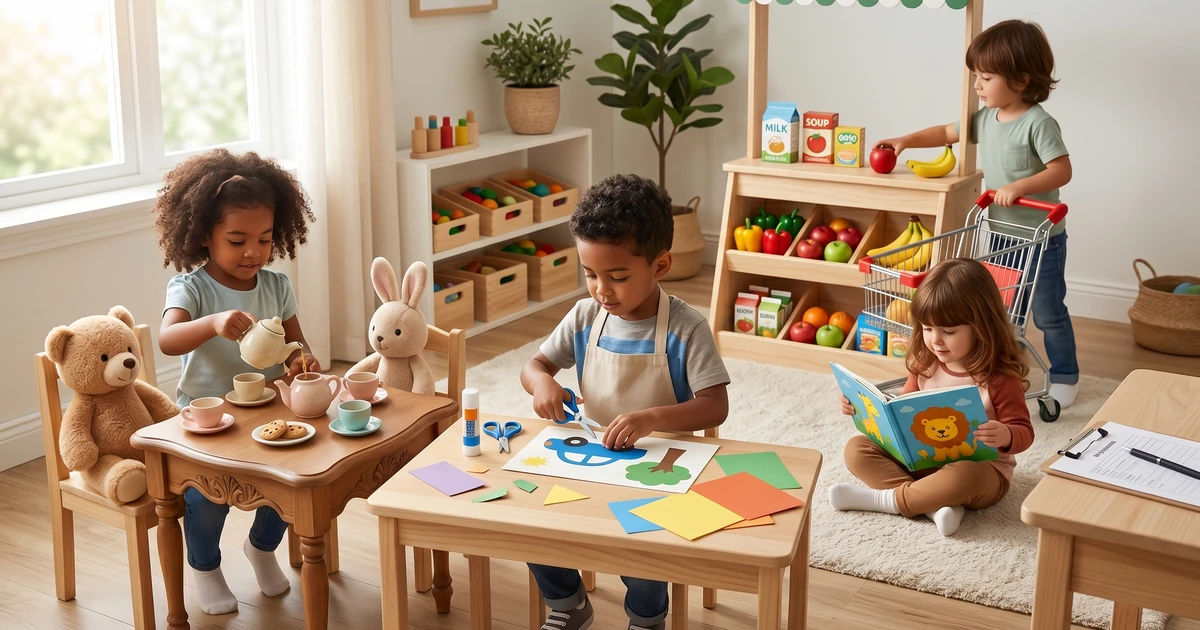
Learning centers set up around the room (sensory table, block area, dramatic play corner, art station, book nook)
-
Teachers circulating and asking open-ended questions (“What do you think will happen if you add another block?”)
-
Scheduled blocks of free choice play alongside small-group activities
-
Materials that invite exploration rather than require a single “right” answer
-
Documentation of children’s learning through observation notes and photos
The key distinction is that the learning is child-initiated and teacher-supported. Children choose where to spend their energy; teachers guide the depth of that exploration.
A play-based classroom is structured. It just doesn’t look like a classroom you grew up in.
The Science Behind Why Play-Based Learning Works
This isn’t a trendy philosophy. The evidence base for play in early childhood is decades deep.
According to the American Academy of Pediatrics, play is essential for healthy brain development and helps children develop creativity, dexterity, and emotional strength. They’ve explicitly stated that play is so important to optimal child development that it has been recognized by the United Nations High Commission for Human Rights as a right of every child.
“Children learn best when they are actively engaged, when they direct their own learning, and when new skills are embedded in meaningful contexts.” - National Association for the Education of Young Children (NAEYC)
A 2023 review published by researchers at MIT found that guided play (where adults set a learning goal but children explore freely) produced stronger learning outcomes than direct instruction for children under age 6. This is because the preschool brain is wired to learn through social interaction, movement, and sensory experience, not passive listening.
Here’s a quick comparison of how different preschool approaches deliver early learning:
| Approach | How Children Learn | Teacher Role | Academic Readiness Outcome |
|---|---|---|---|
| Play-Based | Child-initiated exploration | Facilitator, observer | Strong (especially language, self-regulation) |
| Direct Instruction | Teacher-led lessons | Lecturer, director | Short-term gains, lower motivation |
| Montessori | Self-directed with structured materials | Guide | Strong independence and focus |
| Hybrid/Balanced | Mix of play and instruction | Both | Varies by implementation quality |
| Worksheet-Heavy | Rote practice | Director | Limited long-term benefit at preschool age |
The research consistently points to play-based and guided play approaches as most developmentally appropriate for ages 3 to 5.
What Children Actually Learn During “Just Playing”
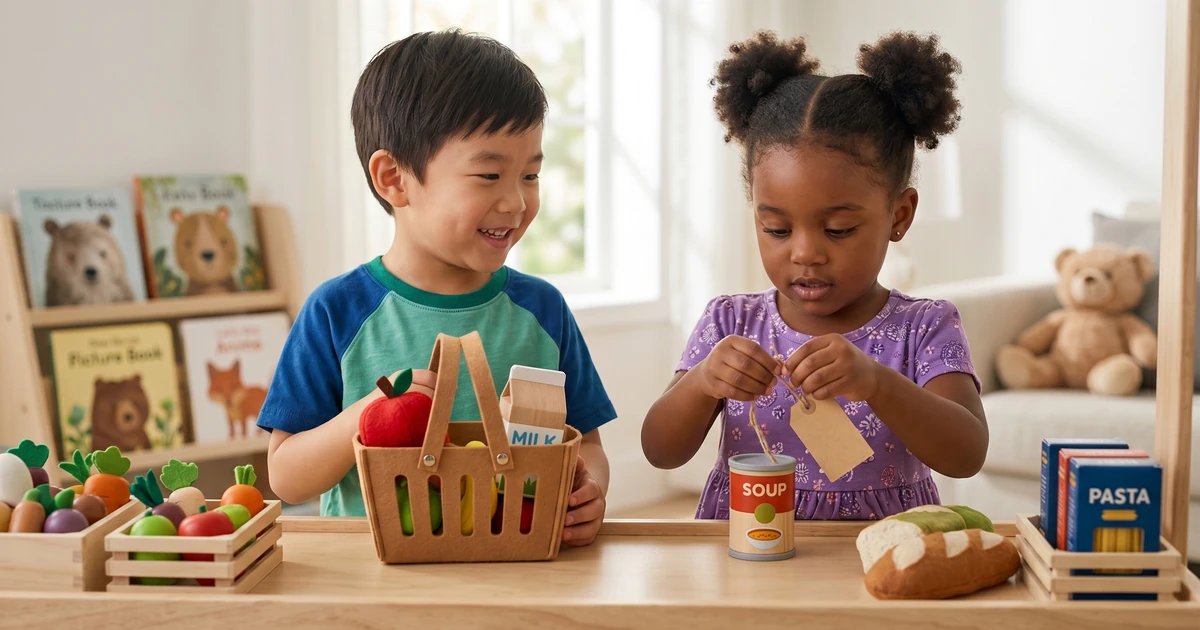
This is the part that surprises most parents. When a 4-year-old spends 20 minutes playing grocery store with a friend, here’s what’s actually happening:
- Math skills. Counting items, sorting by category, making change with pretend money
- Language development. Negotiating roles, describing items, building vocabulary (“organic,” “receipt,” “sale”)
- Executive function. Following self-imposed rules, waiting for a turn, shifting between roles
- Social skills. Reading facial expressions, resolving conflict, cooperating toward a shared goal
- Literacy. “Reading” food labels, writing shopping lists, recognizing print in context
According to the National Association for the Education of Young Children (NAEYC), children who experience high-quality play-based early education show stronger outcomes in reading and math by third grade compared to peers in heavily academic preschool programs.
Pro Tip: If you want to support your child’s play-based learning at home, set up one simple “invitation to play” each week. A tray of sand with small toy animals and some cups, for example, takes 5 minutes to put together and can occupy a curious 3-year-old for 45 minutes while building fine motor skills and imaginative thinking.
Play isn’t the break from learning. For preschoolers, play is the learning.
How to Spot a High-Quality Play Based Preschool Curriculum
Not every program that calls itself “play-based” actually is. I’ve gone through a lot of curriculum reviews and parent feedback, and there’s a meaningful range in quality. Here’s what to look for:
| Quality Indicator | What It Looks Like | Red Flag |
|---|---|---|
| Clear learning objectives | Teachers can explain what children are learning through each activity | ”We just let them play” with no documentation |
| Rich, varied materials | Open-ended toys, art supplies, natural materials | Only plastic toys with one correct use |
| Teacher observation | Educators observe and document children’s play | No observation notes or portfolios |
| Child voice | Children choose activities during free-choice blocks | Every minute is teacher-directed |
| Outdoor time | Daily unstructured outdoor play is built into the schedule | Outdoor time is cut for “learning” activities |
| Family communication | Teachers share what children are exploring and why | No explanation of the learning behind play |
| Low child-to-teacher ratio | 1:6 or 1:8 at most for ages 3-4 | 1:15 or higher |
Pro Tip: When you visit a preschool, don’t just look at the space. Ask the director, “Can you walk me through what a 3-year-old learns during block play in your classroom?” A confident, specific answer tells you the staff actually understands developmental learning.
A quality play-based program can articulate the learning goals behind every activity, even if it looks like “just play” to an outside eye.
Simple Ways to Extend Play Based Learning at Home
You don’t need an expensive curriculum kit or a Pinterest-perfect playroom. Some of the most powerful play-based learning happens with everyday objects.
Here are five ideas I’ve come across repeatedly in parent communities and educator resources, all low-cost and easy to set up:
- Sensory bins. Fill a container with dried pasta, rice, or kinetic sand. Add small figures or scoops. Done. Children explore texture, quantity, and cause-and-effect for long stretches.
- Loose parts play. Gather bottle caps, wooden spools, pebbles, fabric scraps. Let children create with no instructions. This builds creativity and spatial reasoning.
- Dramatic play props. A cardboard box becomes a spaceship, a store, a cave. Add one or two relevant props (a toy phone, a small notebook) and step back.
- Cooking together. Measuring, pouring, stirring, and waiting are all math and science in a meaningful context. Even making a simple fruit salad works.
- Nature exploration. A walk where children stop to examine a beetle, collect leaves, or splash in a puddle is rich sensory and scientific learning.
“Play gives children a chance to practice what they are learning.” - Fred Rogers
These aren’t workarounds. They’re the curriculum. And the best part is they cost almost nothing.
FAQ: Play Based Preschool Curriculum
Is a play-based preschool curriculum academically rigorous enough to prepare kids for kindergarten?
Yes, and in many cases more so than academic-focused programs. Research shows children in high-quality play-based programs enter kindergarten with stronger self-regulation, language skills, and social competence, all of which are stronger predictors of school success than early memorization of letters or numbers. Kindergarten teachers consistently report that self-regulation and curiosity matter far more than specific content knowledge at school entry.
How much free play versus structured learning should a preschool day include?
Most early childhood experts recommend that at least 50% of a preschool day involve child-initiated play. The remaining time can include small-group guided activities, storytime, outdoor play, and transitions. Programs that offer less than 30 minutes of free choice play per session are generally considered below the recommended standard for ages 3 to 5.
My child’s preschool uses a play-based approach, but I’m worried they’re not learning enough. What should I do?
Ask the teacher to show you documentation from your child’s play. Good play-based programs keep observation notes, photos, and learning portfolios that make the learning visible. If the teacher can show you a specific example of what your child explored last week and what skill that developed, the program is working. If they can’t, that’s worth a follow-up conversation with the director.
Can I implement a play based preschool curriculum at home if my child isn’t in preschool?
Absolutely. Home-based play-based learning is both practical and effective. You don’t need a formal curriculum to follow the core principles: offer open-ended materials, follow your child’s interests, ask questions that extend their thinking, and prioritize unstructured exploration time each day. Many families supplement with simple themed “invitations to play” set up around interests their child naturally gravitates toward.
Ready to Go Deeper?
If you’re now curious about how to evaluate specific programs, what the research really says about kindergarten readiness, or how to talk to your child’s school about their approach, I’ve pulled together everything into a detailed resource.
Read the Play Based Preschool Curriculum: Key Elements And Benefits guide for a full breakdown of what separates a good play-based program from a great one.
You can also explore Play Based Learning For Preschoolers: A Parent’s Guide for practical, parent-focused advice on supporting this style of learning at home.
And for the full picture on how play shapes children’s development from birth through early childhood, the The Ultimate Guide to Play-Based Learning for Children covers it all in one place.
Your child playing isn’t wasted time. It might be the most important thing they do all day.
Take the Next Step!
Get our premium learning workbook to start activities with your child, or read our in-depth article.
Recommended Resources & Workbooks
Pair this guide with our hands-on, ready-to-print learning resources.
 Digital Bundle
Learn to Read Program: Levels 1-3
170 sequenced phonics lessons across 199 pages, from first letter sounds to fluent long-vowel reading.
 Digital Learning Bundle
Preschool Learning Bundle
260+ printable worksheets for tracing, ABCs, numbers, shapes, sight words, and kindergarten prep.
 Digital Learning Bundle
Play-Based Learning Bundle for Ages 3-6
230+ play-based learning activities with pretend play, reading, early math, creative arts, and bonus flashcards.
Related Guides & Articles
Explore more of our detailed guides and activities.
The Ultimate Guide to Play-Based Learning for Children
What I found con
What Is Play Based Assessment? A Comprehensive Overview
Play based assessment is one of those terms you hear thrown around in early childhood education circles, but rarely gets the detailed explanation i...
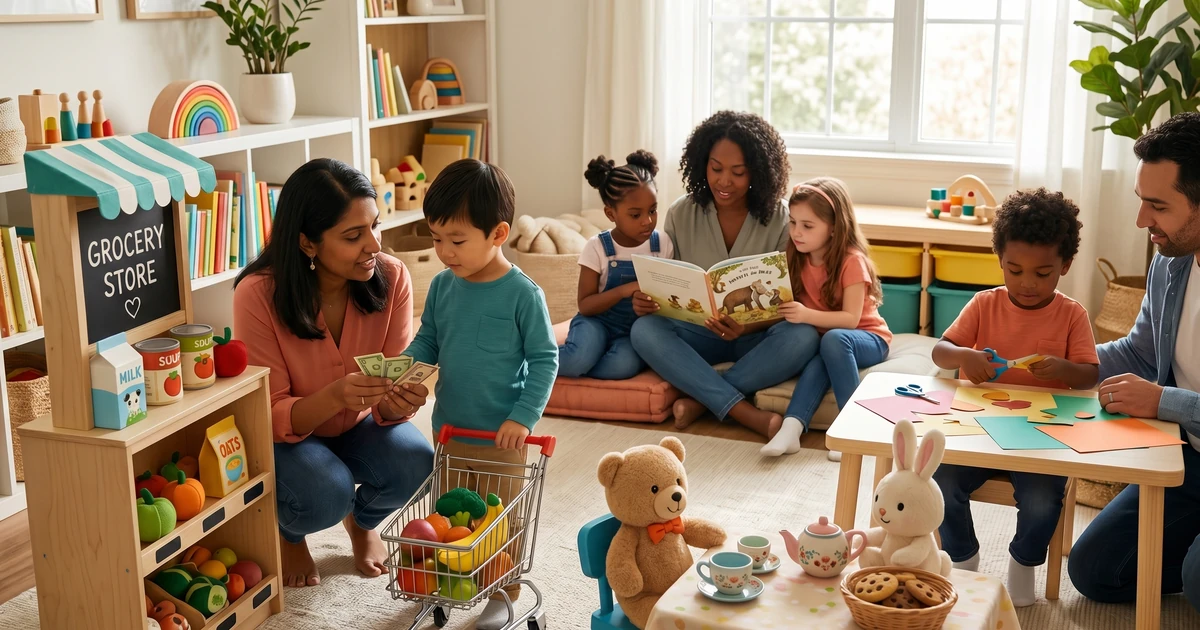
Play Based Learning For Preschoolers: A Parent's Guide
Play based learning for preschoolers is one of those topics where everyone seems to have an opinion, but the research tells a more specific story. ...
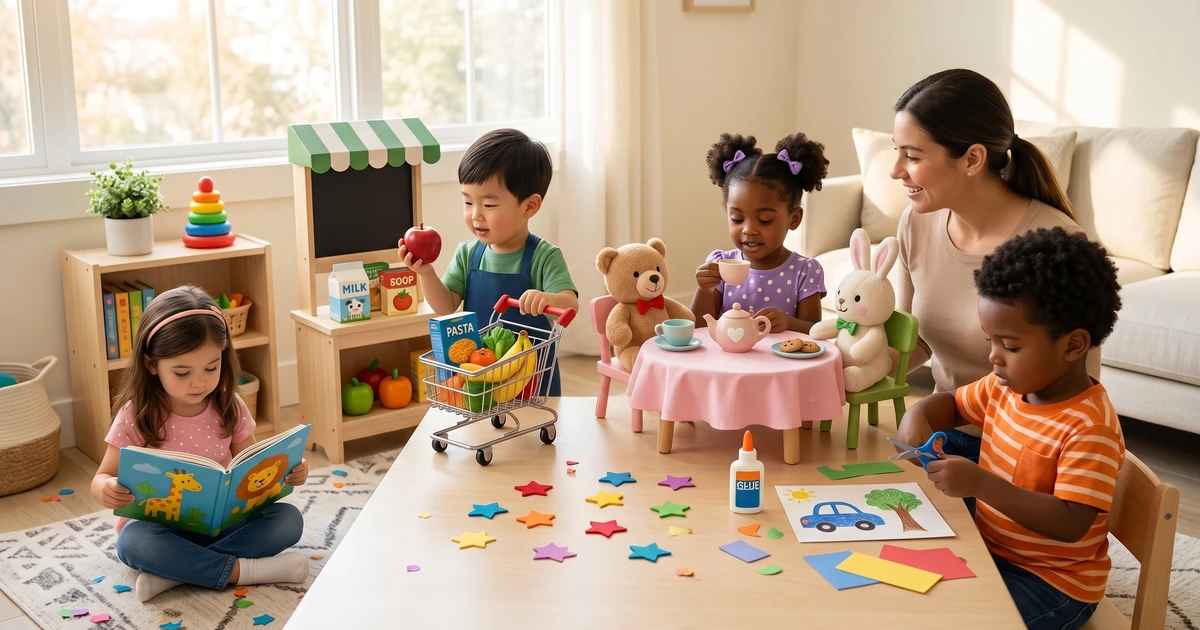
Play Based Preschool Curriculum: Key Elements And Benefits
The term play based preschool curriculum gets used a lot these days, but what does it actually mean in practice? After spending 40+ hours researchi...