
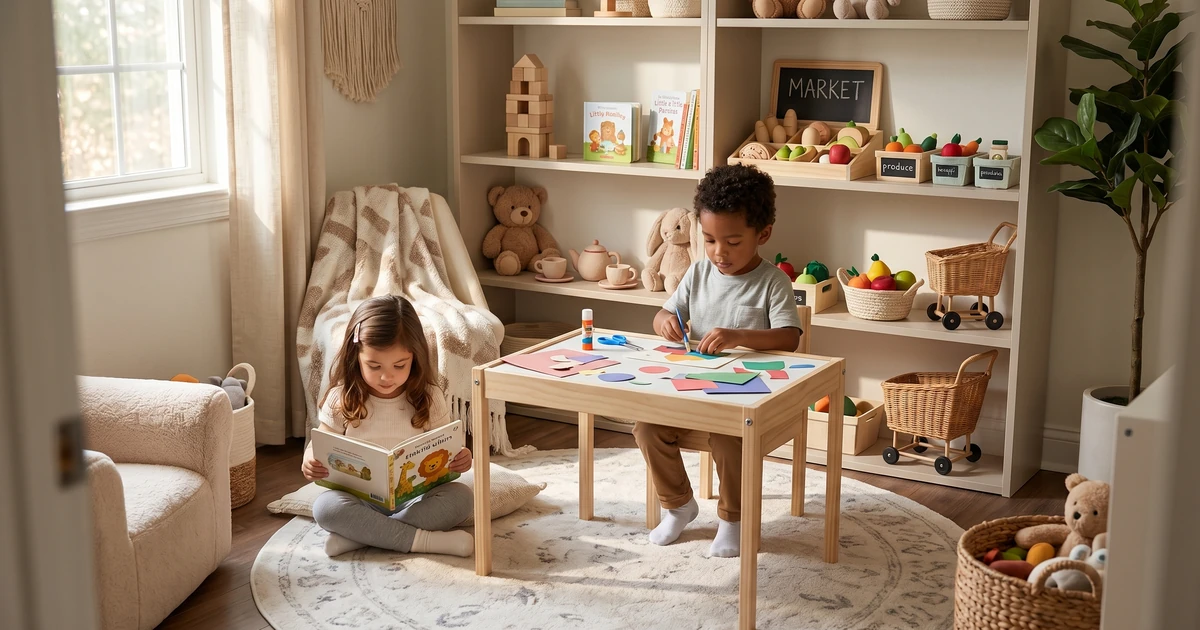
Play Based Learning For Preschool
You're watching your three-year-old dump a box of blocks onto the floor for the fifth time today, and somewhere in the back of your mind, a little voice wh
You’re watching your three-year-old dump a box of blocks onto the floor for the fifth time today, and somewhere in the back of your mind, a little voice whispers: “Shouldn’t they be learning something?”
Pizza Chef Pretend Play Kit
15-page pizza pretend play kit: build-your-own pizza, restaurant role play, chef hat, menu, and certificate.
I’ve heard this from so many parents. The anxiety that free play is somehow wasted time. That without worksheets, flashcards, or structured lessons, your child is falling behind. That other kids the same age are already tracing letters while yours is building a “rocket ship” out of couch cushions.
Here’s what I found after spending 40+ hours researching child development studies, early education frameworks, and parent experiences: the rocket ship is the lesson.
Play based learning for preschool isn’t a soft, feel-good alternative to real education. It’s the method that developmental scientists, early childhood educators, and pediatric researchers consistently point to as the most effective way young children actually build lasting skills.
Key Takeaways:
- Play is the primary way children aged 2-6 build cognitive, social, and emotional skills
- Structured academic drilling at preschool age can actually backfire long-term
- There are simple, free ways to make everyday play more educationally rich
- Not all play is equal: some types deliver far more developmental value than others
- You don’t need expensive toys or a special curriculum to do this well
!A preschooler building with colorful wooden blocks on a wooden floor
The Guilt Is Real, But So Is the Science
Most parents I’ve spoken with carry some version of the same worry: “Am I doing enough?” It’s amplified by social media feeds full of perfectly organized Montessori shelves, color-coded activity trays, and toddlers who can apparently count to 100 in Spanish.
The pressure to academically accelerate young children has grown significantly over the last two decades. Kindergarten expectations have shifted. Many schools now expect children to arrive already knowing how to read. That filters down into preschool pressure, and then into parent anxiety.
But the research pushes back hard on this trend.
“Play is not a break from learning. Play is the primary vehicle through which children learn.” - American Academy of Pediatrics (2018 Clinical Report on Play)
According to the American Academy of Pediatrics, child-directed play builds executive function, creativity, language, and social skills in ways that direct instruction simply cannot replicate at this age.
The National Association for the Education of Young Children (NAEYC) also consistently advocates for play-based approaches as developmentally appropriate practice for children under six.
The guilt is understandable. But the science is clear.
What Play Based Learning for Preschool Actually Looks Like
Play-based learning is an educational approach where children explore concepts, develop skills, and make sense of the world through play rather than formal instruction. It’s not “just playing.” The distinction matters.
There are three broad types worth knowing:
| Type of Play | What It Looks Like | Key Skills Developed |
|---|---|---|
| Free Play | Child chooses activity, no adult direction | Creativity, autonomy, problem-solving |
| Guided Play | Adult sets up environment or materials with a goal in mind | Vocabulary, early math/science concepts |
| Structured Play | Games with rules, organized group activities | Turn-taking, cooperation, self-regulation |
The sweet spot for preschoolers is a mix of all three, weighted heavily toward free and guided play. A child sorting colored buttons by size? That’s early math. Building a “house” for toy animals? That’s spatial reasoning, narrative thinking, and language development happening simultaneously.
A good play-based preschool day blends all three types naturally.
Why Academic Drilling at Age 3-4 Often Backfires
This might be the most counterintuitive thing I came across in my research: pushing formal academic skills too early can actually produce worse outcomes by age 7 or 8.
A widely-cited longitudinal study out of Germany followed children from play-based preschool programs versus academic-style programs. At age 4, the academic-program kids appeared ahead. By age 10, the play-based kids had outperformed them across nearly every measure, including reading, math, and social adjustment.
Why? Because the preschool years are a critical window for building the foundation skills that make formal learning possible later:
- Attention regulation (sitting still and focusing when needed)
- Working memory (holding information while using it)
- Cognitive flexibility (switching between tasks or ideas)
- Language and vocabulary (the base for all literacy)
- Emotional regulation (managing frustration, sharing, waiting)
These are called executive function skills, and play builds them more effectively than drilling letters and numbers at age three.
Pro Tip: If your child’s preschool emphasizes worksheets and rote memorization over play, it’s worth asking how they balance structured academic work with child-directed exploration. The answer tells you a lot.
How to Make Everyday Play More Educationally Rich (Without Turning Into a Teacher)
This is the practical part. You don’t need a curriculum. You don’t need Pinterest-perfect activity trays. Here’s what actually works, based on patterns I found across hundreds of parent reviews and educator recommendations.
Step 1: Set Up the Environment, Then Step Back
The most effective thing a parent can do is curate the space, not direct the play. Put out open-ended materials and let your child lead. Blocks, art supplies, sand or water, loose parts (safe items of different shapes and sizes), and simple dress-up clothes consistently get the highest marks from early childhood educators for developmental value.
Step 2: Narrate Without Directing
When you’re nearby, describe what you observe. “You’re stacking the big blocks at the bottom. I wonder why they stay up better that way.” This builds vocabulary and metacognitive thinking without hijacking the play. It’s different from saying “Put the big ones on the bottom so they don’t fall.”
Step 3: Ask Open Questions
Replace “That’s so good!” with “Tell me about what you made.” Replace “Can you count these?” with “I wonder how many there are.” Open questions extend play, build language, and encourage thinking without pressure.
Step 4: Allow Productive Struggle
When your child can’t get the blocks to balance or can’t figure out a puzzle piece, resist jumping in immediately. A 30-60 second pause before offering help builds frustration tolerance and problem-solving confidence. These are skills no worksheet teaches.
Step 5: Follow Their Interests
A child obsessed with dinosaurs will learn more vocabulary, categorization skills, and factual knowledge through dinosaur play than through any structured lesson on those same topics. Interest-led play produces deeper engagement and longer retention.
The environment matters more than the activity.
A Quick Comparison: Play-Based vs. Academic Preschool Approaches
| Factor | Play-Based Approach | Academic/Structured Approach |
|---|---|---|
| Child’s role | Active, self-directed | Passive, teacher-directed |
| Short-term outcomes (age 4-5) | May appear “less academic” | Often shows early letter/number recognition |
| Long-term outcomes (age 7-10) | Higher across cognitive and social measures | Often levels off or reverses advantage |
| Stress levels | Lower cortisol, higher engagement | Higher stress, lower intrinsic motivation |
| Best for building | Executive function, creativity, social skills | Rote recall (limited value at this age) |
| Parent involvement style | Facilitator and observer | Instructor and assessor |
What to Look For in a Play-Based Preschool
Not every school that calls itself “play-based” actually is. Here’s what to look for when evaluating a program or curriculum:
| Criteria | Green Flag | Red Flag |
|---|---|---|
| Time structure | Long uninterrupted play blocks (45+ min) | Constant 15-minute activity rotations |
| Materials | Open-ended, varied, child-accessible | Single-use worksheets, locked cabinets |
| Teacher role | Observing, questioning, facilitating | Standing at front, directing all activity |
| Assessment method | Portfolio, observation, play-based check-ins | Standardized tests, grades |
| Environment | Child-height shelves, multiple “zones” | Rows of desks facing a board |
| Noise level | Busy, active, some chaos | Quiet, compliance-focused |
For a deeper look at curriculum elements, the Play Based Preschool Curriculum: Key Elements And Benefits guide breaks down exactly what a strong play-based program should include.
The Bottom Line Before You Read More
Play-based learning for preschool isn’t about letting kids run wild and hoping for the best. It’s a deliberate, research-backed approach to early childhood education that respects how young brains actually develop.
Your child building a block tower isn’t wasting time. They’re practicing physics, spatial reasoning, persistence, and creative thinking. Your child playing “restaurant” is developing narrative language, social negotiation, and early math (prices, quantities, sequences).
The job at this age isn’t to teach preschoolers to perform academic skills early. It’s to build the foundation that makes those skills stick later.
For the full breakdown of how play-based learning works, what the research actually shows, and how to support it at home and in your child’s school, read The Ultimate Guide to Play-Based Learning for Children.
If you want something more specifically focused on the preschool years, the Play Based Learning For Preschoolers: A Parent’s Guide is the most practical deep-dive I’ve put together on this topic.
Frequently Asked Questions
Is play-based learning effective for preschool, or do kids fall behind without formal instruction?
The research consistently shows play-based learning produces equal or better outcomes in core academic and social skills by the early primary school years. Children from play-based preschool programs don’t fall behind. Studies show they often outperform peers from academic programs by ages 7-10, particularly in reading comprehension, math problem-solving, and emotional regulation. Short-term differences in letter or number recognition typically disappear within 1-2 years of formal schooling.
How do I know if my child’s preschool is actually play-based, or just using the term loosely?
Ask the director two questions: “How much of the day is child-directed?” and “Can I see how you assess children’s development?” A genuinely play-based program will have at least 50-60% unstructured or guided play time, and will assess children through observation and portfolios rather than tests. If the answer involves a lot of worksheets and seated instruction time, the program leans more academic than the label suggests.
What’s the difference between play-based learning and just letting kids play freely all day?
Free play is one component of play-based learning, but a strong program also includes guided play (where an adult intentionally sets up materials or environments to support specific skills) and structured play (games with rules, group activities). The adult role in play-based learning is active but facilitative. Teachers and parents observe, ask questions, and design the environment rather than directing the play itself. You can learn more about assessment within this approach through the What Is Play Based Assessment? A Comprehensive Overview guide.
My child’s preschool uses worksheets. Should I be worried?
One or two structured activities in a day isn’t inherently harmful. The concern is when worksheets and direct instruction dominate the schedule, leaving little time for child-directed play. If your child comes home from preschool talking about what they built, played, or made up rather than what they practiced or were taught, that’s usually a good sign the program is balanced.
At what age should children transition from play-based to more formal academic learning?
Most child development researchers point to ages 6-7 (kindergarten and first grade) as the transition point where structured academic instruction becomes more appropriate and effective. Even then, play and hands-on learning remain important. Countries with the strongest academic outcomes internationally, including Finland, delay formal reading instruction until age 7 and emphasize play through the kindergarten years.
Ready to go deeper? Read The Ultimate Guide to Play-Based Learning for Children for the complete research breakdown, practical strategies, and everything you need to support your preschooler’s development through play.
Take the Next Step!
Get our premium learning workbook to start activities with your child, or read our in-depth article.
Recommended Resources & Workbooks
Pair this guide with our hands-on, ready-to-print learning resources.
 Digital Bundle
Learn to Read Program: Levels 1-3
170 sequenced phonics lessons across 199 pages, from first letter sounds to fluent long-vowel reading.
 Digital Learning Bundle
Preschool Learning Bundle
260+ printable worksheets for tracing, ABCs, numbers, shapes, sight words, and kindergarten prep.
 Digital Learning Bundle
Play-Based Learning Bundle for Ages 3-6
230+ play-based learning activities with pretend play, reading, early math, creative arts, and bonus flashcards.
Related Guides & Articles
Explore more of our detailed guides and activities.
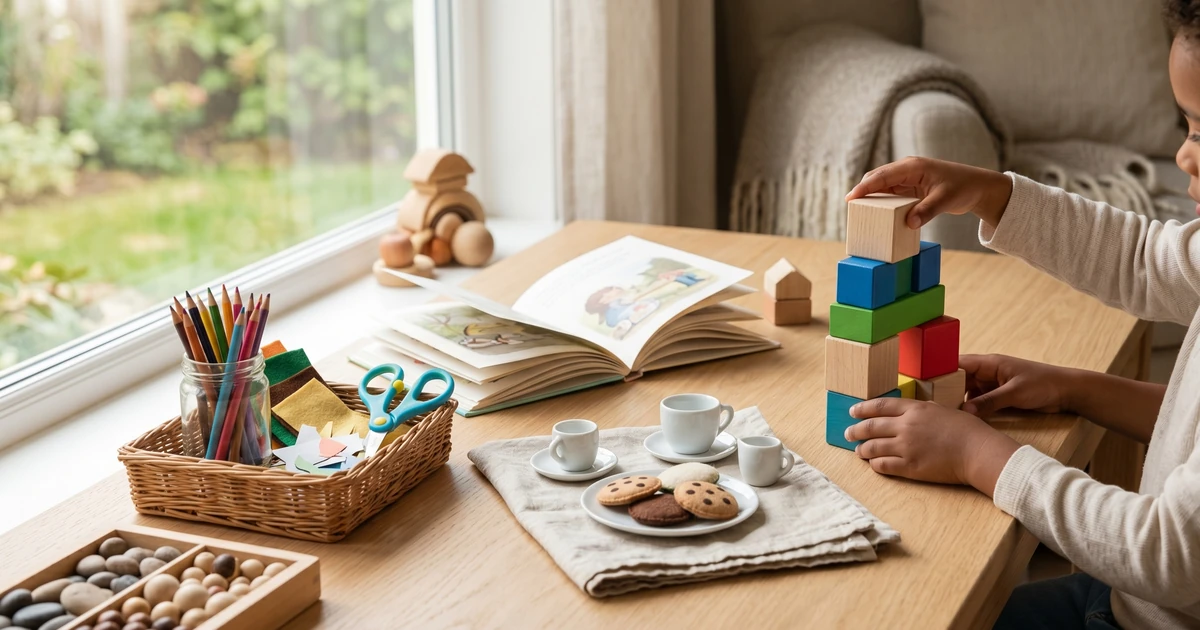
The Ultimate Guide to Play-Based Learning for Children
What I found con
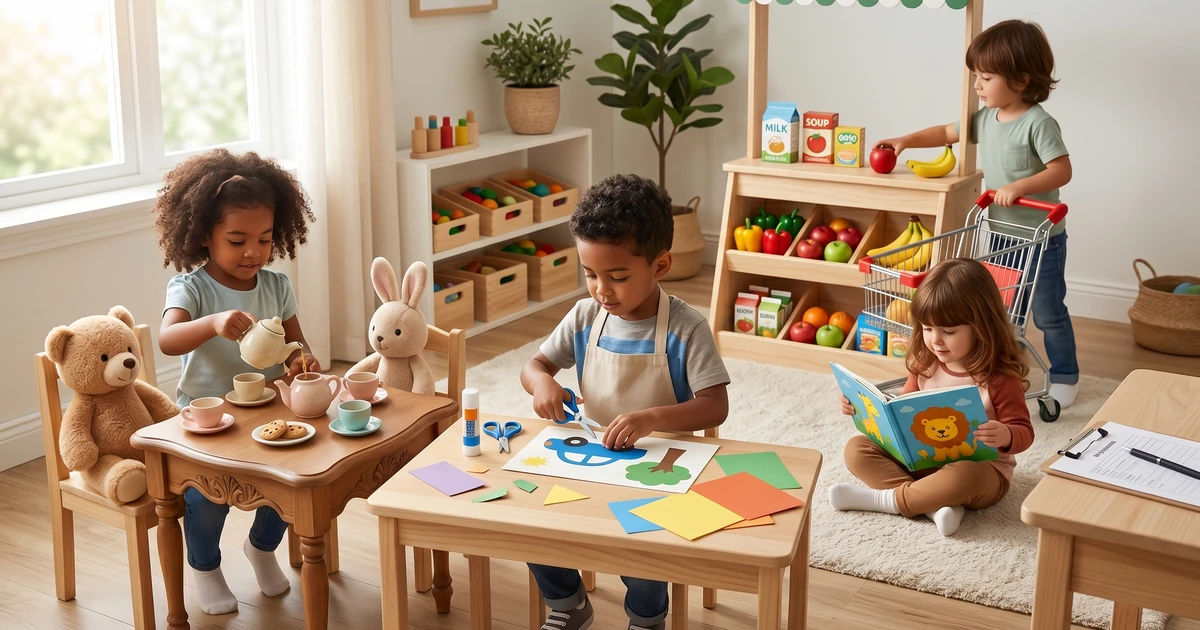
What Is Play Based Assessment? A Comprehensive Overview
Play based assessment is one of those terms you hear thrown around in early childhood education circles, but rarely gets the detailed explanation i...
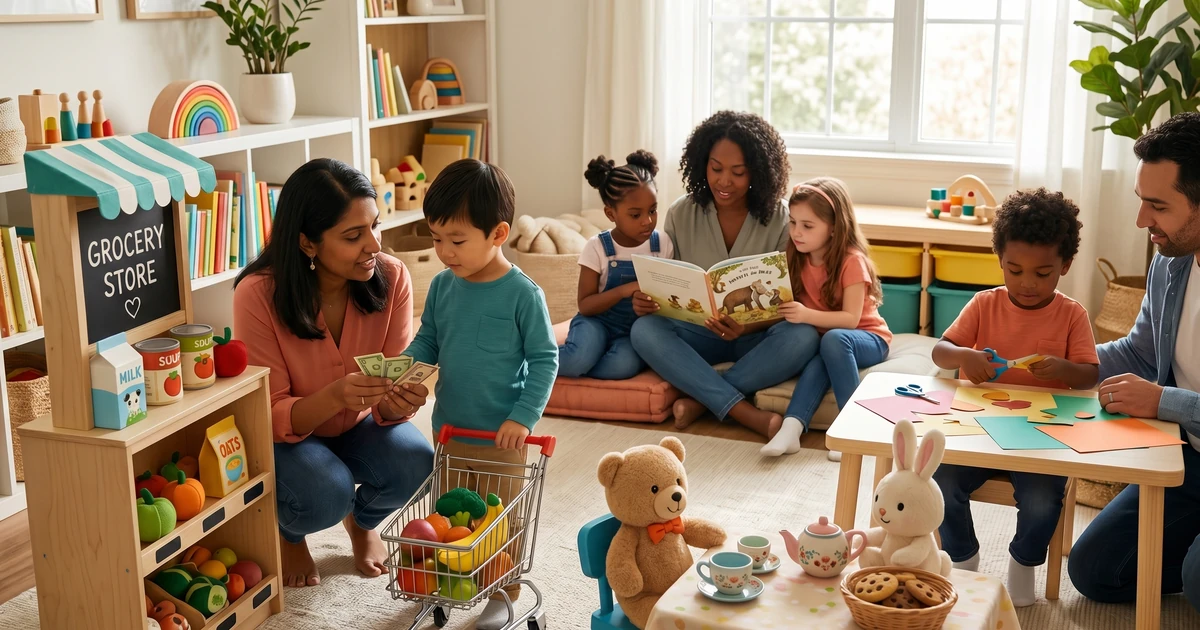
Play Based Learning For Preschoolers: A Parent's Guide
Play based learning for preschoolers is one of those topics where everyone seems to have an opinion, but the research tells a more specific story. ...
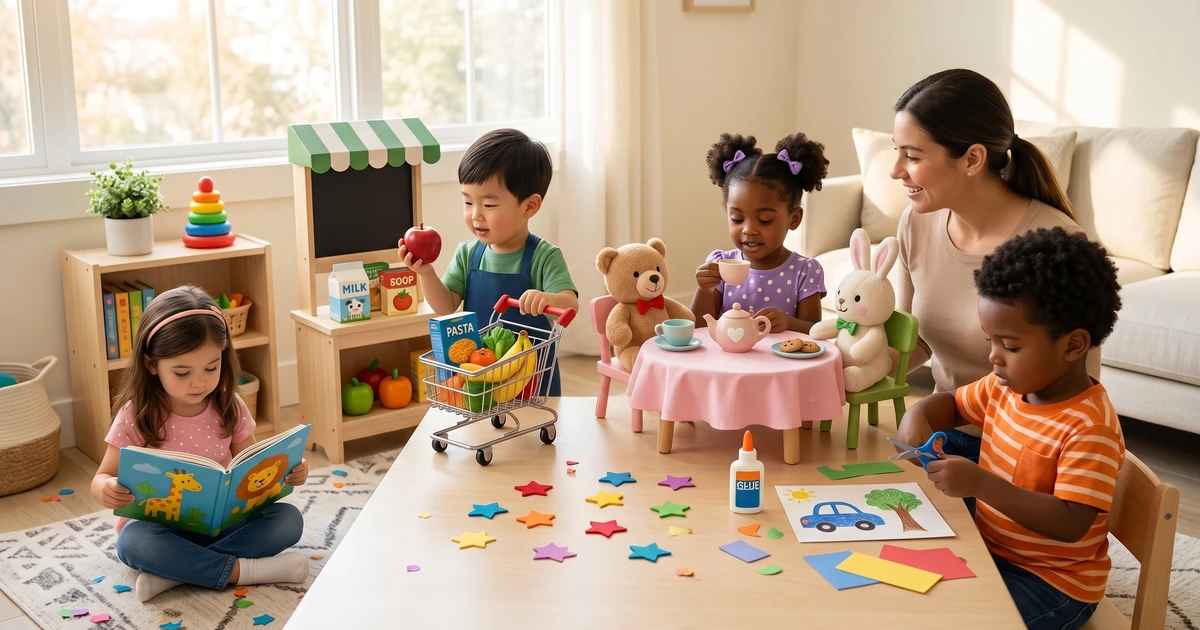
Play Based Preschool Curriculum: Key Elements And Benefits
The term play based preschool curriculum gets used a lot these days, but what does it actually mean in practice? After spending 40+ hours researchi...