

Calm Down Strategies for Parents During Toddler Tantrums
You know that moment. Your toddler is face-down on the grocery store floor, screaming because you got the wrong color cup. Your heart is pounding. Your jaw
!A parent sitting calmly on the floor next to a toddler having a tantrum, breathing deeply

parent calm down strategies tantrums
Recommended products related to this guide.
You know that moment. Your toddler is face-down on the grocery store floor, screaming because you got the wrong color cup. Your heart is pounding. Your jaw is clenched. And some part of your brain is screaming right along with them.
Nobody talks enough about the parent side of tantrums. We have endless advice for kids, but the truth is that parent calm down strategies during tantrums matter just as much as anything you do for your child. You can’t pour from an empty cup, and you absolutely cannot co-regulate a dysregulated child when you’re dysregulated yourself.
I’ve spent a significant amount of time researching this topic, reading through hundreds of parent accounts, early childhood expert recommendations, and behavioral research. What I found surprised me: the most effective parents in tantrum situations weren’t the ones with the most discipline tricks. They were the ones who had a plan for managing their own nervous system first.
Key Takeaways:
- Your nervous system regulation directly affects your child’s ability to calm down
- Physical self-regulation techniques work faster than cognitive ones in the heat of the moment
- Preparation before tantrums happen is more powerful than any in-the-moment tactic
- Visual tools can reduce the mental load on parents during high-stress moments
- You don’t need to be perfectly calm, just calm enough
Why Your Calm Is the Actual Intervention
Children’s brains, especially toddler and preschool brains, are not yet capable of self-regulation. They rely on a process called co-regulation, where a calm adult nervous system literally helps settle their dysregulated one. This is backed by neuroscience, not just parenting philosophy.
“Co-regulation is the support that caregivers provide to help children manage their emotions and behaviors. It’s the foundation from which self-regulation skills develop.” - Center on the Developing Child, Harvard University
When you escalate, your child’s brain registers threat. The cortisol spikes higher. The tantrum intensifies. When you stay regulated (or return to regulation quickly), you create the biological conditions for your child to come down.
This is why parent calm down strategies aren’t just about being “nicer.” They’re the mechanism through which your child’s brain learns to regulate itself over years of repeated experience.
Your calm is the intervention.
The 5 Parent Calm Down Strategies That Work in Real Life
1. The Physiological Sigh (30 Seconds, Works Fast)
Most breathing techniques feel impossible to remember when you’re flooded with adrenaline. The physiological sigh is different because it’s a reflex your body already knows.
Here’s how it works:
- Inhale through your nose until your lungs feel full
- Take a second short inhale to top them off completely
- Exhale slowly and fully through your mouth
The double inhale fully inflates the alveoli in your lungs and the long exhale activates the parasympathetic nervous system. Stanford neuroscientist Andrew Huberman has described this as the fastest known method to reduce physiological arousal.
You can do this while kneeling next to your child. They won’t even notice.
Pro Tip: Practice this technique when you’re calm so it becomes automatic. Your brain needs to have done it before to access it under stress.
2. Name Your Own Emotion Out Loud (But Quietly)
This sounds counterintuitive, but research on emotional regulation consistently shows that labeling an emotion reduces its intensity. The act of putting a word to what you’re feeling shifts processing from the amygdala (reactive brain) to the prefrontal cortex (thinking brain).
You don’t have to announce it dramatically. Under your breath, or even just in your head: “I’m frustrated right now.” That small act of labeling creates just enough distance between the feeling and your response.
Bonus: your child overhears you modeling this, which builds their own emotional vocabulary over time.
3. Drop Your Body Language Before You Change Your Words
Parents often try to think their way to calm, but your body gets there faster. Before you say anything to your child:
-
Drop your shoulders away from your ears
-
Unclench your jaw
-
Lower yourself physically to your child’s level (this also signals safety to their nervous system)
-
Soften your face consciously
Parents who’ve documented their experiences consistently report that changing body language first, before attempting to speak, dramatically reduces the escalation of the situation. Your child reads your posture before they process your words.
4. Give Yourself a “Don’t Do” List
When you’re in fight-or-flight mode, having a short mental list of what NOT to do can be more accessible than remembering a long strategy.
My research suggests the most common parent mistakes that extend tantrums include:
| Action to Avoid | Why It Backfires |
|---|---|
| Raising your voice | Increases the child’s perceived threat level |
| Offering too many words | Overwhelms an already flooded brain |
| Trying to reason logically | Prefrontal cortex is offline during meltdown |
| Taking away comfort items as punishment | Removes co-regulation tools from a dysregulated child |
| Demanding eye contact | Feels aggressive to a scared child |
Keeping this list somewhere visible during high-tantrum phases (like a note on your phone or a card on the fridge) means you don’t have to generate the right response from scratch every time.
5. Have a Signal With Your Co-Parent (If Applicable)
One of the most underused parent calm down strategies is the tag-out. Parents who review this approach almost universally describe it as a “marriage-saver” during toddler years.
Agree on a simple, non-verbal signal that means “I need you to take over right now.” Something like tapping your own shoulder. No explanation needed. The incoming parent steps in, and the overwhelmed parent walks to another room for 90 seconds.
This works because 90 seconds is genuinely enough time for the initial cortisol wave to pass, according to neuroscientist Jill Bolte Taylor’s research on emotional physiology. You don’t need 20 minutes. You need a minute and a half.
What to Do BEFORE Tantrums Happen (This Part Is Often Skipped)
Reactive strategies help, but proactive preparation changes everything. Parents who consistently manage their responses well during tantrums almost always have some kind of system set up in advance.
This is where tools like calm down choice charts come in. When both you and your child know the routine (“when you’re upset, you can try breathing, squeezing something, or drawing how you feel”), the cognitive load on you during a meltdown drops significantly. You’re not improvising. You’re following a known path.
Pro Tip: Visual calm down tools aren’t just for kids. The structured list of options reduces decision fatigue for parents under stress too.
For free printable versions of these visual tools, the Calm Down Choices Free Printable: Downloadable Visuals for Kids resource is a good starting point. Print one for the child’s room and, honestly, one for yourself.
How to Rebuild After You Lose It
You will lose it sometimes. That’s not failure. What matters is the repair conversation afterward.
According to the American Psychological Association, repair after conflict is one of the most important parenting behaviors for attachment security. A rupture followed by a genuine repair actually builds more trust than a smooth interaction with no rupture at all.
A simple repair looks like this:
- Wait until everyone is genuinely calm (not just quiet)
- Get on your child’s physical level
- Name what happened without minimizing it: “I got really upset and I yelled. That wasn’t okay.”
- Reconnect physically if your child is open to it
You don’t need a lengthy apology speech. Short, honest, and warm is more effective.
A Quick Comparison: Reactive vs. Proactive Calm Down Approaches
| Approach | Best For | Effort Required | Effectiveness Over Time |
|---|---|---|---|
| In-the-moment breathing | Immediate de-escalation | Low (once practiced) | High |
| Body language reset | Preventing escalation | Low | High |
| Tag-out signal | Two-parent households | Low to set up | Very high |
| Calm down choice charts | Reducing cognitive load | Medium (set up once) | Very high |
| Repair conversations | Trust and long-term security | Medium | Essential |
| Yelling back | None | Very low | Negative |
For the Full Picture on Teaching Calm Down Strategies
These parent calm down strategies work best when they’re paired with actually teaching your child their own regulation tools. The two systems reinforce each other.
For everything on how to do that, including the science behind it, age-by-age breakdowns, and specific tools, read The Complete Guide to Calm Down Choices: Strategies for Emotional Regulation. It covers the full picture in one place.
If you work with or have preschool-age children, How to Teach Calm Down Choices to Preschool Students has classroom-specific strategies that also translate well to home use.
Frequently Asked Questions
Is it normal to feel angry during my child’s tantrums?
Completely normal. Your nervous system is responding to a perceived threat signal, which is exactly what it’s designed to do. Loud, distressed crying from a child activates stress responses in caregivers across every culture studied. The goal isn’t to stop feeling angry. It’s to have strategies that let you respond rather than react.
How long does it take to get better at staying calm during tantrums?
Most parents who implement consistent strategies report noticeable improvement within 2 to 4 weeks. The first few times feel effortful and mechanical. After consistent practice, the physiological sigh or body language reset becomes more automatic. According to research on habit formation, repeated behavior under similar conditions consolidates into automatic response patterns over roughly 21 to 66 days, depending on complexity.
What if I’m a single parent and I don’t have a co-parent to tag out with?
The tag-out is one tool, not the only one. Single parents often develop strong “safe pause” scripts instead, something like: “I need a moment to calm down. I’m going to stand in the hallway for 60 seconds and then I’ll be right back.” This models regulation, keeps the child safe, and gives you the physiological reset you need. It also requires your child to be in a safe environment (not in danger of hurting themselves) before you step away briefly.
My child’s tantrums feel way more intense than other kids’ meltdowns. Should I be concerned?
Tantrum intensity varies widely and is influenced by temperament, sensory sensitivity, language development, and sleep quality. According to the American Academy of Pediatrics, tantrums are considered typical between ages 1 and 3. If tantrums involve self-harm, occur in children over 5 with high frequency, or significantly disrupt daily functioning, talking to your pediatrician or a child development specialist is a reasonable next step.
Does staying calm mean I’m supposed to ignore the tantrum?
No. Staying calm is not the same as ignoring. You can remain regulated while also staying present, offering comfort when it’s accepted, and holding limits. Ignoring is a specific behavioral strategy with its own research base. Regulation means your emotional state is managed, not that you’re absent.
Ready to go deeper? Read The Complete Guide to Calm Down Choices: Strategies for Emotional Regulation for the full research-backed framework.
Recommended Resources & Workbooks
Pair this guide with our hands-on, ready-to-print learning resources.
 Digital Bundle
Learn to Read Program: Levels 1-3
170 sequenced phonics lessons across 199 pages, from first letter sounds to fluent long-vowel reading.
 Digital Learning Bundle
Preschool Learning Bundle
260+ printable worksheets for tracing, ABCs, numbers, shapes, sight words, and kindergarten prep.
 Digital Learning Bundle
Play-Based Learning Bundle for Ages 3-6
230+ play-based learning activities with pretend play, reading, early math, creative arts, and bonus flashcards.
Related Guides & Articles
Explore more of our detailed guides and activities.
The Complete Guide to Calm Down Choices: Strategies for Kids
Every person, regardless of age, has moments when emotions feel too big to manage. Big feelings, meltdowns, anxiety spirals, and emotional overwhel...

Calm Down Choices for Adult Anxiety: What Works Best
Adults don't always get the same structured emotional support that children receive in schools and therapy programs. Yet the need for calm down cho...
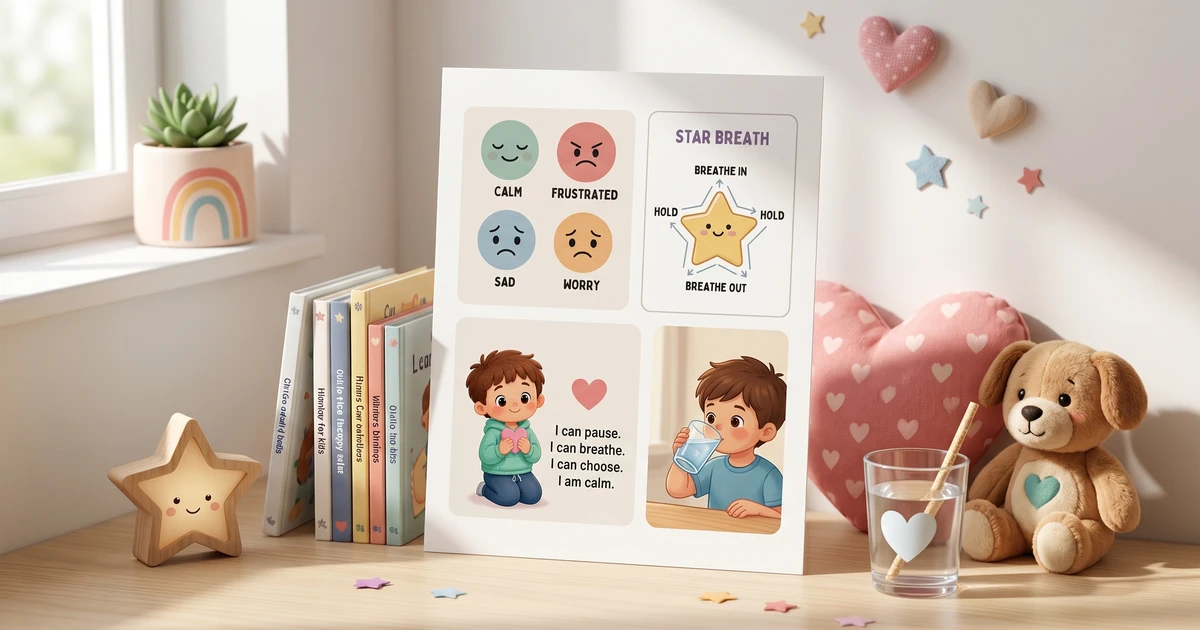
Calm Down Choices Free Printable: Downloadable Visuals for Kids
Finding a calm down choices free printable that actually works in the real world, whether you're a teacher with 25 kids in a classroom or a parent ...
How to Teach Calm Down Choices to Preschool Students
Preschoolers are emotional volcanoes. One moment they're happily building a block tower, and the next they're on the floor, inconsolable because th...