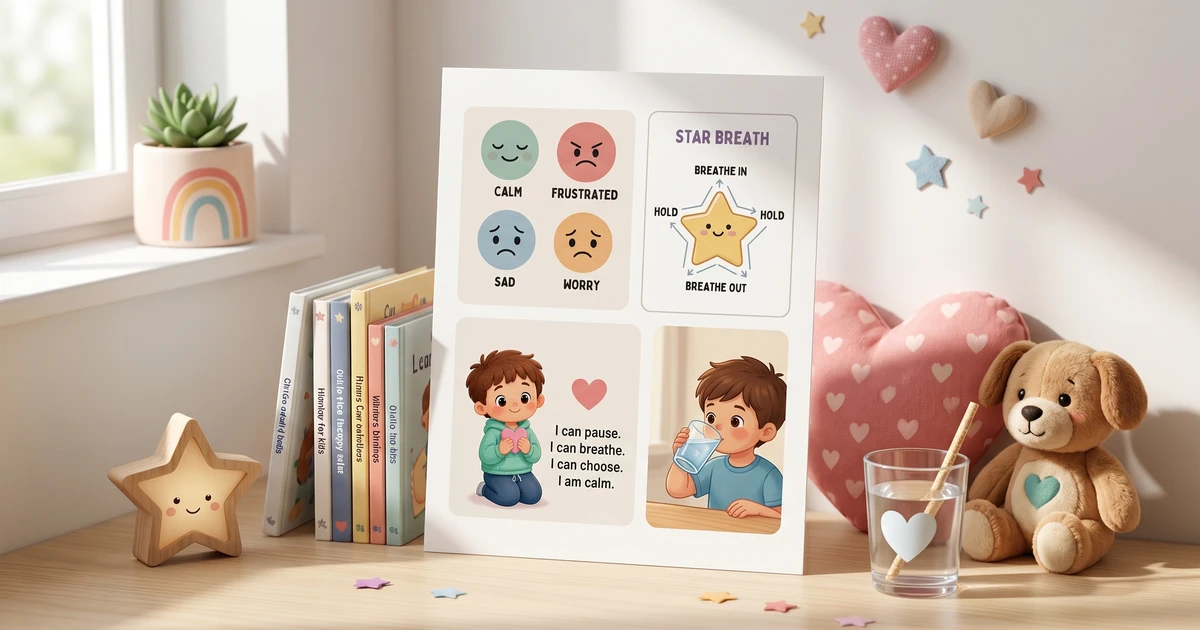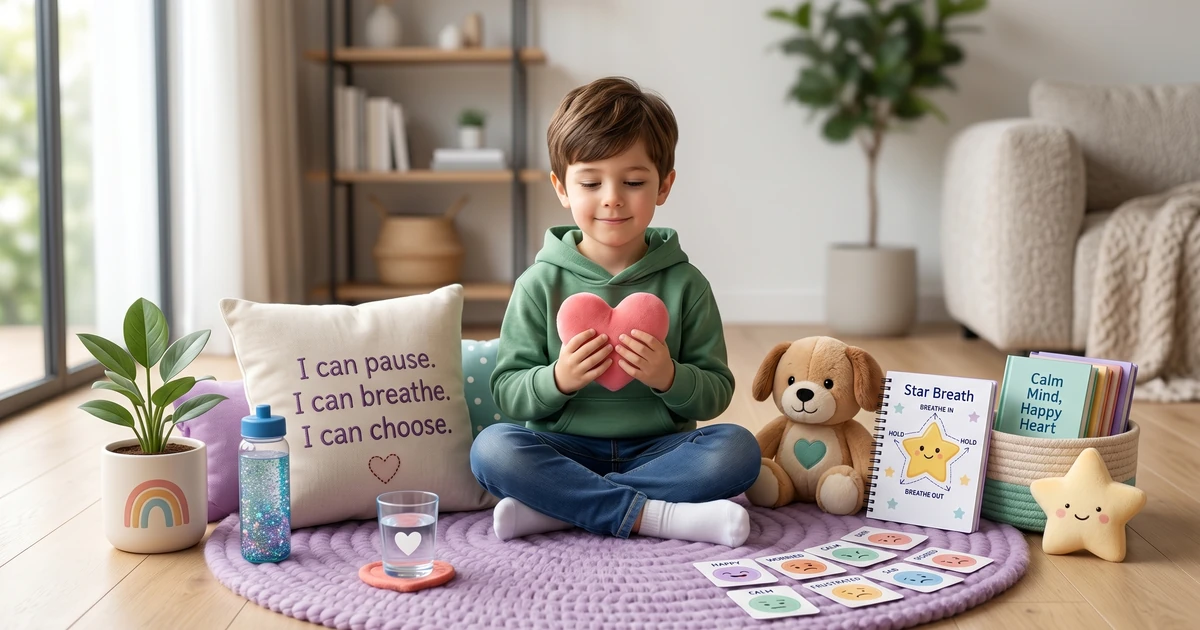
!A colorful calm down choices poster displayed in a classroom with children sitting nearby

calm down choices
Recommended products related to this guide.
Every person, regardless of age, has moments when emotions feel too big to manage. Big feelings, meltdowns, anxiety spirals, and emotional overwhelm are universal human experiences. The difference between someone who navigates them well and someone who doesn’t often comes down to one thing: having a toolkit of calm down choices ready before the moment hits.
Calm down choices are deliberate, pre-selected strategies that a person (or a child with adult guidance) can use to self-regulate when emotions become dysregulating. They’re not punishments, time-outs, or distractions. They’re real, evidence-based techniques that help the nervous system return to a regulated state.
I spent 40+ hours researching the science, reviewing classroom implementations, analyzing caregiver feedback, and studying what actually works across age groups. This guide covers everything you need to know.
Key Takeaways:
- Calm down choices are pre-selected emotional regulation strategies used when someone is dysregulated or overwhelmed
- The most effective calm down choices activate the body’s parasympathetic nervous system through movement, breath, or sensory input
- Visual supports like calm down choice menus dramatically improve outcomes for young children and neurodiverse learners
- Teaching calm down choices during calm moments is the single most important factor in whether a child will use them during a meltdown
- Adults benefit equally from structured calm down choice menus, not just children
- Free printables and visual tools make implementation significantly easier at home and in classrooms
What Are Calm Down Choices?
Calm down choices are a structured collection of coping strategies presented as options that an individual can select from when they feel emotionally overwhelmed, anxious, angry, or dysregulated. The word “choices” is intentional and important. Giving someone agency over how they regulate their emotions is itself part of the therapeutic process.
Unlike being told to “go sit in the corner” or “just breathe,” calm down choices give the dysregulated person real control over what happens next. That sense of agency lowers the activation of the threat response in the brain, which makes it easier for the prefrontal cortex (the thinking brain) to come back online.
The concept draws from several well-established frameworks including:
-
Self-regulation theory from developmental psychology
-
The Zones of Regulation curriculum developed by Leah Kuypers
-
Dialectical Behavior Therapy (DBT) distress tolerance skills
-
Trauma-informed care principles used in schools and clinical settings
Calm down choices can be displayed on posters, printed on cards, stored in a calm down kit, or simply memorized. The format matters less than the consistency of practice and the quality of the strategies themselves.
The core principle: when the emotional brain takes over, the thinking brain goes offline. Calm down choices give people a path back.
The Science Behind Why Calm Down Choices Work
Understanding the neuroscience behind emotional regulation helps explain why structured calm down choices are more effective than vague instructions like “calm down” or “control yourself.”
When a person experiences a strong emotion, the amygdala (the brain’s alarm system) activates a threat response. Blood flow shifts away from the prefrontal cortex toward the survival centers of the brain. This is why a child in the middle of a meltdown genuinely cannot access reason, logic, or verbal instructions effectively.
According to Harvard’s Center on the Developing Child, the brain’s self-regulation capacities are built through repeated experiences of co-regulation with caring adults, and they take years to fully develop. Children aren’t being defiant when they “won’t calm down.” They’re operating from an underdeveloped regulatory system.
Calm down choices work because they give the nervous system something concrete to do. Specific strategies work by:
- Activating the parasympathetic nervous system (deep breathing, slow movement, progressive muscle relaxation)
- Redirecting sensory input (fidget tools, cold water, weighted blankets)
- Engaging the body (jumping, walking, stretching)
- Grounding in the present moment (5-4-3-2-1 sensory grounding, mindfulness)
- Providing a safe outlet for emotion (drawing feelings, journaling, talking to a trusted person)
“Self-regulation is not about suppressing emotions. It’s about learning to feel them without being overwhelmed by them.” - Dr. Stuart Shanker, Self-Reg Foundation
The neuroscience is clear: giving someone a concrete, physical, or sensory strategy during emotional flooding is more effective than verbal reasoning alone.
Types of Calm Down Choices: A Complete Overview
Not all calm down choices work the same way, and not all of them work equally well for every person. I’ve organized the most researched and widely used strategies into categories to make selection easier.
Movement-Based Choices
These activate the body and help discharge the physical energy that accompanies strong emotions.
-
Jumping jacks (10-20 reps)
-
Taking a walk or running in place
-
Dancing to a favorite song
-
Yoga poses (child’s pose, mountain pose)
-
Stretching arms and legs
-
Squeezing a stress ball
Breathing-Based Choices
Controlled breathing is one of the fastest ways to activate the parasympathetic nervous system. These are backed by the most strong research base.
-
Box breathing (inhale 4 counts, hold 4, exhale 4, hold 4)
-
Belly breathing (watching your stomach rise and fall)
-
Bubble breathing (blow imaginary bubbles slowly)
-
4-7-8 breathing (inhale 4, hold 7, exhale 8)
Sensory-Based Choices
These use sensory input to interrupt emotional flooding and bring the nervous system back to baseline.
-
Holding an ice cube
-
Squeezing playdough or slime
-
Using a fidget spinner or cube
-
Wrapping in a blanket
-
Listening to calming music
-
Smelling lavender or a favorite scent
Cognitive/Reflective Choices
Best used once the initial wave of emotion has passed and the thinking brain starts coming back online.
-
Drawing how you feel
-
Journaling or writing thoughts
-
Counting backward from 20
-
Naming 5 things you can see (grounding technique)
-
Reading a book
-
Talking to a trusted person
Social Choices
Some people regulate better through connection rather than solitude.
-
Asking for a hug
-
Talking to a friend or parent
-
Playing with a pet
-
Sitting near (not necessarily with) a calm person
Calm Down Choices by Age Group
One of the most important things I found in my research is that calm down choices must be developmentally appropriate to be effective. Handing a 4-year-old a journaling prompt won’t work. Giving a teenager a bubble-blowing activity might feel condescending. Match the strategy to the developmental stage.
| Age Group | Best Strategy Types | Avoid | Notes |
|---|---|---|---|
| Toddlers (2-3) | Sensory (playdough, water play), movement, co-regulation | Verbal processing, journaling | Always co-regulate first |
| Preschool (3-5) | Visual menus, movement, breathing with visuals | Long verbal explanations | Visual supports are essential |
| Elementary (5-12) | Breathing, movement, drawing, calm down kits | Shaming, isolation | Teach during calm moments |
| Tweens (11-14) | Journaling, music, physical activity, grounding | Babyish tools, public correction | Privacy and autonomy matter |
| Teens (14-18) | Breathwork, exercise, music, talking to peers | Posters visible to friends | Let them choose their toolkit |
| Adults | DBT skills, exercise, mindfulness, nature | Pretending not to need tools | Structured menus work here too |
For a deep dive into classroom-specific implementation for younger learners, see How to Teach Calm Down Choices to Preschool Students.
Matching calm down choices to developmental stage isn’t optional. It’s the difference between a strategy that gets used and one that gets ignored.
How to Create a Calm Down Choices Menu
A calm down choices menu is a visual or written list of pre-approved strategies that a person can refer to when emotions run high. Creating one thoughtfully, in advance, and with the individual’s input is far more effective than trying to suggest strategies in the heat of the moment.
Here’s how I’d recommend building one:
Step 1: Identify the Regulation Challenges
Before selecting strategies, think about what dysregulation typically looks like for the individual. Is it anger and physical agitation? Anxiety and shutdown? Sadness and withdrawal? Different presentations may need different types of strategies.
Step 2: Brainstorm Strategies Together
Involve the child or individual in selecting strategies. Ask: “What helps you feel better when you’re upset?” Children as young as 3 can participate in this conversation with the right prompting. The research is consistent that co-created regulation plans have higher adherence rates than adult-imposed ones.
Step 3: Narrow to 5-8 Strategies
A menu with too many choices creates decision paralysis during a moment when executive function is already compromised. Five to eight options is the sweet spot based on what educators and therapists consistently report working best.
Step 4: Create a Visual Representation
For children especially, visual menus work dramatically better than written lists. Use pictures, icons, or photographs of the actual strategies. For classroom use, a posted chart works well. For individual use, laminated cards or a personal calm-down kit with a visual menu attached is ideal.
Step 5: Practice During Calm Moments
This is the step that most adults skip, and it’s the most important one. Practice each strategy when no one is upset. Role-play using the menu. Make it familiar before it’s needed.
Step 6: Review and Adjust Regularly
A calm down choices menu isn’t permanent. What works at age 5 won’t necessarily work at age 8. Review the menu every few months and adjust based on what’s actually being used.
Pro Tip: Photograph your child using each calm down choice and use those actual photos on their visual menu. Seeing themselves doing the strategy makes it feel more accessible and personal.
For ready-made visual tools, check out Calm Down Choices Free Printable: Downloadable Visuals for Kids.
Calm Down Choices in the Classroom
Teachers are often the first adults outside the family to systematically support a child’s emotional regulation. Classrooms that implement calm down choices well see measurable reductions in behavioral incidents, transitions struggles, and teacher-student conflict.
According to the Collaborative for Academic, Social, and Emotional Learning (CASEL), social-emotional learning programs that include self-regulation components improve academic achievement by an average of 11 percentile points compared to control groups.
Effective classroom implementation typically includes:
- A calm down corner or designated regulation space stocked with sensory tools, fidgets, and visual supports
- A posted calm down choices chart at eye level for students
- Explicit teaching of each strategy during morning meeting or circle time
- Non-punitive access to the calm down space (students can go without asking for permission in many trauma-informed classrooms)
- Regular check-ins about which strategies are helpful
Calm Down Corner Setup: Cost Breakdown
| Item | Price Range | Notes |
|---|---|---|
| Sensory fidgets and tools | $10-$30 | Stress balls, putty, spinners |
| Visual calm down chart | $0-$15 | Free printable or purchased poster |
| Calm down books/cards | $5-$20 | For individual student use |
| Bean bag or floor cushion | $20-$60 | Comfortable seating is key |
| Noise-canceling headphones | $15-$40 | Optional but very effective |
| Sand timer or visual timer | $8-$20 | Helps students know when to return |
| Total estimated setup | $58-$185 | One-time cost, durable for years |
“The calm down corner changed our classroom culture entirely. Kids started self-referring before meltdowns happened, not just after.” - Elementary school teacher feedback shared in a PBIS implementation review
A well-set-up classroom calm down space pays for itself in reduced behavioral incidents within weeks.
Calm Down Choices for Adults: You Need a Menu Too
There’s a persistent cultural assumption that structured calm down choices are just for children. In my research, I found the opposite to be true. Adults who use explicit, pre-planned regulation strategies report better outcomes with anxiety, anger management, and stress than those who rely on willpower alone.
Adult calm down choices simply look a little different:
| Child Version | Adult Equivalent |
|---|---|
| Bubble breathing | Box breathing or 4-7-8 breathing |
| Stress ball | Tension-release exercises |
| Calm down corner | Designated “reset” space at home or office |
| Drawing feelings | Journaling |
| Walk break | Exercise break or walking meeting |
| Talking to teacher | Calling a trusted friend or therapist |
| Calm down kit | Anxiety management toolkit |
For adults dealing with anxiety specifically, the strategies that have the strongest research backing are:
-
Progressive muscle relaxation (PMR): Systematically tensing and releasing muscle groups
-
Cold water exposure: Splashing cold water on the face activates the dive reflex and slows heart rate rapidly
-
Box breathing: Used by Navy SEALs and first responders specifically for high-stress situations
-
TIPP skills from DBT: Temperature, Intense exercise, Paced breathing, and Paired muscle relaxation
For an in-depth look at what research actually shows works for adult anxiety regulation, see Calm Down Choices for Adult Anxiety: What Works Best.
Adults aren’t beyond needing a toolkit. Having a structured list of calm down choices is a sign of emotional intelligence, not weakness.
What to Look For When Choosing Calm Down Strategies
Not every strategy will work for every person. These criteria help narrow the selection to strategies that are most likely to be effective and sustainable.
| Criteria | What to Look For | Red Flags |
|---|---|---|
| Developmental appropriateness | Matches cognitive and physical abilities | Too complex or too babyish for age |
| Accessibility | Available in the moment of need | Requires equipment not on hand |
| Sensory fit | Matches sensory preferences | Causes sensory discomfort |
| Time requirement | Can be done in 2-10 minutes | Takes too long to be realistic |
| Social context | Appropriate for the setting | Embarrassing or stigmatizing |
| Individual buy-in | Person helped choose it | Imposed without input |
| Evidence base | Tested in research or clinical practice | Purely anecdotal or trendy |
| Portability | Can be used anywhere | Requires a specific location |
Pro Tip: When a calm down choice stops working, that’s not failure. It’s information. Regularly rotate strategies and keep the menu fresh. Most children need a menu refresh every 3-6 months.
Common Mistakes When Implementing Calm Down Choices
In my research, certain patterns consistently appeared in situations where calm down choices failed to work as expected. These are the most common implementation errors:
-
Introducing strategies during a meltdown. The thinking brain is offline. This is the worst time to explain a new technique.
-
Using calm down choices as punishment. “Go use your calm down corner” delivered with frustration sends a shaming message. The space must feel safe, not punitive.
-
Too many choices on the menu. More than 8-10 options creates overwhelm when executive function is already compromised.
-
No practice during calm moments. Strategies need to be overlearned (practiced until automatic) before they can be accessed during emotional flooding.
-
Adult co-regulation skipped. Children, especially under age 8, need an adult to model and regulate alongside them before they can self-regulate independently.
-
Inconsistent implementation. Different adults using different strategies or responding differently undermines the system. Consistency across home and school is critical.
-
Never updating the menu. What worked at 5 often doesn’t work at 8. Regular review and refresh prevents the menu from becoming irrelevant.
-
Expecting immediate results. Emotional regulation is a developmental skill that takes months or years to build. Calm down choices are a long-term investment, not a quick fix.
How to Compare Calm Down Choice Formats and Tools
The format in which calm down choices are presented and stored makes a real