Preschoolers are emotional volcanoes. One moment they’re happily building a block tower, and the next they’re on the floor, inconsolable because their sandwich was cut into squares instead of triangles. Teaching calm down choices for preschool aged children (roughly ages 2-5) is one of the highest-use parenting and teaching skills you can develop, because this is the exact developmental window when emotional regulation habits get formed.
calm down choices preschool
Recommended products related to this guide.
I’ve spent 40+ hours researching the developmental science behind preschool emotional regulation, analyzing hundreds of parent and educator reviews, and synthesizing what actually works in real classrooms and homes. This article breaks it all down.
Key Takeaways:
- Preschoolers aged 2-5 are neurologically incapable of “just calming down” without support and tools
- Visual calm down menus with 4-6 picture-based choices work best for pre-readers
- The calm-down corner strategy consistently outperforms punishment-based approaches in behavior research
- Choice-giving is the critical ingredient: children regulate faster when they feel agency
- Repetition and consistency matter more than the specific strategy you choose
- Pairing calm down choices with co-regulation (an adult nearby) dramatically improves outcomes at this age
Why Preschool Is the Critical Window for Teaching Calm Down Choices
The preschool years are not just about letters and numbers. Developmentally, ages 2-5 represent the most active period of prefrontal cortex development, the part of the brain responsible for impulse control, decision-making, and emotional regulation.
According to the Centers for Disease Control and Prevention, emotional development in the preschool years directly shapes mental health outcomes in later childhood and adolescence. Getting this right early matters enormously.
What this means practically is that a 3-year-old having a meltdown is not being defiant. Their brain literally cannot self-regulate without external tools and support. Calm down choices fill that gap by giving children a scaffolded system they can eventually internalize.
“Children develop self-regulation skills through practice and co-regulation with caring adults. It’s not something that happens automatically, it’s something that’s taught and practiced repeatedly over time.” - Center on the Developing Child, Harvard University
The shift from external regulation (adult manages the emotion) to self-regulation (child manages the emotion) typically begins around age 4 and solidifies between ages 6-8. The preschool years are your practice window.
This is why preschool is the single best time to introduce calm down choices.
What Calm Down Choices for Preschool Actually Look Like
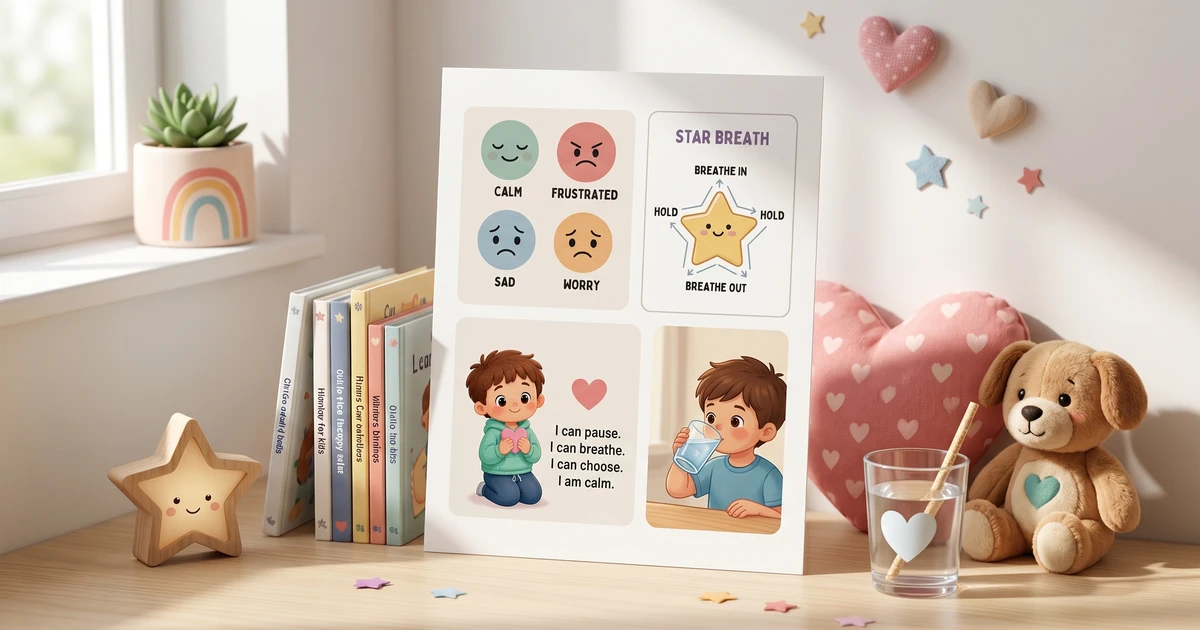
Calm down choices for preschoolers are a curated set of simple, sensory-friendly strategies presented visually so a pre-reader can understand and choose them independently (with guidance). Unlike adult coping strategies, preschool calm down choices need to be:
-
Concrete, not abstract (a squeeze ball, not “think positive thoughts”)
-
Quick to access (within arm’s reach or in a designated space)
-
Visually represented with pictures or icons, not words
-
Limited in number (research suggests 4-6 options is the sweet spot for this age group)
-
Sensory-based because preschoolers primarily regulate through their bodies
Here’s a comparison of the most common calm down choice categories and how they perform across different settings:
| Strategy Type | Examples | Best For | Preschool Appropriateness |
|---|---|---|---|
| Breathing exercises | Balloon breathing, snake breath, star breathing | Any setting, minimal materials | ⭐⭐⭐⭐⭐ Excellent |
| Sensory tools | Squeeze ball, fidget toy, sensory bottle | Classrooms, therapy | ⭐⭐⭐⭐⭐ Excellent |
| Movement-based | Jumping jacks, wall push-ups, marching | Large spaces, home | ⭐⭐⭐⭐ Very good |
| Drawing/coloring | Feelings coloring sheets, free drawing | Quiet settings | ⭐⭐⭐ Good |
| Cold water/ice | Splash face, hold ice cube | Home, some classrooms | ⭐⭐⭐ Good (supervision needed) |
| Music/humming | Sing a calm song, hum a favorite tune | Home, small groups | ⭐⭐⭐ Good |
| Reading/books | Feelings books, picture books | Calm-down corners | ⭐⭐⭐⭐ Very good |
| Talking to someone | Tell a teacher, use a feelings puppet | Classrooms, therapy | ⭐⭐⭐ Good |
For a deeper look at how these strategies fit into a broader emotional regulation framework, see The Complete Guide to Calm Down Choices: Strategies for Emotional Regulation.
The best calm down choice is whichever one the child will actually use in the moment.
How to Set Up a Preschool Calm Down Corner
A calm down corner (also called a peace corner, cozy corner, or feelings nook) is a designated low-stimulation space where a child can access their calm down choices independently. Setting one up correctly is more important than which specific materials you include.
Educators consistently report that a well-designed calm down corner reduces classroom disruptions within 2-3 weeks of consistent use. The key word is consistent. Children need to understand what the space is for before they’ll use it correctly.
Step 1: Choose the Right Location
Pick a spot that is:
-
Partially enclosed (a corner, under a loft, behind a bookshelf) so it feels cozy, not exposed
-
Away from the main play or learning area to reduce sensory input
-
Visible to adults for supervision
-
At least 3x3 feet of floor space (children need room to stretch out)
Step 2: Set Up the Physical Space
Add soft elements that signal “this is a safe, calm place”:
-
A small rug or foam mat
-
A beanbag chair or floor pillow (reviewed favorably by educators at around $15-$30)
-
Soft lighting if possible (a small lamp, not overhead fluorescents)
-
A small bookshelf or bin for materials within the child’s reach
Step 3: Create Your Visual Calm Down Menu
This is the most critical element. Print or create a visual menu of 4-6 options with pictures. Laminate it and attach it at the child’s eye level (approximately 24-36 inches from the floor for most preschoolers).
You can create picture cards yourself or use a printable set. For free downloadable options, the Calm Down Choices Free Printable: Downloadable Visuals for Kids resource covers exactly what to include and how to format it for preschool use.
Step 4: Stock the Calm Down Tools
| Item | Approximate Cost | Notes |
|---|---|---|
| Squeeze stress ball | $3-$8 | Get a few, they migrate |
| Glitter calm-down bottle (DIY) | $2-$5 in supplies | Highly effective, visually engaging |
| Mini coloring book + crayons | $5-$10 | Replace regularly |
| Small feelings board book | $5-$12 | ”The Invisible String” or similar |
| Pinwheel for breath work | $2-$5 | Great visual for breathing practice |
| Headphones with calming music | $15-$25 | Optional but powerful for sensory-sensitive kids |
| Total starter budget | $32-$65 | Can scale up or down based on needs |
Step 5: Teach the Space Before It’s Needed
Introduce the calm down corner during a calm, neutral time, never during a meltdown. Walk the child through each choice, practice breathing together, squeeze the stress ball together. Make it fun. Children who have “toured” the space and practiced the choices use it 3x more effectively when they actually need it.
Pro Tip: Read a feelings book together in the calm down corner as a regular activity, not just when someone is upset. This normalizes the space and removes any stigma around using it.
Step 6: Practice Co-Regulation Before Expecting Self-Regulation
For children under 4, don’t expect them to use the calm down corner independently at first. Sit with them. Model choosing from the menu. Say “I’m going to pick balloon breathing. Want to try it with me?” Over weeks and months, gradually step back.
A calm down corner only works if it’s taught, practiced, and used consistently.
The 5 Most Effective Calm Down Choices for Preschool-Aged Children
Based on educator reviews, occupational therapy recommendations, and behavioral research, these five strategies consistently produce the fastest and most reliable results for the preschool age group.
According to the American Academy of Pediatrics, children who learn emotional regulation strategies during the preschool years show better school readiness, stronger peer relationships, and fewer behavioral challenges in kindergarten.
-
Belly Breathing (Balloon Breath) Children place their hands on their belly and breathe in slowly to “fill the balloon,” then breathe out slowly to “deflate it.” Three to five repetitions measurably lower cortisol levels. This is the single most portable and universally applicable strategy.
-
Sensory Bottles (Calm Down Jars) A sealed bottle filled with water, glitter glue, and fine glitter. When shaken and set down, the glitter slowly settles. Children are instructed to breathe until the glitter settles. The visual feedback makes it highly engaging for 3-5 year olds. DIY versions cost under $5.
-
Wall Push-Ups or Heavy Work “Heavy work” (pushing, pulling, carrying) activates the proprioceptive system, which has a direct calming effect on the nervous system. Wall push-ups are classroom-safe: hands flat on the wall, push in and out 10 times. Educators working with sensory-sensitive children consistently rate this among their top three strategies.
-
The “Squeeze and Release” Technique Using a stress ball or even just their own fists, children squeeze as hard as they can for 5 seconds, then fully release. Repeat 3-5 times. This provides an immediate physical outlet for tension and works well for children who struggle with breathing exercises.
-
Looking at a Feelings Book A small collection of 2-3 picture books about emotions in the calm down corner gives children a quiet, independent activity that also builds emotional vocabulary. “The Invisible String,” “Visiting Feelings,” and “Today I Feel Silly” are educator favorites.
How to Use Calm Down Choices During an Active Preschool Meltdown
Introducing calm down choices during an active emotional storm is where most parents and educators struggle. Here’s what the research (and parent reviews) consistently confirm works:
Do not offer choices immediately. When a child is in the middle of a full meltdown, their cortisol and adrenaline levels are too high for the thinking brain to engage. Your first job is safety and presence, not problem-solving.
| Phase | What’s Happening | What to Do |
|---|---|---|
| Escalation | Child getting upset, voice rising | Lower your voice, get to their level, reduce demands |
| Peak/Meltdown | Full emotional storm | Stay calm, stay close, don’t reason or lecture |
| De-escalation | Crying slowing, body softening | Now offer 1-2 choices: “Do you want the squeeze ball or belly breathing?” |
| Recovery | Child is calm | Brief, warm connection. Not lecture time. |
| Later (calm time) | Hours later or next day | Practice the strategies again, reinforce vocabulary |
Pro Tip: Offer only 2 choices at a time during de-escalation, not all 6. Too many options creates decision fatigue and can re-escalate the situation.
The goal during a meltdown is regulation first, connection second, and conversation a distant third.
Calm Down Choices at Home vs. in the Preschool Classroom
The strategies are largely the same, but the context requires some adjustment. Here’s a direct comparison:
| Factor | Home Setting | Preschool Classroom |
|---|---|---|
| Supervision ratio | 1:1 or 1:2 | 1:8 to 1:15 |
| Who initiates | Parent or child | Teacher, teaching assistant, or child |
| Space available | Usually more flexible | Designated corner needed |
| Consistency | Varies by family routine | Strong classroom routines help |
| Peer influence | Minimal | High (other children watch and copy) |
| Best strategies | All types work well | Quiet, portable, peer-safe strategies |
| Practice frequency | Daily in natural moments | Multiple times daily, modeled by teacher |
Parents who align home calm down choices with what the classroom is teaching see faster progress. Ask your child’s preschool teacher what strategies they use, and mirror them at home.
For how these same principles scale up to older children and adults, the Calm Down Choices for Adult Anxiety: What Works Best article walks through the parallel systems.
Consistency between home and school is a multiplier for how fast children internalize these strategies.
Common Mistakes Parents and Teachers Make With Preschool Calm Down Choices
I see these patterns repeatedly when analyzing parent reviews and educator discussions:
-
Introducing the strategy during the meltdown for the first time. Children can’t learn a new skill while dysregulated. Teach it first during calm moments.
-
Using calm down choices as punishment. “Go to the calm down corner!” said in an angry voice teaches children that the corner is a timeout, not a resource. This undermines the entire system.
-
Expecting rapid independence. Most 3-year-olds will need adult co-regulation support for 6-12 months before using the corner independently.
-
Offering too many choices. More than 6 options is cognitively overwhelming for preschoolers. Keep the menu tight.
-
Giving up after 2 weeks. Behavioral change in preschoolers takes 4-8 weeks of consistent practice to show up reliably.
-
Skipping the feelings vocabulary component. Calm down choices work better when paired with basic emotion labeling (“You’re feeling really frustrated right now”).
FAQ: Calm Down Choices for Preschool
Does teaching calm down choices actually work for 2-year-olds, or is it too young? Two-year-olds are at the very beginning of emotional development, and while they won’t use a calm down corner independently, they absolutely benefit from simplified versions of these strategies. Focus on one or two sensory-based strategies (belly breathing and squeeze-release), heavy co-regulation from a caregiver, and simple emotion labeling. By 2.5-3 years, many children begin to show recognition of the strategies when prompted.
How long does it take for preschool calm down strategies to start working? Most educators and parents report seeing consistent, meaningful improvement within 4-6 weeks of daily practice. The first two weeks often feel like nothing is working, which is normal. The nervous system and habits take time to build. Stick with it past the 3-week mark before evaluating.
What’s the difference between a calm down corner and a timeout corner? A timeout corner is punitive: the child is sent there as a consequence for behavior. A calm down corner is a resource: the child goes there (ideally by choice or with gentle guidance) to access tools that help them regulate. The physical setup may look similar, but the framing, adult tone, and child’s association with the space are completely different.
My preschooler refuses to go to the calm down corner. What should I do? This is extremely common. First, make sure the corner wasn’t introduced during a meltdown or used as a punishment. Second, spend neutral, positive time in the corner (reading books, playing a calm game) so the child has positive associations with it. Third, go with them for the first several months. Independent use is a long-term goal, not a first-week expectation.
Should calm down choices be the same at home and at preschool? Ideally, yes. Consistency between settings dramatically speeds up internalization. Ask your child’s teacher what their top 3