
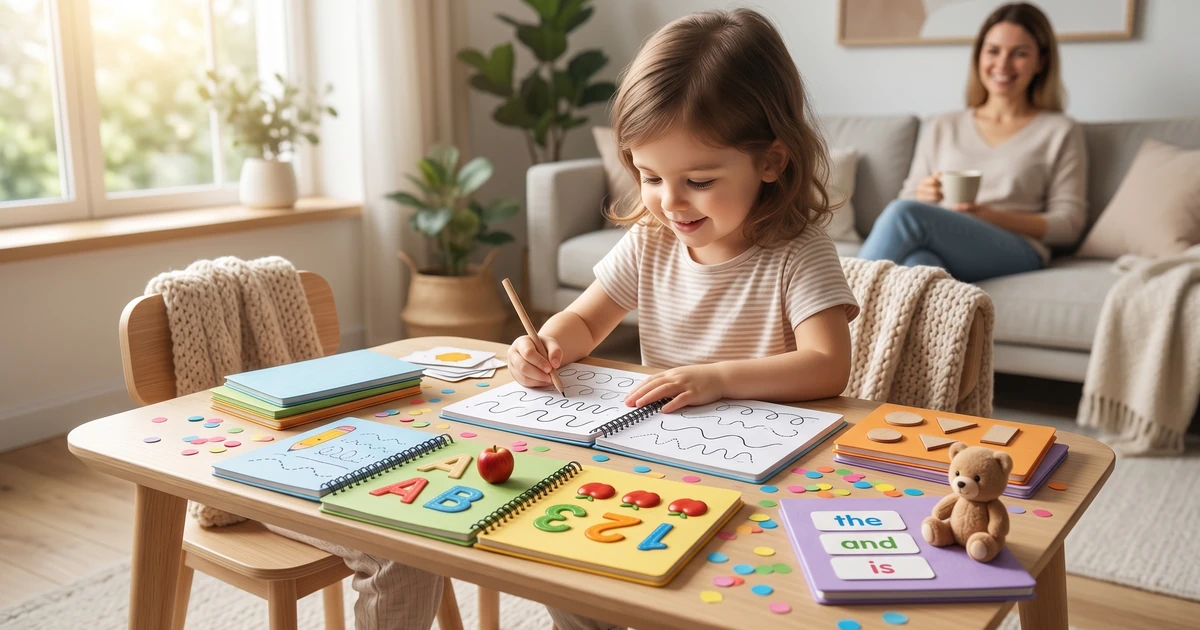
The quiet time kit that made my preschooler ask for 'worksheet time'
You finally sit down. Maybe it's after lunch, or during the baby's nap, or just a 30-minute window where you desperately need your preschooler to be indepe

You finally sit down. Maybe it’s after lunch, or during the baby’s nap, or just a 30-minute window where you desperately need your preschooler to be independently occupied. You’ve set them up with something. Crayons, a puzzle, a coloring book. Three minutes later, they’re standing next to you. “Mommy, I’m bored.” “Daddy, what’s this?” “Can I watch TV?”
DISCOVERY ACTIVITY WORKBOOKPhonics Reading Lesson Guide Level 1
67 pages with 60 short phonics lessons covering all short vowels, V-C patterns, CVC words, and early sentences.
If this sounds familiar, you’re not alone. Getting a 3 or 4-year-old to sustain independent activity for even 20 minutes feels like a small miracle most days. The good news? It’s not about your child’s attention span. It’s usually about the structure of what they’re doing.
I’ve spent a lot of time researching what actually works for quiet time at the preschool age, combing through parent forums, early childhood educator recommendations, and product reviews from thousands of families. What I found surprised me: the parents who consistently report successful quiet time aren’t using more expensive toys or longer screen time. They’re using quiet time kits built around simple, structured printable worksheets.
Here’s what I learned.
Key Takeaways:
- Quiet time for preschoolers works best when activities have a clear start and end
- Printable worksheets outperform open-ended toys for sustained independent engagement in the 3-5 age range
- The best quiet time kit preschool worksheets combine multiple skill areas (tracing, coloring, matching, cutting) so kids don’t get bored
- Rotation is key: swap worksheets every few days to keep novelty high
- You don’t need to spend a lot to build a solid kit, but organization matters more than quantity
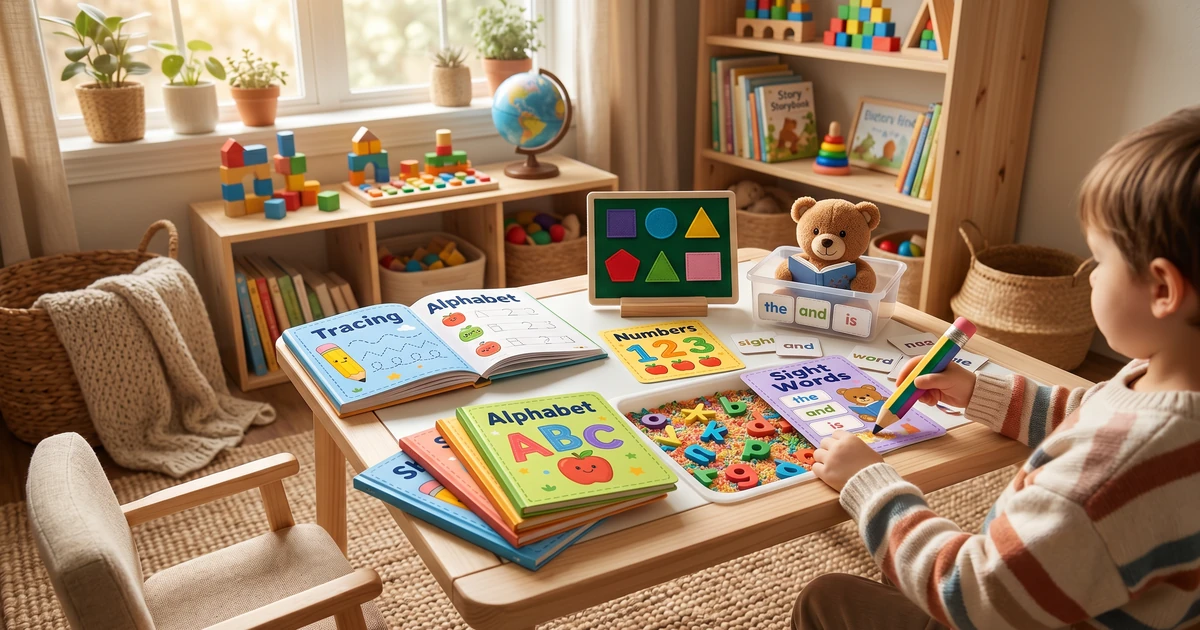
!A preschooler sitting at a small table working on colorful printable worksheets during quiet time
Why Preschoolers Struggle With Independent Quiet Time
Before we talk solutions, it helps to understand what’s actually going on developmentally. Children between ages 3 and 5 are in a stage where self-directed play is still a skill they’re actively building, not something they arrive at automatically.
According to the American Academy of Pediatrics, preschoolers thrive with predictable routines and clear expectations. When quiet time feels undefined, “go play” isn’t actually a direction a 3-year-old can act on independently for long.
The other factor? Open-ended activities require more executive function than most preschoolers have yet. A blank piece of paper and a crayon asks the child to generate their own idea, sustain motivation, and execute it alone. That’s a lot. A worksheet with a clear prompt (trace these letters, color the shapes, draw a line to match the animals) removes that cognitive load and lets the child focus on doing rather than deciding.
“Children this age need scaffolded independence. The activity should have enough structure that the child knows what success looks like, but enough freedom that they feel creative ownership.” - Early Childhood Education Research, National Association for the Education of Young Children (NAEYC)
The fix isn’t less freedom. It’s better scaffolding.
What Actually Goes Inside a Quiet Time Kit for Preschoolers
A quiet time kit is a curated set of activities a child can access and complete independently during a designated rest or quiet period. The printable worksheet version is popular because it’s low-cost, easy to refresh, and doesn’t require batteries, WiFi, or supervision.
Here’s what parents consistently report works best in a preschool quiet time kit:
| Activity Type | Why It Works | Recommended Age |
|---|---|---|
| Alphabet tracing sheets | Clear start/end, builds pencil grip | 3-5 |
| Number recognition pages | Visual matching keeps attention | 3-5 |
| Color-by-code worksheets | Combines coloring + learning | 4-5 |
| Cut-and-paste activities | Physical engagement extends time-on-task | 4-5 |
| Shape and pattern matching | Low frustration, high satisfaction | 3-4 |
| Simple mazes | Problem-solving without reading | 3-5 |
| Dot-to-dot pages | Sequential, self-correcting | 4-5 |
The variety is the point. A quiet time kit that only has one type of activity will get stale fast. The families who report the longest successful quiet time sessions (we’re talking 30-45 minutes) rotate between 3-4 activity types per session.
Variety within structure is the sweet spot.
How to Set Up a Quiet Time Kit That Your Preschooler Will Actually Use
This is where I see most parents go wrong. They print a stack of worksheets, put them on the table, and hope for the best. The setup matters just as much as the content.
Step 1: Create a Dedicated Quiet Time Space
Pick a spot that’s theirs during quiet time. A small table, a corner of the living room with a mat, even a lap desk on the couch. The physical boundary signals “this is quiet time mode.” Children this age respond strongly to environmental cues.
Step 2: Build a Simple Rotation System
I’d suggest printing 5-7 worksheets at a time and placing them in a simple folder or small bin. Label it something fun (“My Work Box” or “Kubby’s Activity Folder”). Rotate the contents every 2-3 days. Novelty is the enemy of boredom.
Step 3: Introduce It During a Low-Stakes Moment
Don’t launch quiet time when you’re already desperate for a break. Introduce it when you have 10 minutes to sit nearby and encourage. The first few sessions are about building the habit, not getting a full 30 minutes of peace.
Step 4: Use a Visual Timer
A sand timer or a simple visual timer takes the “is quiet time over yet?” question off the table completely. Start with 10-15 minutes and build up. Most 4-year-olds can reach 30 minutes within 2-3 weeks of consistent practice.
Step 5: Make the Completion Feel Special
Have a “done pile” where finished sheets go. Let them show you their work afterward. That moment of sharing is motivating enough that many kids will push through a worksheet just to get to the show-and-tell moment.
Pro Tip: Laminate 2-3 favorite worksheets and provide dry-erase markers. Kids can “do them again” without using new prints, and the novelty of the marker keeps engagement high for weeks.
How to Choose Quiet Time Kit Worksheets (What to Look For)
Not all preschool printables are created equal. I’ve noticed a clear pattern in what parents praise versus what ends up ignored in the “bottom of the bin.”
| Criteria | What to Look For | Red Flag |
|---|---|---|
| Age appropriateness | Clearly labeled 3-4 or 4-5 | One-size-fits-all with no range |
| Visual clarity | Clean, uncluttered design | Too many elements on one page |
| Skill variety | Multiple skill areas included | Only coloring or only tracing |
| Independent usability | Child can understand without explanation | Requires reading or complex instructions |
| Print efficiency | Prints well in black and white | Requires full color to make sense |
| Skill progression | Easy to hard within the set | No sense of scaffolding |
Pro Tip: Before committing to a large bundle, look for a sampler or freebie from the same creator. The design style and difficulty level should feel consistent throughout the set.
If you want to make sure you’re covering all the right developmental areas, the Kindergarten Readiness Worksheets: 8 Essential Preschool Skills to Practice article goes deep on exactly which skills matter most before age 5 and why.
How Much Does a Quiet Time Worksheet Kit Cost?
One of the most refreshing things about the printable worksheet approach is the cost. Here’s a realistic breakdown:
| Item | Price Range | Notes |
|---|---|---|
| Large printable bundle (200+ sheets) | $5-$15 | One-time download, print as needed |
| Printer paper (500 sheets) | $8-$12 | Lasts weeks of daily printing |
| Laminator (optional) | $25-$35 | One-time cost, extends sheet life |
| Laminating pouches (100-pack) | $10-$15 | For favorite repeat-use sheets |
| Crayons/colored pencils | $3-$8 | Already have these? Skip it |
| Small storage bin or folder | $3-$6 | Dollar store works fine |
| Total first-time setup | $54-$91 | Much less if you skip laminating |
Compared to educational subscription boxes ($25-$35/month) or tablet-based apps ($8-$15/month), a one-time printable bundle is genuinely one of the most cost-effective options out there. And you’re not dealing with screen time concerns.
A one-time investment in a quality bundle is almost always cheaper than a 3-month subscription.
The Skills Your Quiet Time Worksheets Should Be Building
Quiet time isn’t just about buying yourself a break (though that’s valid). It’s also a low-pressure window for real learning. The best quiet time kit preschool worksheets work on skills that directly support school readiness.
The five areas I’d prioritize:
- Fine motor control (tracing, cutting, drawing), builds the hand strength needed for writing
- Letter recognition and early phonics, familiarity with the alphabet before kindergarten makes a measurable difference
- Number sense (counting, matching quantities, simple patterns), foundational math concepts
- Visual discrimination (matching, sorting, spot-the-difference), critical for reading readiness
- Following directions independently, quiet time itself builds this, but worksheets with multi-step prompts accelerate it
For a deeper breakdown of these five areas and which specific activities support each one, Preschool Printables Bundle: The Only 5 Skill Areas Your 3-Year-Old Needs is worth reading in full.
And if you want alternatives to worksheets for days when your child needs movement, 7 Screen-Free Preschool Learning Activities That Actually Keep Kids Engaged has a solid list that pairs well with a worksheet-based quiet time routine.
FAQ: Quiet Time Kits for Preschoolers
Q: How long should quiet time be for a 3-year-old?
Start with 10 minutes and build gradually. Most 3-year-olds can sustain 15-20 minutes of structured independent activity once the routine is established. By age 4-5, 30 minutes is a realistic and common target. The key is consistency: daily quiet time builds the habit faster than occasional longer sessions.
Q: My preschooler refuses to do worksheets. What am I doing wrong?
Usually it’s one of three things: the worksheets are too hard (frustrating), too easy (boring), or the routine hasn’t been introduced consistently enough to feel normal yet. Try going down an age level in difficulty, introduce only 2-3 sheets at a time, and sit nearby for the first few sessions without helping. Kids often resist when they feel unsure. Confidence builds fast once they succeed.
Q: Do quiet time worksheets need to be educational, or can they just be fun?
Both. The most effective quiet time kit preschool worksheets blend skill-building with activities that feel like play. A coloring page where the child colors by shape-name is more educational than a blank coloring page, but it doesn’t feel like “school work.” Look for worksheets that disguise learning inside activities the child finds inherently satisfying (mazes, dot-to-dot, color-by-number).
Q: How often should I rotate the worksheets?
Every 2-3 days is the sweet spot for most preschoolers. Too frequent rotation (daily) and the child doesn’t have time to develop confidence with a skill. Too infrequent (weekly) and boredom sets in. With a large bundle of 200+ sheets, you have plenty of variety to rotate without repeating content for weeks.
Q: Can I use the same worksheets more than once?
Yes, and many parents do. Laminating favorite sheets and using dry-erase markers is the most popular approach. Repetition isn’t a problem at this age; preschoolers often request the same activity multiple times as they work toward mastery. A worksheet your child asked to “do again” is a sign it’s pitched at exactly the right level.
For a complete breakdown of how to structure your preschooler’s learning routine, including which specific worksheets to use at each age and how to progress through skills systematically, read the full guide:
Kindergarten Readiness Worksheets: 8 Essential Preschool Skills to Practice →
And if you’re just starting to build your preschooler’s letter skills, Alphabet Tracing for 3 Year Old: 5 Mistakes Parents Make with Letter Practice covers the most common pitfalls parents run into and how to avoid them.
You May Also Like
Take the Next Step!
Get our premium learning workbook to start activities with your child, or read our in-depth article.
Recommended Resources & Workbooks
Pair this guide with our hands-on, ready-to-print learning resources.
 Digital Bundle
Learn to Read Program: Levels 1-3
170 sequenced phonics lessons across 199 pages, from first letter sounds to fluent long-vowel reading.
 Digital Learning Bundle
Preschool Learning Bundle
260+ printable worksheets for tracing, ABCs, numbers, shapes, sight words, and kindergarten prep.
 Digital Learning Bundle
Play-Based Learning Bundle for Ages 3-6
230+ play-based learning activities with pretend play, reading, early math, creative arts, and bonus flashcards.
Related Guides & Articles
Explore more of our detailed guides and activities.
Kindergarten Readiness Worksheets: 8 Essential Preschool
Download kindergarten readiness worksheets covering writing, sounds, numbers, and more. Help your child build skills with printable sheets designed...
Alphabet Tracing for 3 Year Old: 5 Mistakes Parents Make
Alphabet tracing for 3 year olds is one of the most effective ways to build early literacy and fine motor skills at the same time. But here's what ...
Preschool Printables Bundle: The Only 5 Skill Areas Your Child Needs
If you've been searching for a preschool printables bundle that covers more than just coloring pages, you're in the right place. I've spent 40+ hou...
7 Screen-Free Preschool Learning Activities That Actually
If you've been searching for screen-free preschool learning activities that hold a 3-to-5-year-old's attention for more than four minutes, you're i...