
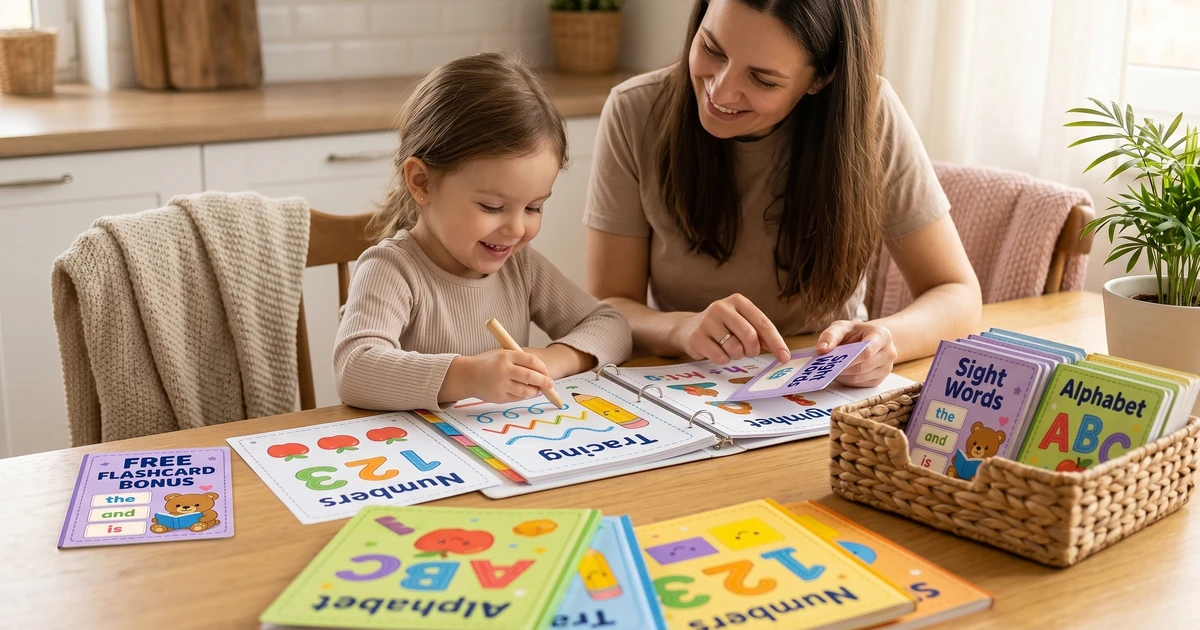
No printer? No problem. The screen-free solution I almost missed
You planned a productive morning. Your preschooler was going to "do school," you had activities lined up, and then, the printer runs out of ink. Or it jam

You planned a productive morning. Your preschooler was going to “do school,” you had activities lined up, and then, the printer runs out of ink. Or it jams. Or you simply don’t have one at all.
DISCOVERY ACTIVITY WORKBOOKPhonics Reading Lesson Guide Level 1
67 pages with 60 short phonics lessons covering all short vowels, V-C patterns, CVC words, and early sentences.
Sound familiar? I hear this constantly from parents who want structured, educational time with their 3-5 year olds but feel stuck the moment technology fails them (or when they’re actively trying to avoid screens in the first place).
The good news: some of the richest no printer preschool activities screen free learning happens with nothing more than what’s already in your home. I’ve spent time researching what actually works for this age group, synthesizing feedback from hundreds of parents in early childhood forums, and pulling together what child development experts consistently recommend. Here’s what I found.
Key Takeaways:
- No printer and no screens doesn’t mean no learning, preschoolers absorb skills through hands-on play
- The 5 core skill areas (literacy, numeracy, fine motor, social-emotional, and sensory) can all be practiced without any tech
- Simple household materials cover 90% of what expensive learning kits offer
- Short sessions (10-15 minutes) beat long ones for ages 3-5
- When you do want printables, a downloadable bundle is a one-time solution that eliminates the “out of ink” scramble
!A preschooler sitting at a table doing hands-on learning activities with crayons, playdough, and sorting toys
Why “No Printer, No Screen” Feels So Hard (But Isn’t)
Most parents assume educational = digital or printed. That assumption is the whole problem. According to the National Association for the Education of Young Children (NAEYC), play-based learning is the primary vehicle for development in children under 5. That means the plastic cups in your kitchen cabinet and the dried pasta in your pantry are legitimate learning tools.
The overwhelm comes from not having a plan. Without a structure, it’s easy to default to a screen “just for 20 minutes” that turns into 90. What helps is knowing a handful of reliable activity formats you can pull out on demand, no prep required.
“Children learn best through active, hands-on exploration rather than passive instruction. The preschool years are uniquely suited to learning through play, movement, and sensory experience.” - NAEYC Position Statement on Developmentally Appropriate Practice
The real issue isn’t resources. It’s having a mental menu of go-to activities ready before the moment hits.
What Preschoolers Actually Need to Learn (Without a Single Worksheet)
Before jumping to activities, it helps to know what you’re targeting. Preschool learning isn’t random, there are specific skill areas that set kids up for kindergarten readiness. I break these down fully in my Kindergarten Readiness Worksheets: 8 Essential Preschool Skills to Practice guide, but here’s the short version:
| Skill Area | Why It Matters | No-Prep Activity Example |
|---|---|---|
| Pre-literacy | Letter recognition, phonics foundation | Alphabet hunt around the house |
| Pre-numeracy | Counting, number sense, patterns | Sort and count dried beans by color |
| Fine motor | Writing grip, scissors skills | Tear and crumple newspaper into shapes |
| Sensory processing | Focus, self-regulation | Rice bin with hidden objects |
| Social-emotional | Turn-taking, expressing feelings | Emotion sorting with drawn faces |
None of these require a printer, a screen, or a trip to a store. They require about 5 minutes of setup and your presence.
Knowing the 5 skill areas means every activity you choose can be intentional, not just keeping them busy.
5 No Printer Preschool Activities That Actually Teach Something
These are the activities that parents consistently report sticking with because they’re repeatable, adaptable, and genuinely engaging for ages 3-5.
Step 1: Salt Tray Letter Tracing
Pour a thin layer of salt (or sand, or rice) into a baking tray. Call out a letter and have your child trace it with their finger. This is one of the highest-rated sensory literacy activities in early childhood communities because it gives tactile feedback that paper simply doesn’t.
Vary it by asking for numbers, shapes, or their name. Clean up takes 30 seconds.
Step 2: Color and Shape Sorting Hunt
Give your child a muffin tin and ask them to fill each cup with items of a specific color found around the house. Buttons, toys, crayons, socks, anything goes. Extend it by sorting by size instead of color, or by shape.
This hits pre-numeracy, categorization, and fine motor in one 10-minute activity.
Step 3: Playdough Letters and Numbers
Make a quick batch (1 cup flour, ½ cup salt, ½ cup water, 1 tsp oil) or use store-bought. Roll snakes and form letters. Flatten and press number amounts. Playdough is endlessly reusable and parents consistently report it’s one of the few activities that holds attention for 20+ minutes.
Pro Tip: Keep a small laminated alphabet strip next to the playdough station as a visual reference. If you don’t have one laminated, slide a handwritten card into a zip-lock bag.
Step 4: Story Retelling with Drawings
Read a short picture book (library books are free), then ask your child to draw what happened. First, middle, last. This builds narrative comprehension, sequencing, and expressive language, three skills kindergarten teachers say are often underdeveloped at school entry.
You don’t need a book either. Make up a 5-sentence story out loud and ask them to draw the ending.
Step 5: Number Line Hopscotch (Indoors or Out)
Use painter’s tape on the floor or chalk outside. Write numbers 1-10 in a line. Call a number and have them jump to it, hop back, or jump “2 more than 4.” This is physical, mathematical, and incredibly fun. Parents in homeschool communities specifically call this out as a winner for kids who resist sitting still for learning.
Five activities. Zero tech. Zero printing. All intentional learning.
The Honest Case for Having Printables Ready Too
Here’s where I’ll be straight with you. No-prep activities are wonderful, and they should form the backbone of your daily routine. But there are moments (quiet independent work time, focus practice, travel) where a physical worksheet does something hands-on activities can’t: it asks a child to sit, concentrate, and complete a structured task independently.
That skill matters. A lot. Kindergarten readiness includes the ability to follow written instructions and work at a table.
The problem with printing individual worksheets is the printer. One jammed page or an empty cartridge derails the whole morning.
What many parents have shifted to is downloading a large, organized bundle once and printing batches in advance at a library, FedEx, or during a single home print session. The KubbyLab Preschool Learning Bundle covers 260+ worksheets across all 5 skill areas for ages 3-5: you print what you need, when you need it, without scrambling.
I cover the specific skill areas included in more detail in Preschool Printables Bundle: The Only 5 Skill Areas Your 3-Year-Old Needs.
Pro Tip: Print 2-3 weeks’ worth of worksheets in one library visit. Keep them in a labeled folder. Now you have a “no-prep drawer” that works even when your home printer doesn’t.
How to Build a Screen-Free Preschool Routine (Without Burning Out)
The parents who sustain screen-free learning aren’t doing more, they’re doing smarter. Here’s the structure that consistently shows up in what experienced homeschool and stay-at-home parents report works:
| Time Block | Duration | Activity Type |
|---|---|---|
| Morning circle | 5-10 min | Calendar, weather, day of week |
| Structured learning | 15-20 min | Worksheet or targeted skill activity |
| Free exploration | 20-30 min | Sensory bin, playdough, building |
| Read-aloud | 10-15 min | Picture book + discussion |
| Outdoor/movement | 20-30 min | Gross motor, nature exploration |
According to Zero to Three, young children learn most effectively when there’s a predictable daily rhythm. The structure itself reduces resistance because kids stop negotiating when they know what comes next.
You don’t need to follow this exactly. Even hitting 2-3 blocks consistently is a strong foundation.
Routine beats variety, a simple repeatable structure outperforms elaborate one-off activities every time.
Comparing Your Options: No-Prep vs. Printables vs. Kits
| Option | Cost | Prep Time | Reusability | Skill Coverage |
|---|---|---|---|---|
| Household materials (no prep) | $0 | 2-5 min | High | Moderate (depends on you) |
| Free printables (individual) | $0 | 20+ min searching | Low | Narrow |
| Printable bundle (downloaded) | $10-25 one-time | 5 min (batch print) | High | Broad, organized |
| Physical learning kits (subscription) | $25-50/month | None | Low | Moderate |
| Educational apps (screen-based) | $5-15/month | None | High | Variable |
The bundle model consistently wins on cost-per-use. Parents who’ve switched from subscription kits to downloadable bundles report saving $200-400 annually with comparable (or better) educational outcomes.
For a deeper look at what activities specifically support kindergarten readiness, read 7 Screen-Free Preschool Learning Activities That Actually Keep Kids Engaged.
FAQ: No Printer Preschool Activities (Screen Free)
Q: My 3-year-old won’t sit still for any activity. What actually works?
Movement-based activities work best for kids under 4 who resist sitting. Floor hopscotch, sorting games where they physically move items across the room, and playdough are consistently the highest-rated with wiggly kids. Keep sessions to 8-10 minutes maximum and switch activities before they disengage, not after.
Q: How do I keep screen-free activities from feeling like a chore for me?
The prep is the chore, not the activity itself. The solution is batching: set up 3-4 activity stations on Sunday (a sensory bin, a sorting tray, a drawing prompt, a book stack) and rotate through them across the week. Total setup time is 20 minutes once, not daily.
Q: Can I really teach letters and numbers without worksheets or apps?
Yes, and research supports it. Tactile letter learning (salt trays, playdough, physical manipulation) is actually more effective for preschoolers than paper tracing for initial letter recognition. Worksheets are valuable for practice and fine motor development, but they’re not the only route. I go deeper on this in Alphabet Tracing for 3 Year Old: 5 Mistakes Parents Make with Letter Practice.
Q: At what age should a preschooler start structured learning activities?
Most child development guidelines suggest introducing short structured activities around age 3, with sessions staying under 15 minutes. By 4-5, kids can manage 20-minute focused work periods. The key word is short, quality over duration at this stage.
Q: What if I don’t have art supplies or sensory materials at home?
You have more than you think. Dried pasta and beans for sorting and counting. Flour for drawing surfaces. Old magazines for tearing and collaging. Tape on the floor for roads, number lines, and letter shapes. A toilet paper roll for a fine motor threading activity. The constraint forces creativity, and kids genuinely don’t notice the difference between a $30 sensory kit and a bowl of rice.
The Full Picture
No printer preschool activities screen free learning is completely doable, and honestly, some of the best early childhood learning happens this way. The household-materials approach builds creativity and keeps you present and engaged with your child rather than managing devices or refilling ink cartridges.
For the complete breakdown of skill areas, age-appropriate benchmarks, and a full activity library organized by learning goal, read the full guide: Kindergarten Readiness Worksheets: 8 Essential Preschool Skills to Practice.
Your kid is ready to learn. You’ve got what it takes to teach them.
You May Also Like
Take the Next Step!
Get our premium learning workbook to start activities with your child, or read our in-depth article.
Recommended Resources & Workbooks
Pair this guide with our hands-on, ready-to-print learning resources.
 Digital Bundle
Learn to Read Program: Levels 1-3
170 sequenced phonics lessons across 199 pages, from first letter sounds to fluent long-vowel reading.
 Digital Learning Bundle
Preschool Learning Bundle
260+ printable worksheets for tracing, ABCs, numbers, shapes, sight words, and kindergarten prep.
 Digital Learning Bundle
Play-Based Learning Bundle for Ages 3-6
230+ play-based learning activities with pretend play, reading, early math, creative arts, and bonus flashcards.
Related Guides & Articles
Explore more of our detailed guides and activities.
Kindergarten Readiness Worksheets: 8 Essential Preschool
Download kindergarten readiness worksheets covering writing, sounds, numbers, and more. Help your child build skills with printable sheets designed...
Alphabet Tracing for 3 Year Old: 5 Mistakes Parents Make
Alphabet tracing for 3 year olds is one of the most effective ways to build early literacy and fine motor skills at the same time. But here's what ...
Preschool Printables Bundle: The Only 5 Skill Areas Your Child Needs
If you've been searching for a preschool printables bundle that covers more than just coloring pages, you're in the right place. I've spent 40+ hou...
7 Screen-Free Preschool Learning Activities That Actually
If you've been searching for screen-free preschool learning activities that hold a 3-to-5-year-old's attention for more than four minutes, you're i...