
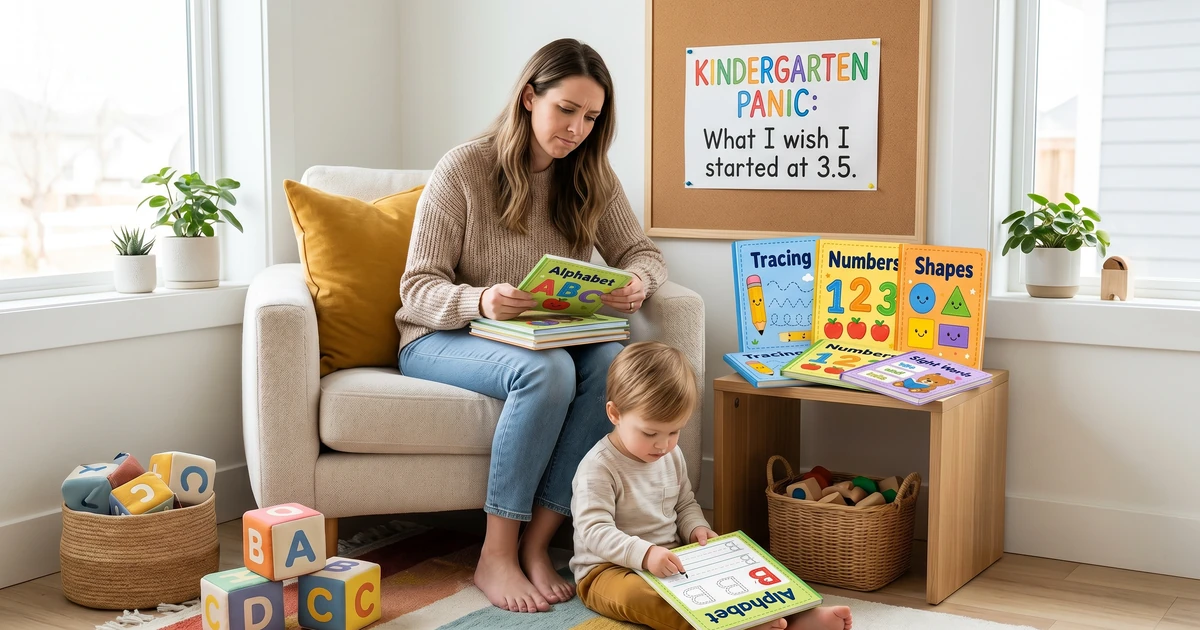
Kindergarten panic: What I wish I started at age 3.5
There's a specific kind of dread that hits when you're sitting in a pediatrician's office or scrolling through a school district website and you realize: k

There’s a specific kind of dread that hits when you’re sitting in a pediatrician’s office or scrolling through a school district website and you realize: kindergarten is closer than you thought, and your child can’t write their name, doesn’t recognize half the alphabet, and still struggles to hold a pencil correctly.
DISCOVERY ACTIVITY WORKBOOKPhonics Reading Lesson Guide Level 1
67 pages with 60 short phonics lessons covering all short vowels, V-C patterns, CVC words, and early sentences.
I’ve been there. And if you’re reading this at 11pm wondering whether your 3.5-year-old is already “behind,” I want you to take a breath first.
Kindergarten panic is real, it’s incredibly common among parents of children ages 3 to 5, and it usually kicks in right around the 3.5-year mark, when parents start doing the math and realize they have roughly 18 months before the first day of school. That’s both more time than you think AND less time than you’d like.
The good news? Starting at 3.5 is actually ideal. Not too early to stress your child out, and not so late that you’re scrambling.
Key Takeaways:
- Kindergarten panic typically peaks when parents realize how close school really is, usually around age 3.5
- Children develop at wildly different rates, and “behind” at 3.5 rarely means “behind” at 5
- Structured, playful practice at home can close skill gaps without pressure or burnout
- 15 to 20 minutes of focused activity per day is more effective than long, exhausting sessions
- The five core skill areas that matter most are literacy, numeracy, fine motor, social-emotional, and self-care
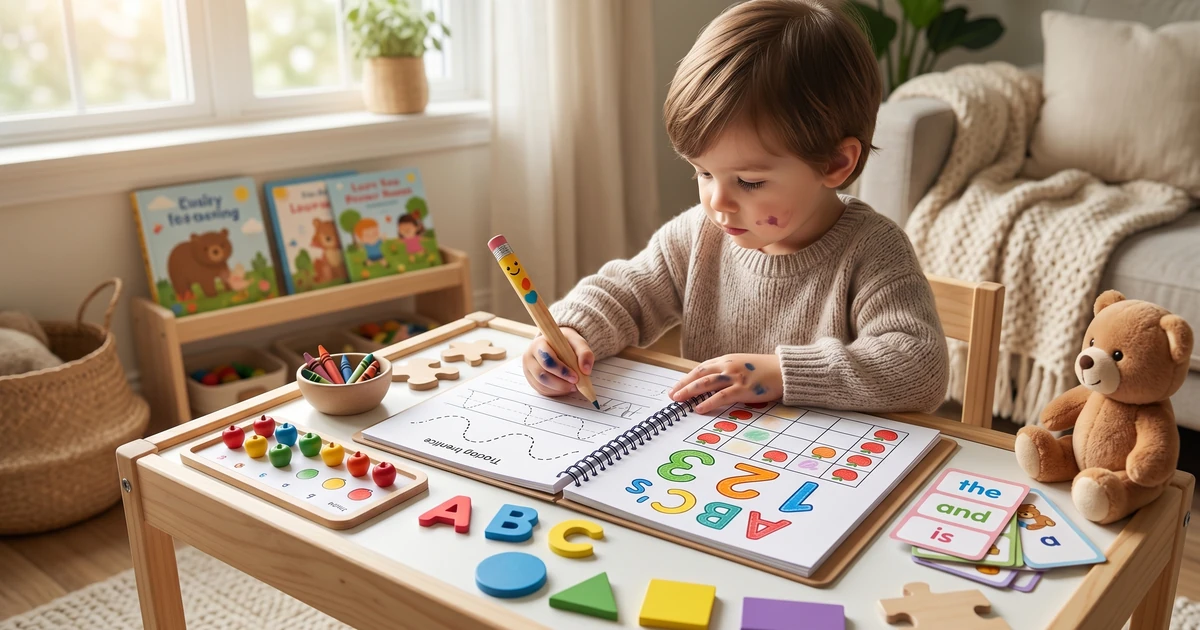
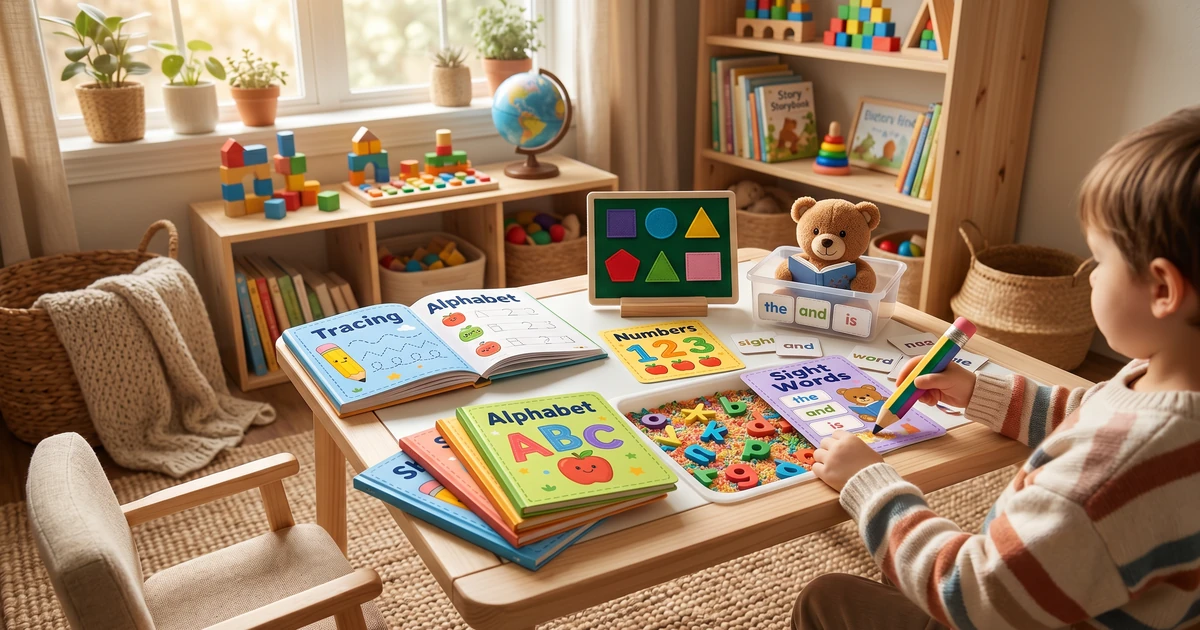
!A young child sitting at a small table working on colorful worksheets with crayons and pencils nearby
What “Kindergarten Ready” Actually Means at Age 3.5
Kindergarten readiness is the collection of academic, social, physical, and emotional skills a child needs to thrive on the first day of school. But here’s what most panic-inducing articles leave out: readiness is a spectrum, not a checklist you either pass or fail.
According to the National Association for the Education of Young Children (NAEYC), kindergarten readiness encompasses far more than letters and numbers. It includes a child’s ability to separate from a caregiver, follow simple two-step instructions, engage in cooperative play, and manage basic self-care tasks like putting on shoes or opening a lunch box.
At 3.5 years old, most children are not expected to read, write sentences, or count past 10. What matters more at this stage is building the foundation, not completing the building.
“School readiness is not about children being ready for a fixed school, but about schools being ready for diverse children.” - NAEYC Position Statement on Kindergarten Readiness
The key insight: starting structured learning at 3.5 gives you a full 18 months of low-pressure practice before school begins.
The 5 Skill Areas That Actually Predict Kindergarten Success
I spent a lot of time reading through early childhood education research to understand which skills genuinely predict how well a child transitions into kindergarten. It’s not handwriting. It’s not knowing the whole alphabet by heart. It comes down to five core areas.
| Skill Area | What It Looks Like at 3.5 | What to Aim for by Age 5 |
|---|---|---|
| Pre-Literacy | Recognizes some letters, enjoys being read to | Knows all 26 letters, understands sounds |
| Pre-Numeracy | Counts to 5, understands “more” and “less” | Counts to 20, basic number recognition to 10 |
| Fine Motor Skills | Can scribble, struggles with pencil grip | Can trace, cut with scissors, hold a crayon correctly |
| Social-Emotional | Plays near others, needs adult help with feelings | Takes turns, expresses emotions with words |
| Self-Care & Independence | Needs help with shoes, clothes | Can manage basic tasks independently |
The five areas interact with each other. A child who struggles with fine motor skills will naturally find writing more frustrating, which can affect their confidence with literacy. Starting early means you can work on all five areas gradually and gently, without the pressure of a school deadline looming next month.
Bottom line: address all five areas, not just the academic ones.
Why 3.5 Is the Sweet Spot (Not a Warning Sign)
Parents who start thinking about kindergarten readiness at 3.5 often feel like they’re already late. They’re not. They’re actually ahead of the curve.
Here’s a rough timeline of how kindergarten preparation tends to unfold:
Step 1: Awareness (Age 3 to 3.5) You notice other parents talking about preschool programs, or your child starts asking about “big kid school.” This is a natural starting point for low-pressure exploration.
Step 2: Foundation Building (Age 3.5 to 4) This is the ideal window for introducing structured but playful learning activities at home. 15 to 20 minutes per day is enough. Focus on fine motor skills (coloring, tracing, cutting), letter recognition, and basic number concepts.
Step 3: Skill Consolidation (Age 4 to 4.5) By now, your child should be building confidence in foundational skills. This is when you can introduce more intentional practice with letter sounds, simple writing, and number sequences.
Step 4: Confidence and Independence (Age 4.5 to 5) Shift focus toward independence and social skills. Can they raise their hand? Ask for help? Follow a group instruction? These matter just as much as academic skills.
Pro Tip: At 3.5, the most valuable thing you can do is make learning feel like play. A child who associates practice with fun will be far more prepared than a child who has technically learned more but dreads sitting down to do it.
According to the Centers for Disease Control and Prevention (CDC), preschool-age children learn best through hands-on, exploratory activities. Worksheets and structured practice work best when they’re kept short, positive, and mixed with movement and play.
Starting at 3.5 with a consistent, low-pressure routine puts you in the strongest possible position.
The Biggest Mistakes Parents Make When Starting Early
I’ve seen a lot of well-meaning early preparation backfire. These are the patterns that come up most often.
Mistake 1: Cramming too much, too fast A 3.5-year-old’s attention span is roughly 5 to 15 minutes for a structured task. Sitting them down for 45-minute “study sessions” doesn’t build skill faster. It builds resentment.
Mistake 2: Focusing only on academics Parents fixate on letter recognition and counting while skipping fine motor and social-emotional development. A child who can recite the alphabet but can’t hold a pencil or sit in a group will still struggle in kindergarten.
Mistake 3: Comparing to other children At 3.5, the developmental range is enormous. One child might already write their name. Another might not recognize a single letter. Both can absolutely be kindergarten-ready by age 5 with consistent, appropriate practice.
Mistake 4: Using screens as the primary learning tool Educational apps have a role, but screen-based learning at this age tends to be passive. Fine motor skills, in particular, require physical practice. Tapping a tablet does not build the pencil grip that writing requires. For ideas that don’t involve screens, 7 Screen-Free Preschool Learning Activities That Actually Keep Kids Engaged is worth bookmarking.
Mistake 5: Waiting for “signs of readiness” Some children are naturally eager learners who ask for activities. Others are happy to play and won’t show obvious signs of academic curiosity. Both types benefit from structured practice, and waiting for the second type to “ask” often means waiting too long.
Avoid these five traps and you’re already doing better than most.
What a Simple at-Home Learning Routine Looks Like
You don’t need a dedicated classroom, expensive curriculum, or a teaching degree to prepare your 3.5-year-old for kindergarten. A realistic at-home routine looks something like this:
| Activity Type | Time | Frequency | Example |
|---|---|---|---|
| Fine motor practice | 10 min | 4-5x per week | Tracing shapes, coloring within lines |
| Letter recognition | 5-10 min | 3-4x per week | Matching letter cards, tracing letters |
| Number concepts | 5-10 min | 3x per week | Counting objects, number tracing |
| Reading aloud together | 15-20 min | Daily | Any picture book they love |
| Free creative play | 30+ min | Daily | Drawing, building, pretend play |
Notice the reading aloud and free play aren’t optional extras. They’re the backbone. Structured activities work better when a child has space to play and a rich language environment around them.
Printable worksheets can be a useful tool here, not as a replacement for play, but as a way to make structured practice feel organized and achievable for both parent and child. At KubbyLab, the Preschool Learning Bundle covers all five core skill areas with age-appropriate activities for 3 to 5-year-olds, and it’s one option among several for parents who want ready-made materials rather than building from scratch.
For a deeper look at which specific skills to prioritize and how to practice them effectively, the Preschool Printables Bundle: The Only 5 Skill Areas Your 3-Year-Old Needs covers exactly this ground.
Frequently Asked Questions
Is my 3.5-year-old behind if they don’t know the alphabet yet?
No. Most children begin recognizing letters consistently between ages 3 and 4, with full alphabet recognition typically developing between 4 and 5. At 3.5, it’s completely normal to recognize some letters (especially those in their own name) but not others. Consistent, low-pressure practice over the next 12 to 18 months is far more effective than intensive drilling now.
How much should I be “teaching” my 3.5-year-old at home?
Aim for 15 to 20 minutes of intentional activity per day, broken into short 5 to 10 minute chunks if needed. Daily reading aloud doesn’t count toward this, but it should happen every day regardless. The goal at this age is consistency and positive associations with learning, not volume.
My child hates sitting still for activities. What should I do?
This is very normal at 3.5. Try incorporating movement into practice: trace letters on each other’s backs, count while jumping, sort objects on the floor rather than at a table. The 7 Screen-Free Preschool Learning Activities That Actually Keep Kids Engaged has specific ideas for active learners. Also, shorter and more frequent sessions work much better than longer ones for children who resist sitting.
What are the actual kindergarten entry requirements?
Requirements vary significantly by state and district. Most US kindergartens require children to be 5 years old by September 1 of the enrollment year (though some states use August 1 or December 1 cutoffs). Academic requirements are generally minimal at enrollment, but social and self-care skills matter a great deal. Check your specific district’s website for exact requirements.
How do I know if my child might need additional support?
If your child is not making progress with language, seems significantly behind peers in multiple areas, or shows signs of frustration that go beyond typical resistance, it’s worth talking to your pediatrician. Early intervention for speech delays, fine motor difficulties, or developmental concerns is far more effective at 3.5 than waiting. A pediatrician or early childhood specialist can provide a proper assessment.
The panic you’re feeling at 3.5 is actually useful information. It means you’re paying attention early enough to do something about it, calmly and consistently, without it becoming a crisis.
Start small. Stay consistent. Make it feel like play.
For the complete breakdown of what to practice, when, and how to structure it by age, read the full guide: Kindergarten Readiness Worksheets: 8 Essential Preschool Skills to Practice
You May Also Like
Take the Next Step!
Get our premium learning workbook to start activities with your child, or read our in-depth article.
Recommended Resources & Workbooks
Pair this guide with our hands-on, ready-to-print learning resources.
 Digital Bundle
Learn to Read Program: Levels 1-3
170 sequenced phonics lessons across 199 pages, from first letter sounds to fluent long-vowel reading.
 Digital Learning Bundle
Preschool Learning Bundle
260+ printable worksheets for tracing, ABCs, numbers, shapes, sight words, and kindergarten prep.
 Digital Learning Bundle
Play-Based Learning Bundle for Ages 3-6
230+ play-based learning activities with pretend play, reading, early math, creative arts, and bonus flashcards.
Related Guides & Articles
Explore more of our detailed guides and activities.
Kindergarten Readiness Worksheets: 8 Essential Preschool
Download kindergarten readiness worksheets covering writing, sounds, numbers, and more. Help your child build skills with printable sheets designed...
Alphabet Tracing for 3 Year Old: 5 Mistakes Parents Make
Alphabet tracing for 3 year olds is one of the most effective ways to build early literacy and fine motor skills at the same time. But here's what ...
Preschool Printables Bundle: The Only 5 Skill Areas Your Child Needs
If you've been searching for a preschool printables bundle that covers more than just coloring pages, you're in the right place. I've spent 40+ hou...
7 Screen-Free Preschool Learning Activities That Actually
If you've been searching for screen-free preschool learning activities that hold a 3-to-5-year-old's attention for more than four minutes, you're i...