
Grandparent hack: How I 'play school' without a tablet
My neighbor called me last spring, a little frustrated. Her mother-in-law watches her three-year-old two days a week, and the grandkids had started arrivin

My neighbor called me last spring, a little frustrated. Her mother-in-law watches her three-year-old two days a week, and the grandkids had started arriving home glassy-eyed, having spent most of the day in front of a tablet “learning” from YouTube. She didn’t want to offend anyone. She just wanted something better, something Grandma could actually do, without needing a lesson plan degree or a Wi-Fi password.
DISCOVERY ACTIVITY WORKBOOKPhonics Reading Lesson Guide Level 1
67 pages with 60 short phonics lessons covering all short vowels, V-C patterns, CVC words, and early sentences.
I hear this constantly. Grandparents are stepping up as primary caregivers during the preschool years more than ever before, and most of them genuinely want to help their grandkids learn. They’re just not sure how to do it without defaulting to a screen. And honestly? The right tools make this so much easier than people think.
This page is for grandparents (and the parents who love them) who want a real, tablet-free grandparent play school experience that feels fun, not stressful.
Key Takeaways:
- Grandparent-led preschool doesn’t require screens, apps, or expensive curriculum kits
- Short, structured 10-15 minute activity blocks work better than long sessions for ages 3-5
- Printable worksheets are one of the easiest tools for grandparents to use independently
- Kids learn best through repetition, play, and hands-on interaction, all things grandparents excel at
- You don’t need to “teach”, you need to engage, and there’s a big difference
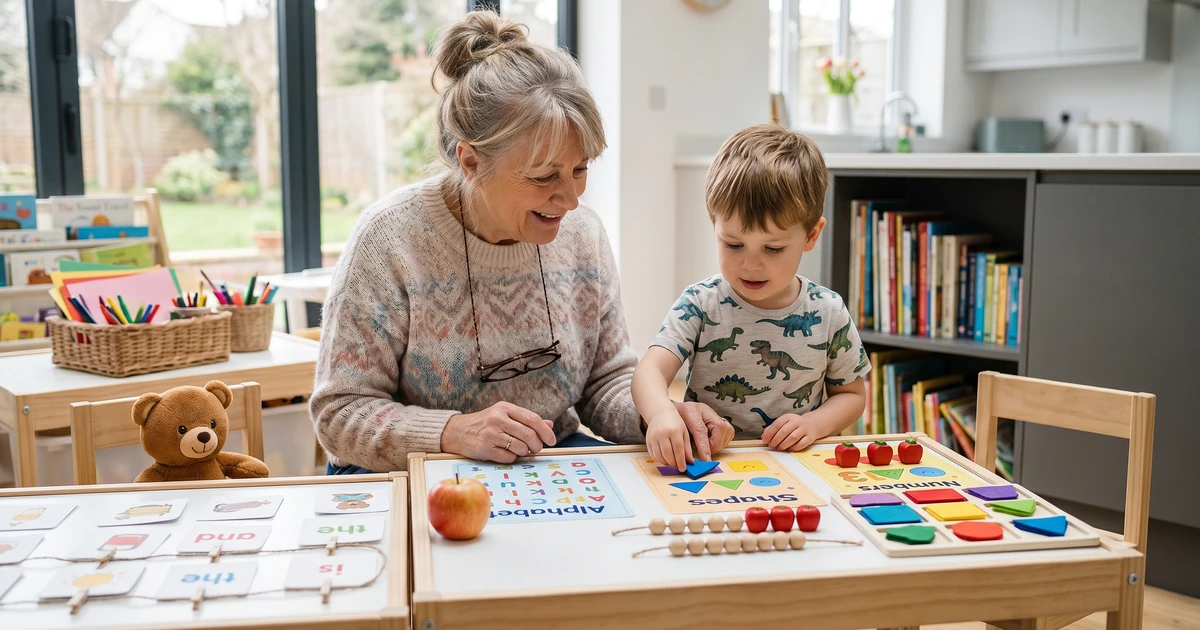
!Grandmother and grandchild doing printable worksheets at a kitchen table
Why Grandparent Play School Works Better Than You’d Expect
Grandparent play school is the informal (or semi-structured) learning time that happens when grandparents are the primary daytime caregiver for preschool-aged grandchildren. It’s not a replacement for formal preschool, but research consistently shows that warm, responsive one-on-one interaction with a trusted adult is one of the strongest predictors of early learning outcomes.
According to the American Academy of Pediatrics, children ages 2-5 should have no more than one hour of high-quality screen time per day. Yet grandparent caregiving situations often default to tablets simply because they’re easy and the grandparent doesn’t feel confident doing “school stuff.”
The good news: grandparents don’t need to be teachers. They need to be present, willing, and armed with the right activities.
“Children learn through play, and the most powerful play happens in the context of a loving relationship.” - Dr. Stuart Brown, National Institute for Play
The biggest advantage grandparents have is time and patience, two things preschool teachers rarely have enough of.
The Real Problem: Grandparents Don’t Know What to Do Instead of Screens
Most grandparents turn to tablets not because they’re lazy, but because they genuinely don’t know what a 3-year-old should be learning, or how to make it fun without formal training.
Here’s what I’ve found after researching this extensively: the activities that work best for grandparent-led preschool are:
- Short (10-15 minutes per activity, max)
- Hands-on (coloring, tracing, cutting, matching)
- Low-prep (no elaborate setup required)
- Repeatable (kids this age love doing the same thing multiple times)
- Conversation-rich (grandparents talk while kids do, that’s the real learning)
Printable worksheets tick every one of these boxes. Print a sheet, sit down together, and talk through it. That’s the whole method.
How to Build a Simple Daily Rhythm for Grandparent Play School
You don’t need a curriculum. You need a rhythm. Preschoolers thrive on predictable routines, and a simple daily structure makes grandparent caregiving dramatically less stressful.
Step 1: Morning Welcome (5 minutes)
Start with something consistent: a song, a greeting ritual, or even just asking “What do you want to learn today?” This signals that learning time is beginning.
Step 2: Tabletop Activity (10-15 minutes)
This is where worksheets, coloring pages, or simple puzzles come in. One skill at a time. Don’t rush through a stack, one focused page is worth more than five rushed ones.
Step 3: Movement Break (10 minutes)
Jump, dance, walk outside, or play Simon Says. Physical movement between learning blocks dramatically improves retention in young children.
Step 4: Story or Read-Aloud (10-15 minutes)
Grandparents are often the best storytellers in a child’s life. Use it. Ask questions about the pictures. Let the child “read” to you.
Step 5: Free Play (30-60 minutes)
Blocks, dolls, sand, play-dough. Unstructured play is not wasted time, it’s how preschoolers process everything they just learned.
Step 6: Afternoon Quiet Activity (10-15 minutes)
Another worksheet, a simple matching game, or drawing. By now, the child is usually calmer and more focused.
Pro Tip: Keep a small basket of worksheets and crayons permanently on the kitchen table. Accessibility removes the biggest barrier, grandparents are far more likely to do an activity if it takes zero setup.
A predictable structure removes decision fatigue for grandparents and anxiety for kids.
What Skills Should Grandparent Play School Actually Cover?
Ages 3-5 have a surprisingly clear set of developmental targets. You don’t need to guess. Here’s a simple breakdown:
| Skill Area | What It Looks Like at Age 3-5 | Easy Grandparent Activity |
|---|---|---|
| Pre-Writing | Holding a crayon, tracing lines and shapes | Tracing worksheets, drawing paths |
| Letter Recognition | Identifying uppercase letters | Alphabet matching games, letter coloring pages |
| Number Sense | Counting objects up to 10-20 | Counting everyday objects, number tracing |
| Fine Motor Skills | Cutting, coloring within lines | Scissors practice, dot-to-dot pages |
| Phonological Awareness | Rhyming, hearing sounds in words | Rhyme games, “I Spy” letter sounds |
| Shapes and Colors | Identifying and sorting basic shapes | Shape coloring pages, sorting household objects |
| Listening and Focus | Sitting for a short activity | Read-alouds, simple follow-the-directions pages |
For a deeper look at exactly which skills matter most before kindergarten, the Kindergarten Readiness Worksheets: 8 Essential Preschool Skills to Practice guide covers each of these in detail with specific activity ideas.
Covering just 2-3 skill areas per day is more than enough for a grandparent play school session.
Tablets vs. Printables: An Honest Comparison
I’m not anti-technology. But for grandparent-led learning specifically, there are real practical reasons why printables tend to work better.
| Factor | Tablet/App Learning | Printable Worksheets |
|---|---|---|
| Grandparent Confidence | Low (app updates, settings confusion) | High (print and go) |
| Screen Time Concerns | Adds to daily screen total | Zero screen time |
| Hands-On Engagement | Passive (tapping) | Active (holding, writing, coloring) |
| Fine Motor Development | Minimal | Strong (gripping, tracing) |
| Conversation Opportunity | Low (child focused on screen) | High (side-by-side interaction) |
| Cost | Ongoing subscriptions ($8-$15/month) | One-time purchase or free print |
| Repeatability | Child gets bored of apps quickly | Kids love re-doing familiar sheets |
| Setup Required | Device charging, Wi-Fi, logins | Printer + paper |
For grandparents specifically, the setup simplicity of printables is often the deciding factor. There are no app updates. No subscription renewals. No accidentally ending up on YouTube.
If you’re looking for structured screen-free options beyond worksheets, 7 Screen-Free Preschool Learning Activities That Actually Keep Kids Engaged has a solid list of ideas that work well in a home caregiving environment.
How to Choose the Right Printable Worksheets for Grandparent-Led Learning
Not all printable worksheet packs are created equal. Here’s what I’d look for specifically for grandparent play school use:
| Criteria | Why It Matters |
|---|---|
| Age-appropriate skill range | Should cover ages 3-5 with clearly labeled difficulty levels |
| Visual clarity | Large, uncluttered designs are easier for young eyes and older eyes |
| Variety of skill areas | Mix of tracing, coloring, matching, and number activities prevents boredom |
| Print-friendly design | Black-and-white options save ink; color options for special sessions |
| No internet required to use | Once printed, completely offline and tablet-free |
| Quantity | A large bundle (100+ pages) means months of content without reordering |
KubbyLab’s Preschool Learning Bundle includes 260+ printable worksheets covering all the core skill areas above, designed specifically for ages 3-5. It’s one option worth looking at if you want a single download that covers everything without hunting for individual sheets. For a breakdown of which skill areas matter most, Preschool Printables Bundle: The Only 5 Skill Areas Your 3-Year-Old Needs explains the reasoning.
A Note on Alphabet and Number Practice Specifically
Two of the most common grandparent play school activities are letter tracing and number recognition. These are also two of the areas where well-meaning adults accidentally make it harder for kids.
The most common mistake I see: moving too fast. Grandparents (and parents) often want to get through the whole alphabet in a week. But research from Understood.org on early literacy development consistently shows that depth beats breadth at this age. Spending a full week on just the letter “A” (tracing it, finding it in books, drawing things that start with A) produces far better long-term retention than racing through all 26 letters.
For specific guidance on letter practice, Alphabet Tracing for 3 Year Old: 5 Mistakes Parents Make with Letter Practice covers this in practical detail.
Pro Tip: Let the grandchild pick which letter or number they want to practice that day. Autonomy dramatically increases engagement, even in three-year-olds.
Go slow, go deep, and let the child lead more than you think you should.
Frequently Asked Questions About Grandparent Play School
Q: How long should a grandparent play school session actually be?
For ages 3-5, total structured learning time should be 30-60 minutes spread across the whole day in short blocks. A three-year-old cannot sustain focused attention for more than 10-15 minutes on a single activity. Multiple short sessions with movement breaks in between are far more effective than one long sitting. Don’t try to replicate a formal classroom schedule.
Q: What if my grandchild refuses to do worksheets or structured activities?
Start with the activity they most enjoy and build from there. If they love coloring, start with coloring-based worksheets. If they love cutting, start with scissors practice pages. Resistance usually comes from the activity feeling imposed rather than chosen. Offer two options (“Do you want to do the dinosaur tracing page or the star one?”) and let them pick. Control over small choices dramatically reduces refusal.
Q: Do I need any special supplies beyond a printer?
Not really. Crayons or washable markers, a pencil for tracing, child-safe scissors for cutting practice, and a flat table surface are genuinely all you need. Some grandparents add a small whiteboard for letter practice, but it’s completely optional. The beauty of a printable-based grandparent play school is that the barrier to entry is extremely low.
Q: How do I explain to my grandchild’s parents what we did during the day?
Keep a simple “learning log”, a notebook where you jot down what worksheet or activity you did, and one funny or sweet thing the child said or did. Parents love this, and it helps track progress over weeks. It also gives you something to show if parents ask about screen time or learning goals.
Q: My grandchild is in a formal preschool program two days a week. Should I try to match what they’re doing there?
You don’t need to. Reinforcing general skills (tracing, counting, letter recognition) in a relaxed home environment complements formal preschool without competing with it. If the teacher sends home information about the current theme or letter of the week, you can loosely tie your activities to that, but it’s not necessary. Consistency and warmth matter more than curriculum alignment at this age.
For the complete guide to building a structured, screen-free preschool routine that grandparents can run confidently, read the full article: Kindergarten Readiness Worksheets: 8 Essential Preschool Skills to Practice.
You May Also Like
Take the Next Step!
Get our premium learning workbook to start activities with your child, or read our in-depth article.
Recommended Resources & Workbooks
Pair this guide with our hands-on, ready-to-print learning resources.
 Digital Bundle
Learn to Read Program: Levels 1-3
170 sequenced phonics lessons across 199 pages, from first letter sounds to fluent long-vowel reading.
 Digital Learning Bundle
Preschool Learning Bundle
260+ printable worksheets for tracing, ABCs, numbers, shapes, sight words, and kindergarten prep.
 Digital Learning Bundle
Play-Based Learning Bundle for Ages 3-6
230+ play-based learning activities with pretend play, reading, early math, creative arts, and bonus flashcards.
Related Guides & Articles
Explore more of our detailed guides and activities.
Kindergarten Readiness Worksheets: 8 Essential Preschool
Download kindergarten readiness worksheets covering writing, sounds, numbers, and more. Help your child build skills with printable sheets designed...
Alphabet Tracing for 3 Year Old: 5 Mistakes Parents Make
Alphabet tracing for 3 year olds is one of the most effective ways to build early literacy and fine motor skills at the same time. But here's what ...
Preschool Printables Bundle: The Only 5 Skill Areas Your Child Needs
If you've been searching for a preschool printables bundle that covers more than just coloring pages, you're in the right place. I've spent 40+ hou...
7 Screen-Free Preschool Learning Activities That Actually
If you've been searching for screen-free preschool learning activities that hold a 3-to-5-year-old's attention for more than four minutes, you're i...