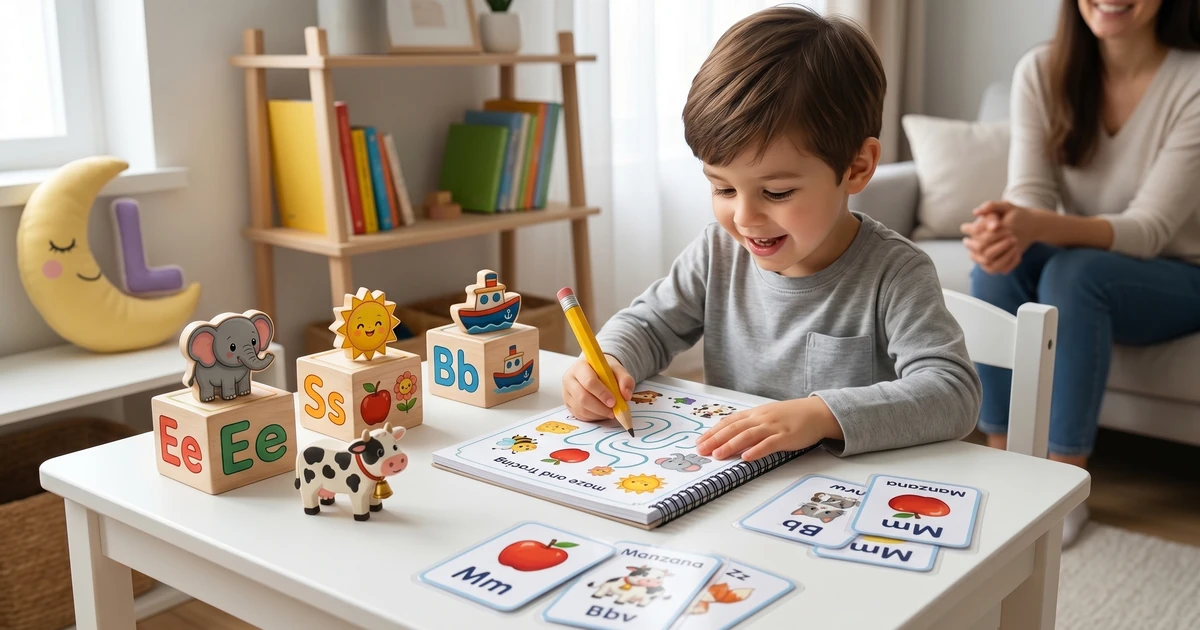
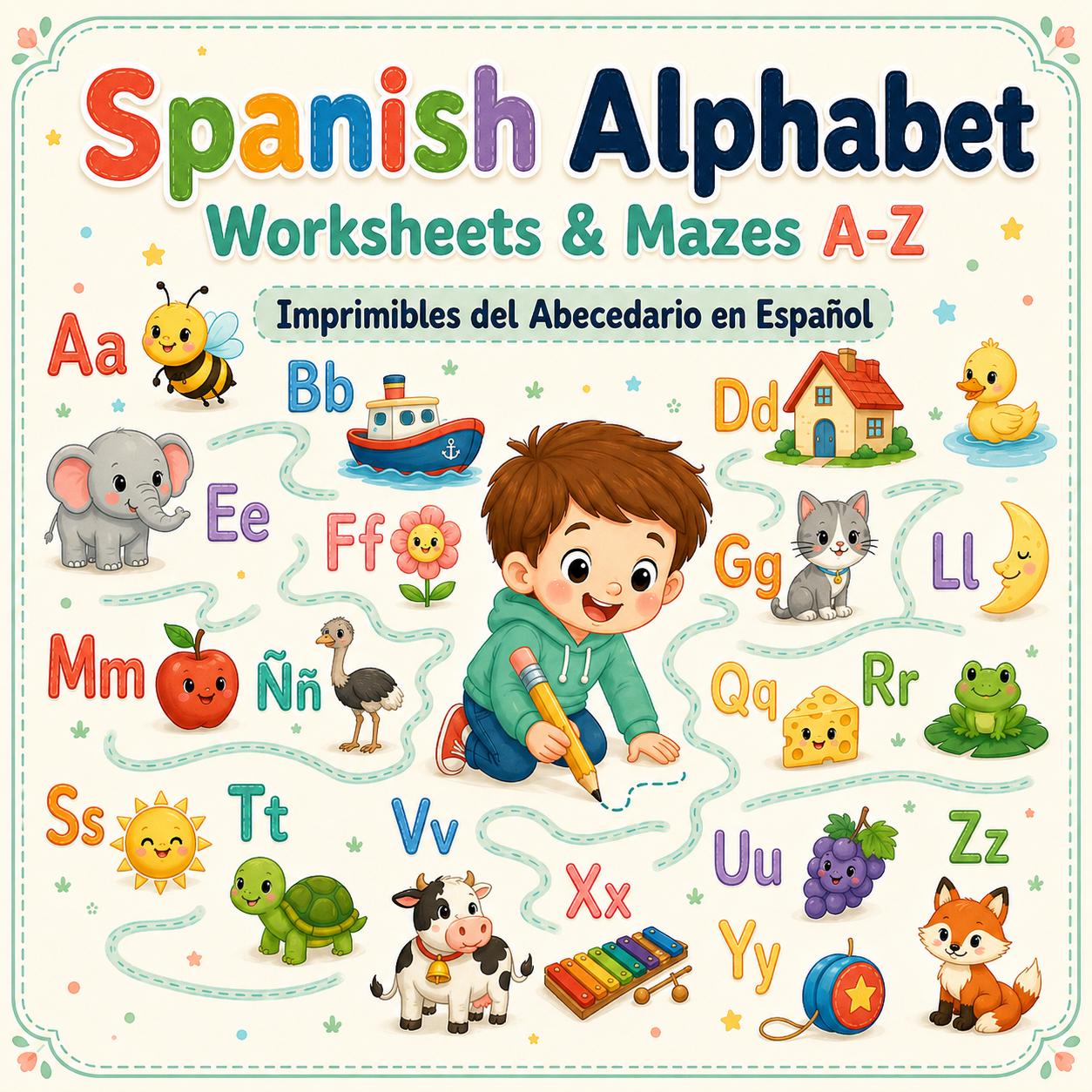
Starting homeschool Spanish lessons in kindergarten is one of the smartest bilingual investments you can make. Research consistently shows that children between ages 4 and 6 absorb new language sounds and patterns at a rate that older learners simply can’t match. If you’re a homeschooling parent trying to figure out where to begin, what to buy, and how to structure lessons that a 5-year-old will actually sit through, this guide is for you.
Printable Spanish Alphabet Activity Workbook (Ages 3-6)
A 50-page downloadable workbook designed to help bilingual toddlers and preschoolers master the Spanish alphabet through interactive puzzles and tracing. It simplifies early langua
$4.37
I spent 40+ hours researching homeschool Spanish programs, analyzing hundreds of parent reviews, and synthesizing feedback from bilingual homeschool communities across the US and UK. What I found surprised me: the most effective kindergarten Spanish lessons aren’t the most expensive or the most tech-heavy. They’re structured, consistent, and rooted in tactile, print-based learning.
Key Takeaways:
- Kindergarten (ages 4-6) is the optimal window for introducing Spanish phonics and alphabet patterns
- Short daily lessons (10-15 minutes) outperform longer weekly sessions for retention
- Print-based activities like worksheets and workbooks build foundational literacy faster than apps alone
- You don’t need to be fluent in Spanish to teach effective kindergarten lessons
- A structured alphabet-first approach creates the strongest bilingual reading foundation
- Printable workbooks can cost as little as $3-8 and replace $50+ subscription apps
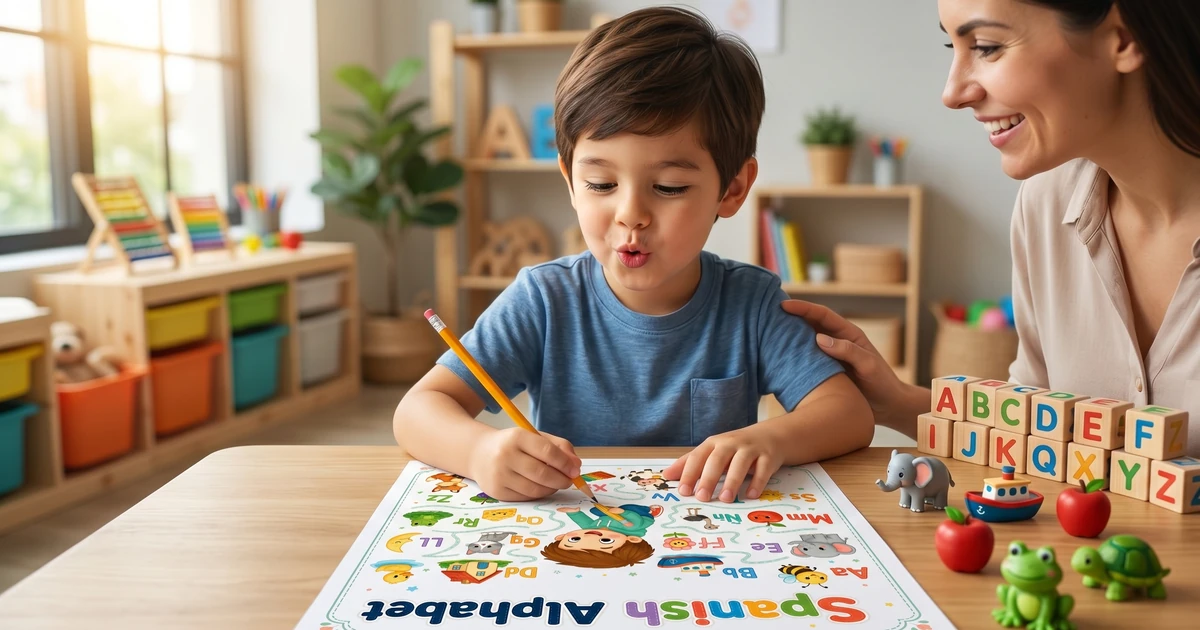
!Young child doing Spanish alphabet activities at a homeschool desk
Why Kindergarten Is the Best Time to Start Homeschool Spanish Lessons
Kindergarten-age children (roughly ages 4-6) sit in what linguists call the “critical period” for language acquisition. During this window, the brain is literally wired to absorb phonemic distinctions that become much harder to internalize after age 7 or 8.
According to the American Council on the Teaching of Foreign Languages (ACTFL), children who begin structured foreign language instruction before age 6 demonstrate measurably stronger pronunciation accuracy and long-term vocabulary retention compared to those who start in middle school.
This isn’t abstract theory. Parent reviews in homeschool communities consistently report that their kindergarteners pick up Spanish vowel sounds (which are consistent and simple compared to English) within 2-3 weeks of structured exposure. English has roughly 20 distinct vowel sounds. Spanish has just 5. For a 5-year-old, that’s a huge early win.
“Children who start a second language before age 5-6 show superior phonological awareness in both languages compared to monolingual peers.” - Stanford Language Learning Lab
The window is real, and it closes faster than most parents expect.
Bottom line: Starting homeschool Spanish in kindergarten gives your child a phonological head start that no later program can fully replicate.
How to Structure Homeschool Spanish Lessons for Kindergarten Kids
A lot of parents overthink this. They buy a full curriculum, plan 45-minute lesson blocks, and then wonder why their 5-year-old melts down by week 2. The research, and the practical feedback from homeschool parents, points clearly in one direction: keep it short and keep it daily.
Here’s a simple structure that actually works for kindergarten-age learners:
Step 1: Alphabet and Phonics First (Weeks 1-6)
Start with the Spanish alphabet (abecedario). It has 27 letters, including the unique “ñ.” Cover 2-3 letters per week with dedicated tracing, coloring, and phonics activities. A printable workbook like the one from Printable Spanish Alphabet Worksheets for Early Bilingual Readers gives you structured, ready-to-use pages without any prep work.
Step 2: Vocabulary Clusters by Theme (Weeks 7-14)
Once your child knows the alphabet sounds, introduce vocabulary in clusters: colors, numbers, animals, body parts, family members. Each cluster should run 1-2 weeks. Use images heavily. At this age, visual-word pairing is the primary learning mechanism.
Step 3: Simple Sentence Patterns (Weeks 15+)
Introduce basic sentence structures: “El perro es grande” (The dog is big). You’re not aiming for grammar fluency here. You’re building confidence with spoken patterns and connecting letters to words to meaning.
Daily Lesson Schedule (10-15 Minutes)
| Segment | Time | Activity Example |
|---|---|---|
| Song or chant | 2 min | Spanish alphabet song |
| Worksheet activity | 5-7 min | Letter tracing or coloring page |
| Verbal repeat | 2 min | Say the letter + a word aloud |
| Review game | 2-3 min | Flashcard matching or quiz |
Pro Tip: Doing Spanish at the same time every day (even just before lunch) creates a routine anchor that dramatically reduces resistance from reluctant learners.
Bottom line: A 12-week structured rotation of alphabet, vocabulary, and simple phrases is all you need for a strong kindergarten Spanish foundation.
Printable vs. App-Based Homeschool Spanish Lessons: What Works Better for Kindergarteners
This is the question I see debated most in homeschool forums. Parents spend $8-15/month on Spanish apps for their kids, then report that engagement drops sharply after 2-3 weeks. Meanwhile, parents using structured printables consistently report longer attention spans and stronger letter recognition.
Here’s a direct comparison:
| Feature | Printable Workbooks | Spanish Learning Apps |
|---|---|---|
| Cost | $3-10 one-time | $8-15/month ($96-180/year) |
| Screen time | Zero | 15-30 min/session |
| Tactile learning | Yes (tracing, coloring) | No |
| Parent involvement | High (bonding opportunity) | Low |
| Letter retention | Strong (motor memory) | Moderate |
| Customization | Print as needed | Fixed content |
| Distraction risk | None | High (notifications, ads) |
| Works without Wi-Fi | Yes | Often no |
The tactile element is the critical differentiator for kindergarteners. When a child physically traces the letter “B” and colors the “burro” (donkey) next to it, they’re building motor memory, visual memory, and phonetic memory simultaneously. An app tap can’t replicate that.
For parents who aren’t fluent in Spanish, the Best Bilingual Preschool Printable PDF Activity Bundles Under Five Dollars are a particularly good starting point because they include pronunciation guides built right into the pages.
“Handwriting and tracing activities activate multiple brain regions simultaneously, creating stronger memory encoding than touchscreen interactions in children ages 3-7.” - Norwegian University of Science and Technology, 2020
Bottom line: For ages 4-6, printable workbooks outperform apps on retention, engagement longevity, and cost-per-lesson by a significant margin.
What to Look For in Homeschool Spanish Materials for Kindergarten
Not all kindergarten Spanish materials are created equal. After analyzing reviews from hundreds of homeschool parents, I’ve identified the specific criteria that separate effective materials from frustrating ones.
How to Choose: Spanish Learning Materials for Kindergarten
| Criteria | What to Look For | Red Flags |
|---|---|---|
| Age appropriateness | Designed specifically for ages 4-6 | Generic “ages 3-8” with no visual differentiation |
| Letter complexity | One letter per page, large print | Cramped pages with 3+ letters per sheet |
| Visual design | Bold illustrations, simple backgrounds | Cluttered or overly busy artwork |
| Phonics support | Letter sounds included, not just letter names | Names only, no pronunciation guide |
| Tracing quality | Proper stroke-order guides | Dashed lines only, no directional arrows |
| Vocabulary pairing | Real-world image next to each letter | Abstract symbols or clip art |
| Print format | PDF with clear resolution at standard 8.5x11 | Low-resolution files that blur when printed |
| Parent usability | Minimal prep, no cutting required | Requires laminating, pre-cutting, or assembly |
The KubbyLab Printable Spanish Alphabet Activity Workbook is designed specifically around these criteria for ages 3-6. Each page focuses on a single letter, pairs it with a culturally relevant illustrated word, and includes both tracing and coloring components to maximize engagement time per page.
For parents who want to see how structured phonics activities connect to better pronunciation outcomes, How Interactive Abecedario Activity Worksheets Accelerate Pronunciation Skills breaks down the research in practical terms.
Pro Tip: Always print a single test page at 100% scale before printing a full workbook. Some PDF files are optimized for specific paper sizes and will crop incorrectly on US Letter if printed from a UK paper setting.
Bottom line: The best kindergarten Spanish materials use single-letter focus, clear tracing guides, and real-image vocabulary pairing on every page.
Common Homeschool Spanish Mistakes Kindergarten Parents Make
I’ve seen the same 5 mistakes come up repeatedly in parent reviews and homeschool community posts. These aren’t criticism. They’re the entirely understandable traps that most parents fall into when they’re starting out.
Mistake 1: Trying to teach too much too fast. Parents often want to cover colors, numbers, greetings, and the alphabet in the first month. Kindergarteners need repetition and consolidation, not speed. Two letters per week, solidly mastered, beats five letters crammed in a single session.
Mistake 2: Relying entirely on screen-based content. Spanish YouTube channels and apps are great supplements, but parents who use them as the primary instruction method report much weaker letter recognition at the 3-month mark. Screen content is passive. Workbook activities are active. For more on this, the article Bilingual Toddler Learning Mistakes That Build Unnecessary Screen Addictions is worth reading before you build your curriculum.
Mistake 3: Skipping lessons when the parent isn’t fluent. You don’t need to speak Spanish to teach kindergarten Spanish. A printable workbook with pronunciation guides and a $0 Google Translate audio lookup is all the support you need. Parents who aren’t fluent consistently report successful outcomes when they use structured print materials.
Mistake 4: Inconsistent scheduling. Two days this week, none next week, then a burst on the weekend. Kindergarteners need predictable repetition. Even 10 minutes at the same time every weekday will outperform an hour-long Saturday session.
Mistake 5: Underestimating the value of fun. Five-year-olds learn through joy. If a lesson feels like a chore, they’ll resist it. Color pages, letter stamps, Spanish songs sung badly but loudly, and sticker rewards all matter. The Fun Home Spanish Preschool Activities for Parents Who Barely Speak It has excellent low-prep ideas for keeping sessions engaging.
Bottom line: Consistency and simplicity beat intensity every time when teaching Spanish to kindergarteners.
Cost Breakdown: Homeschool Spanish for Kindergarten on a Real Budget
One of the most practical questions I see from homeschool parents is: “How much does this actually cost per year?” Here’s an honest breakdown.
Spanish Curriculum Cost Comparison
| Option | Upfront Cost | Annual Cost | Best For |
|---|---|---|---|
| Full boxed curriculum (e.g., Rosetta Stone Kids) | $99-199 | $99-199 | Families with $150+ budget |
| App subscription (e.g., Duolingo Kids, Gus on the Go) | $0-$8/month | $0-96 | Tech-heavy households |
| Physical workbook (retail) | $12-25 | $12-25 | Traditional learners |
| Printable PDF workbook (e.g., KubbyLab) | $3-8 one-time | $3-8 | Budget-conscious homeschoolers |
| Library + free printables | $0 | $0 | Highly motivated DIY parents |
| Private Spanish tutor (30 min/week) | $25-60/session | $1,200-3,000 | Advanced bilingual goals |
For most kindergarten homeschool families, a combination of a $5-8 printable workbook and free Spanish music on YouTube covers 90% of what a 5-year-old actually needs in year one.
What You Actually Need to Buy (First Year)
| Item | Price Range | Notes |
|---|---|---|
| Printable Spanish alphabet workbook | $3-8 | Print at home, reuse across siblings |
| Printer ink/paper (for a full year) | $10-20 | Standard home printer is fine |
| Crayons or colored pencils | $3-8 | Already in most homes |
| Alphabet flashcards (optional) | $0-12 | Many free printable versions exist |
| Total Year 1 | $16-48 | No subscription needed |
Pro Tip: Because PDF workbooks are printable and reusable, a single purchase serves multiple children. If you have two or three kids in the homeschool, your per-child cost drops to under $3 for the year.
Bottom line: Effective homeschool Spanish for kindergarten can cost less than $50 for an entire year without sacrificing quality.
FAQ: Homeschool Spanish Lessons for Kindergarten
How many days a week should I do Spanish with my kindergartener?
Five short days per week (10-15 minutes each) beats two longer sessions every time for this age group. Kindergarteners retain language through daily repetition, not intensity. Even on busy days, a quick 5-minute alphabet review keeps the neural pathways active.
Do I need to speak Spanish to homeschool my kindergartener in it?
No. Kindergarten Spanish focuses on the alphabet, basic phonics, colors, numbers, and simple vocabulary. A printable workbook with pronunciation guides and free audio tools (like Google Translate’s voice feature) give you everything you need. Hundreds of non-fluent parents successfully teach kindergarten Spanish using structured printables.
At what age should I start homeschool Spanish lessons?
Ages 3-6 are ideal. Age 4-5 (typical kindergarten age) is the most common and effective starting point because children have enough attention span for structured 10-minute activities but are still fully in the critical acquisition window. Starting at 3 is great with very visual, low-demand activities. Starting at 6 still works well.
What’s the difference between a bilingual preschool curriculum and a kindergarten Spanish curriculum?
Preschool bilingual curricula (ages 3-4) focus almost entirely on oral language: songs, repetition, and picture vocabulary. Kindergarten Spanish curricula (ages 5-6) add written letter recognition, tracing, and early phonics. A workbook like KubbyLab’s spans both ranges (ages 3-6) by including both coloring/vocabulary pages and structured tracing activities.
Is 15 minutes a day of Spanish really enough for kindergarten?
Yes, especially in year one. The goal in kindergarten isn’t fluency. It’s phonemic familiarity, alphabet recognition, and positive association with the language. Overloading a 5-year-old leads to resistance. Fifteen focused minutes daily at this age produces measurably better outcomes than 60-minute sessions twice a week, according to language acquisition research.
When is a printable Spanish workbook NOT the right choice?
If your child has fine motor delays that make tracing and writing painful or discouraging, a purely printable approach may frustrate rather than engage. In those cases, pair tracing pages with oral and audio activities and reduce the writing demand. Also, if your family goal is conversational fluency by age 8, a printable workbook alone won’t be sufficient. You’ll need speaking practice with a tutor or Spanish-speaking family members as well.
What do I do if my kindergartener refuses Spanish lessons?
First, check the length. Most refusals happen when lessons run over 15 minutes. Second, check the fun factor. Adding a Spanish song, a sticker reward, or a simple coloring page changes the emotional tone completely. Third, try doing Spanish at a different time of day. Some kids engage better right after breakfast; others need it after outdoor play. Rarely is the refusal about Spanish itself.
Can I use the same Spanish workbook for my 3-year-old and my 6-year-old?
Yes, if the workbook spans the full