Raising a bilingual toddler sounds straightforward until you’re three months in and your child refuses to speak Spanish, mixes up letters from both alphabets, or shuts down entirely when you try to practice. I’ve spent 40+ hours researching bilingual early childhood education, analyzing parent reviews, and synthesizing findings from linguists and early literacy specialists to understand exactly where things go wrong, and why the same mistakes keep showing up in households across the US and UK.
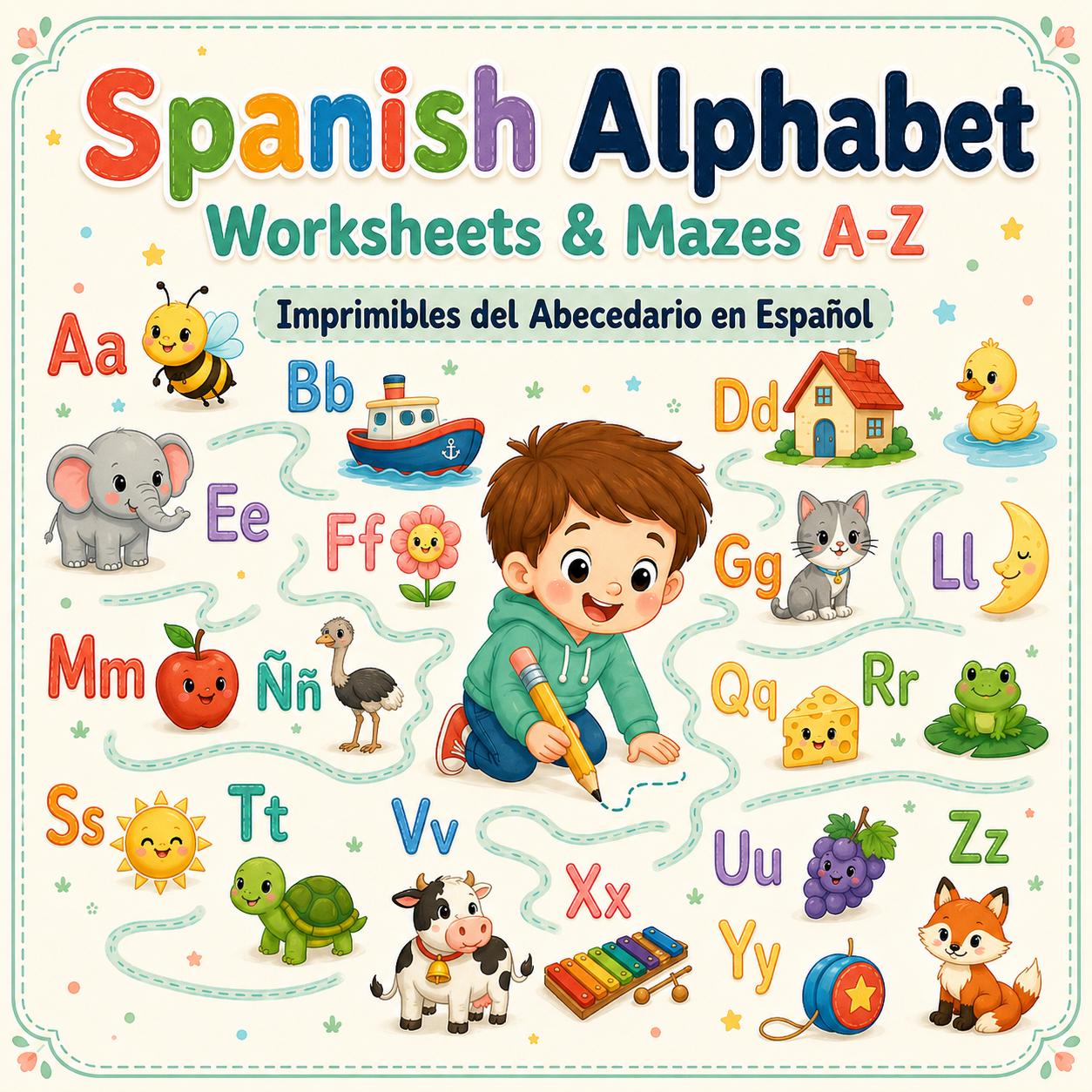
Printable Spanish Alphabet Activity Workbook (Ages 3-6)
A 50-page downloadable workbook designed to help bilingual toddlers and preschoolers master the Spanish alphabet through interactive puzzles and tracing. It simplifies early langua
$4.37
The good news: most bilingual toddler learning mistakes are entirely fixable once you know what to look for. This article breaks down the most common pitfalls, the research behind them, and practical steps you can take this week.
Key Takeaways:
- Overwhelming toddlers with too much structured instruction too early backfires consistently
- Language mixing (code-switching) in toddlers is normal and should not be corrected aggressively
- Consistency in context matters more than consistency in hours per day
- Printable activity tools work best when paired with audio, movement, and repetition
- Starting with the alphabet in isolation (without meaning) is one of the most common early mistakes
- Ages 3-6 is a critical window, but missing it doesn’t close the door permanently
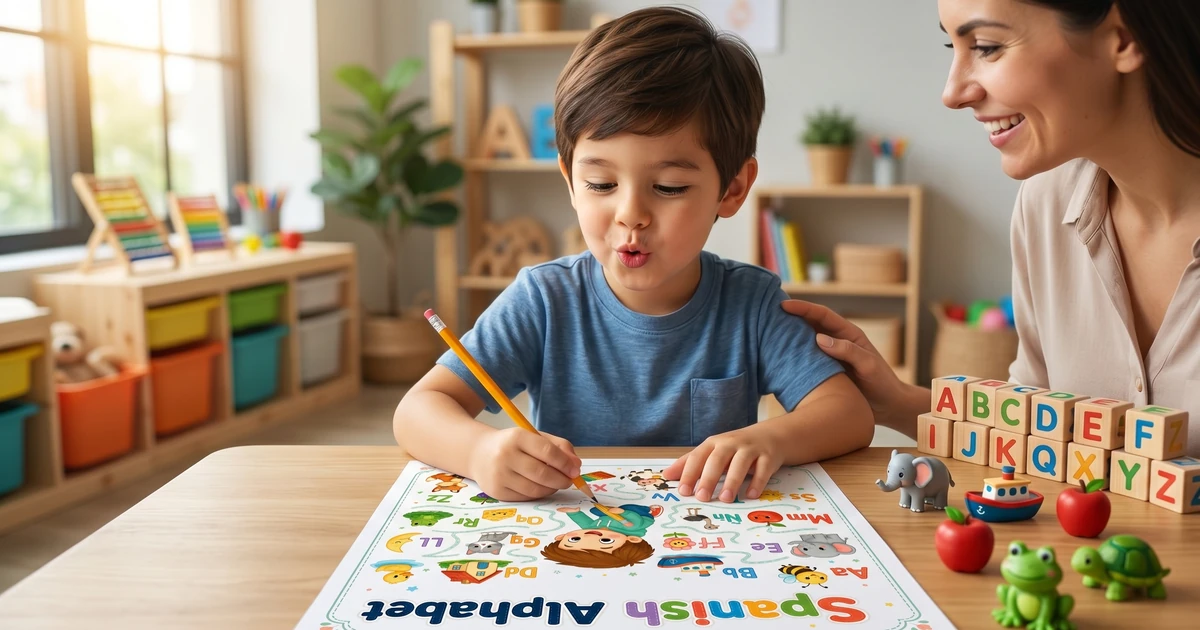
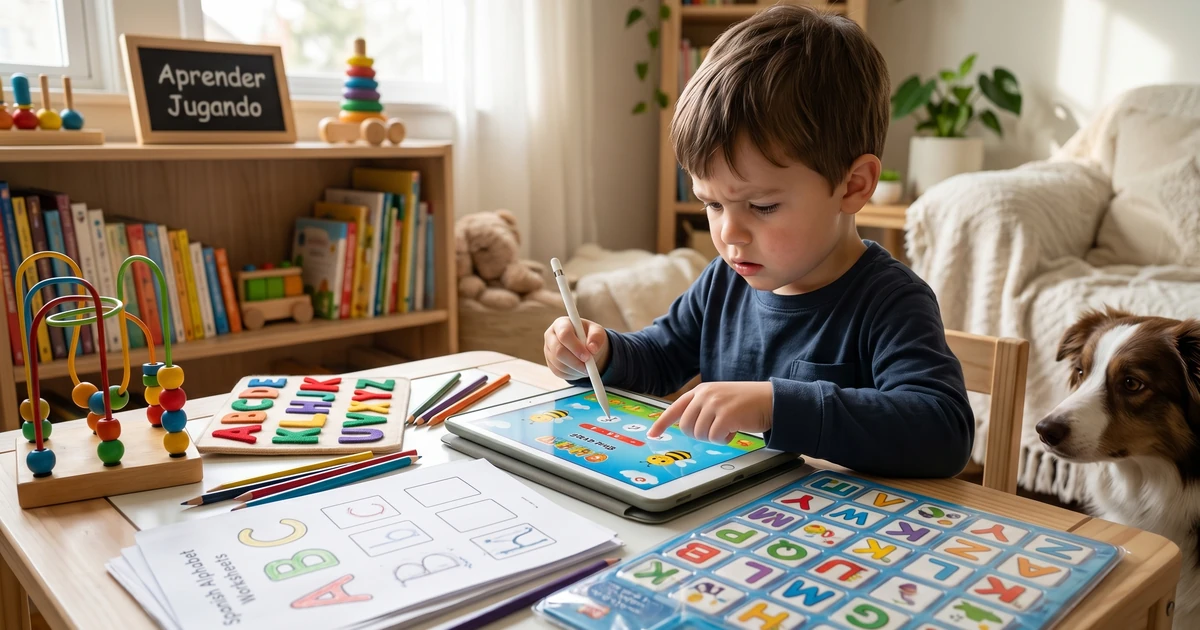
!Toddler practicing Spanish letters with printable worksheets
Mistake #1: Treating Bilingual Learning Like a Second Curriculum
The single biggest mistake I see parents make is approaching bilingual toddler learning the same way they’d approach teaching a second school subject. They schedule “Spanish time,” sit their 3-year-old down, and expect the child to toggle into learning mode.
It doesn’t work like that at this age.
Immersive language acquisition is the process by which young children absorb language through context, emotion, and repetition, not instruction. When you separate Spanish into a dedicated 20-minute block, you’re signaling to your toddler’s brain that this is a separate, optional thing, not a living part of daily experience.
“Children don’t learn languages through formal instruction in the early years. They learn through meaningful interaction, repetitive exposure, and emotional connection to the language.” - Dr. Patricia Kuhl, University of Washington Institute for Learning & Brain Sciences
The fix is simple but requires a mindset shift: weave Spanish into existing routines. Name foods at lunch. Count steps on the stairs. Label colors during bath time. This kind of low-pressure, high-frequency exposure is what bilingual researchers consistently point to as the foundation of early language acquisition.
The takeaway: Language learning at ages 3-6 needs to feel like life, not like school.
Mistake #2: Skipping Phonemic Awareness and Jumping Straight to Letters
Parents who are eager to get started often pull out an alphabet chart, point to the letter “A,” and say “this is A, it says ‘ah’ in Spanish.” Then they move to B, then C, and so on.
The problem? A toddler who can’t yet hear the sounds of Spanish distinctly can’t connect them to symbols meaningfully. Phonemic awareness (the ability to hear, identify, and manipulate individual sounds in spoken words) has to come before letter recognition for literacy to stick.
According to the National Institute for Literacy, phonemic awareness is the single strongest predictor of reading success, and it applies equally to children learning to read in Spanish.
What I’ve found from analyzing parent communities and early childhood educator feedback is that the most effective sequence looks like this:
Step 1: Build Listening and Sound Recognition
Play Spanish songs, rhymes, and read-alouds. Focus on sound repetition before any visual letters are introduced.
Step 2: Introduce High-Frequency Sounds Orally
Pick 3-4 sounds that appear in your child’s world: the “m” in “mamá,” the “p” in “papá,” the “s” in “sí.” Practice identifying them in spoken words.
Step 3: Connect Sounds to Letters Visually
Now introduce the printed letter alongside the sound. Use materials like Printable Spanish Alphabet Worksheets for Early Bilingual Readers that pair letters with familiar vocabulary images so the connection feels meaningful.
Step 4: Reinforce Through Tracing and Activity
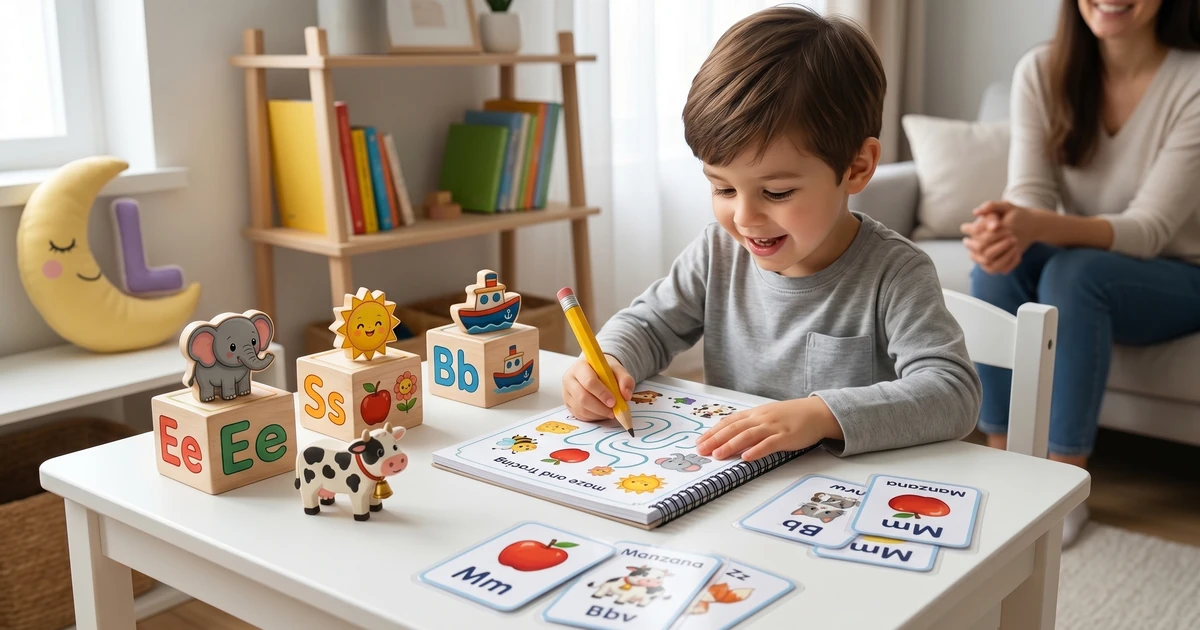
Hands-on activity pages that combine tracing, coloring, and picture-matching build multi-sensory memory pathways far more effectively than flashcards alone.
The takeaway: Sound-first, symbol-second is the sequence that research and experienced parents keep coming back to.
Mistake #3: Panicking About Language Mixing (Code-Switching)
You ask your toddler “¿Dónde está tu zapato?” and they respond “It’s over there, Mommy.” You feel like you’ve failed. You haven’t.
Code-switching (moving fluidly between two languages in a single conversation) is neurologically normal in bilingual children. It’s actually a sign of cognitive flexibility, not confusion. Yet the number of parents who pivot away from bilingual learning because their child “keeps mixing languages” is significant and heartbreaking.
“Bilingual children are not confused. They are using their full linguistic repertoire strategically. Code-switching is a sophisticated linguistic behavior, not a deficit.” - Ellen Bialystok, York University
The research from the American Speech-Language-Hearing Association (ASHA) confirms that code-switching does not indicate a language delay and should not be treated as an error to correct.
What actually helps is maintaining consistent contextual cues: speak Spanish during specific activities (alphabet practice, mealtime, bath), so your child’s brain builds associations between context and language. Don’t demand one-language responses. Model the correct form naturally without making a correction feel like punishment.
The takeaway: Language mixing is a feature of bilingual development, not a bug.
Mistake #4: Using Only One Input Format
A lot of parents find a resource that works (let’s say printable worksheets) and stick exclusively to that format. When the child plateaus or loses interest, they assume the approach has failed.
The real issue is input variety. Young children need multiple sensory channels to consolidate language learning. Visual (printed materials), auditory (songs, speech), kinesthetic (tracing, crafts, movement games), and social (interacting with other Spanish speakers) inputs each activate different neural pathways.
Here’s how different formats compare for toddler bilingual learning:
| Input Format | Strengths | Limitations | Best For |
|---|---|---|---|
| Printable worksheets | Structured, repeatable, portable | Passive if used alone | Letter recognition, fine motor + literacy |
| Spanish songs/nursery rhymes | High engagement, builds phonemic awareness | Limited vocabulary scope | Sound recognition, rhythm |
| Picture books in Spanish | Context-rich, builds vocabulary | Requires adult facilitation | Comprehension, story association |
| Flashcards | Fast review, easy to use | Low context, often boring for toddlers | Quick recall only |
| Screen-based apps | Interactive, engaging | Screen time concerns, limited personalization | Supplement only |
| Bilingual play (with peers) | Natural immersion | Access-dependent | Fluency and spontaneous use |
The parents who report the best outcomes consistently combine at least 3 of these formats. Printable activity workbooks like those in Best Bilingual Preschool Printable PDF Activity Bundles Under Five Dollars work beautifully as the anchor resource, with songs and picture books filling the gaps.
Pro Tip: Try pairing each letter in a Spanish alphabet workbook with a specific song that emphasizes that letter’s sound. Children who hear “la canción de la S” while tracing the letter “S” retain the association significantly faster.
The takeaway: Variety isn’t just nice to have, it’s neurologically necessary for bilingual toddler development.
Mistake #5: Inconsistent Exposure Without a Flexible System
Consistency is cited in every bilingual parenting guide ever written. But the advice usually stops at “be consistent,” which isn’t actionable for a parent managing a toddler who’s had three meltdowns before 9am.
What actually works is flexible consistency: a system that survives bad days, travel, illness, and schedule changes.
Here’s what that looks like in practice:
| Situation | Minimum Viable Spanish Exposure |
|---|---|
| Normal day at home | 20-30 mins of structured activity + mealtime labeling |
| Busy workday | 2-3 Spanish songs during commute/car ride |
| Child is sick/tired | One Spanish picture book at bedtime only |
| Travel | Pre-downloaded app or printed activity pages |
| Grandparent care | Leave Spanish labeled items around the house |
The goal is never miss twice. One skipped day won’t undo anything. A two-week gap starts to erode the neural pathways being built.
Parents who’ve successfully maintained bilingual learning routines often use printable resources specifically because they require no setup, no screens, and no internet. Grab a sheet from a workbook, hand it to the child with crayons, and you’ve got 10-15 minutes of meaningful Spanish exposure without any preparation.
You can also explore structured approaches in How to Run Homeschool Spanish Lessons Kindergarten Kids Keep Asking For for building routines that hold even when your week goes sideways.
The takeaway: A simple system that survives chaos beats a perfect system that only works on ideal days.
Mistake #6: Underestimating the Role of Pronunciation Practice
Many parents focus almost entirely on vocabulary and letter recognition, overlooking pronunciation. This is especially common among English-speaking parents who aren’t fluent in Spanish themselves: they don’t feel confident modeling sounds, so they skip it.
The problem is that Spanish phonology (particularly rolled R’s, the difference between B and V, and vowel sounds that don’t exist in English) is much easier to acquire before age 6 than after. The neuroplasticity window for phonetic accuracy is real.
“The critical period for phonological acquisition is strongest before age 7. After that, accent reduction requires deliberate effort that young children never have to make.” - Patricia Kuhl, MIT Technology Review interview
Activities that specifically target pronunciation include:
- Minimal pair games: Listening to and repeating similar words (“pato” vs. “palo”) to train the ear
- Mirror tracing: Having the child trace a letter while saying its sound out loud (combines kinesthetic + auditory input)
- Call-and-response songs: Songs where children repeat phrases build muscle memory for correct articulation
- Abecedario chanting: Saying the Spanish alphabet aloud, not just recognizing it visually
For structured pronunciation support, How Interactive Abecedario Activity Worksheets Accelerate Pronunciation Skills covers specific techniques that pair visual worksheets with oral practice.
The takeaway: Pronunciation is a use-it-or-lose-it skill at this age, and it deserves dedicated attention.
Mistake #7: Not Accounting for the Child’s Dominant Language Stage
Every toddler goes through predictable bilingual developmental stages. Parents who don’t know these stages mistake normal developmental pauses for failure.
| Stage | Age Range | What It Looks Like | Common Parent Mistake |
|---|---|---|---|
| Single language dominance | 2-3 years | Prefers one language strongly | Forcing equal use too early |
| Vocabulary building burst | 3-4 years | Rapid word acquisition in dominant language | Introducing too much grammar |
| Transfer stage | 4-5 years | Starts applying dominant language rules to L2 | Overcorrecting code-switching |
| Consolidation | 5-6 years | Both languages become more balanced | Reducing input, thinking job is done |
The ages 3-6 window featured in resources like KubbyLab’s workbook activities aligns precisely with the vocabulary building burst and transfer stage, which is why starting structured alphabet exposure between 3 and 5 tends to produce the best long-term results.
Parents who are earlier in this journey can also find non-fluent-parent strategies in Fun Home Spanish Preschool Activities for Parents Who Barely Speak It.
The takeaway: Knowing which stage your child is in stops you from interpreting normal development as a setback.
What to Look For When Choosing Bilingual Learning Tools
Not every resource is built with developmental appropriateness in mind. Here’s a criteria table I put together based on what educators and experienced bilingual parents consistently recommend:
| Criteria | Why It Matters | Green Flag | Red Flag |
|---|---|---|---|
| Age-appropriate complexity | Prevents overwhelm and disengagement | Activities scale by difficulty | Same format for ages 2-8 |
| Multi-sensory design | Supports different learning styles | Tracing + coloring + matching | Letter charts only |
| Phonics integration | Connects sound to symbol correctly | Each letter has a sound cue | Visual recognition only |
| Familiar vocabulary | Builds meaning, not just memorization | Uses words toddlers know (“mamá,” “casa”) | Obscure vocabulary |
| Printability + reusability | Practical for daily use | Clear PDF, works at home | Low resolution, single use |
| Cultural context | Builds genuine bilingual identity | Includes cultural references | Purely mechanical alphabet drill |
How Much Do Bilingual Learning Tools Cost?
One of the most common questions I see from parents is whether quality bilingual resources require a big investment. The short answer is no.
| Resource Type | Cost Range | Notes |
|---|---|---|
| Printable PDF workbooks | $2 - $8 | One-time purchase, print as many times as needed |
| Physical workbooks (store-bought) | $8 - $22 | Single use, can’t customize |
| Bilingual apps (subscription) | $5 - $15/month | Ongoing cost, screen-dependent |
| Private Spanish tutor (toddler) | $25 - $75/hour | Highest quality, least accessible |
| Free YouTube resources | $0 | Variable quality, no structure |
| Bilingual preschool programs | $400 - $1,500+/month | Most immersive, not accessible to all |
Printable PDF activity workbooks consistently represent the best value per use, especially when they’re designed to be printed repeatedly so multiple children (or the same child across multiple sessions) can use them.
FAQ: Bilingual Toddler Learning Mistakes
Q: My 3-year-old completely refuses to speak Spanish when I ask. Is this a learning problem?
Selective refusal is extremely common and almost never indicates a learning disorder. Toddlers at age 3 are asserting autonomy in every domain, and language is no exception. Back off direct requests, increase exposure through songs and stories without any response requirement, and give it 4-6 weeks. Owners of bilingual learning workbooks frequently report that children who initially refused started voluntarily identifying Spanish words within a month of low-pressure exposure.
Q: Can I start bilingual learning at age 5 if we missed the earlier window?
Ages 3-6 is ideal, but age 5 is absolutely not too late. The phonological window stays open until around age 7, and vocabulary acquisition can happen rapidly at any age. What changes after age 7 is mostly accent acquisition. Starting structured alphabet work at 5 with consistent daily input still produces strong outcomes.
Q: My child is behind in their dominant language. Should I hold off on bilingual learning?
This is one of the most persistent myths in bilingual parenting. According to ASHA, learning two languages does not cause language delays. If your child is behind in one language, a speech-language pathologist should be consulted, but bilingual exposure is not the cause and doesn’t need to stop. Separate concerns are separate.
Q: How many minutes per day do we actually need for bilingual learning to work?
Research from Concordia University suggests a minimum of 20-30 minutes of meaningful exposure per day for noticeable language development. The key word is meaningful: passive background noise (TV in Spanish) counts for much less than interactive, focused activity. Ten focused minutes beats sixty minutes of background noise every time.
Q: Are printable worksheets enough on their own, or do I need more?
Printable worksheets are an excellent structured foundation, but they work best as part of a multi-format routine. Pair them with at least one auditory source (songs, read-alouds) and try to include some spontaneous spoken Spanish in daily life. Worksheets build letter recognition and fine motor skills; real fluency needs more input channels.
**Q: What’s the biggest mistake parents make when they think