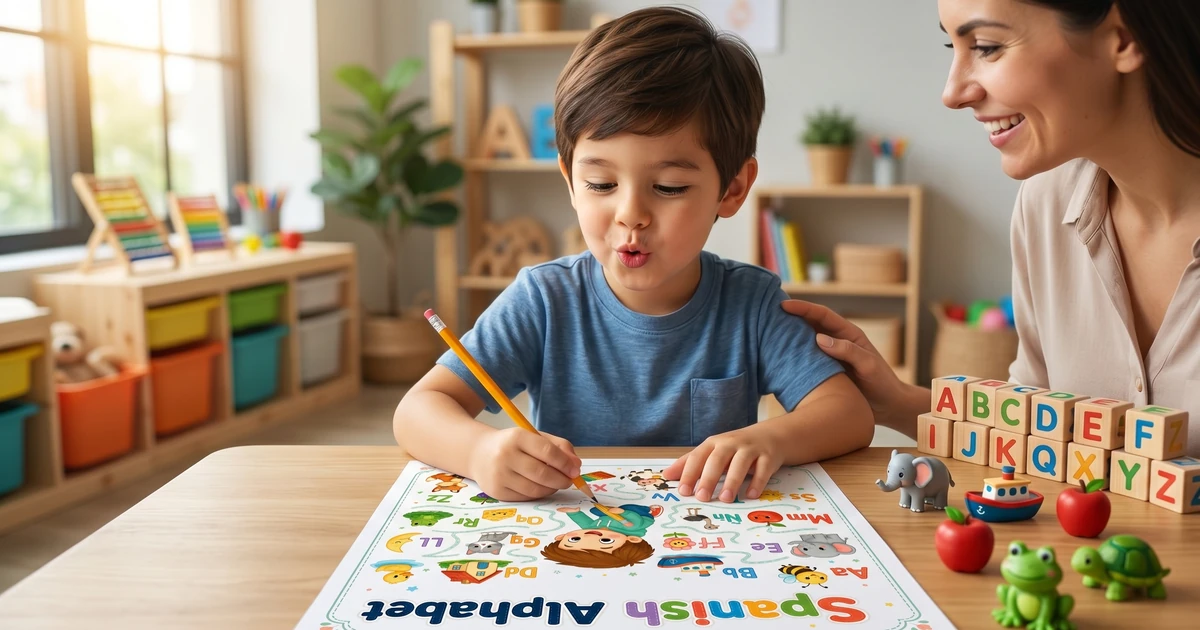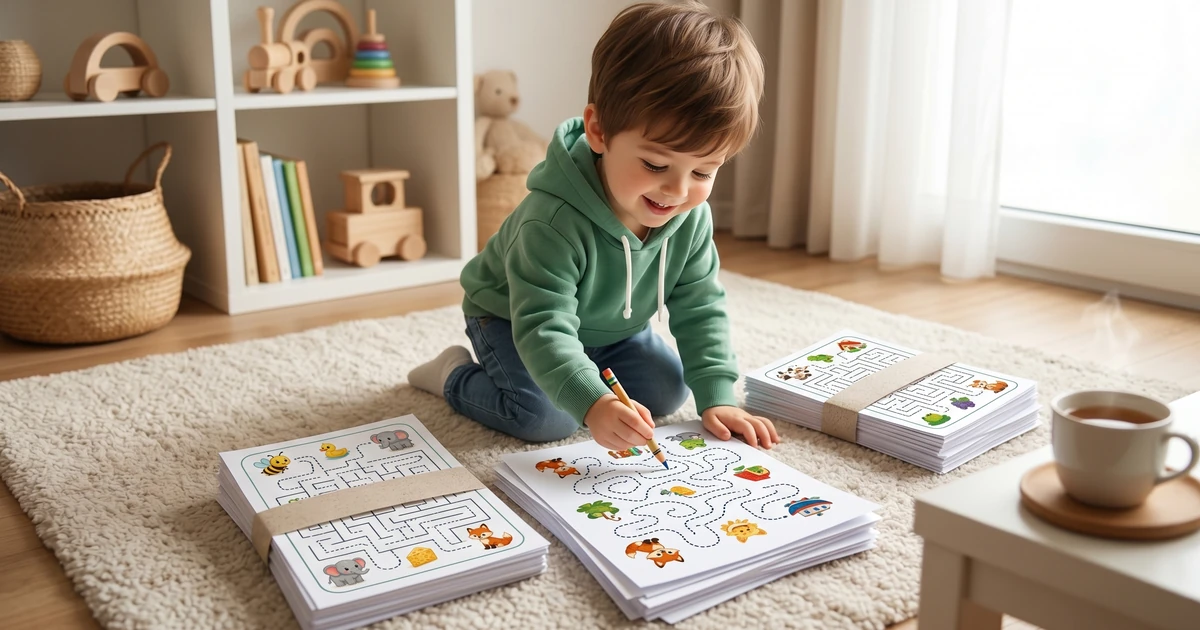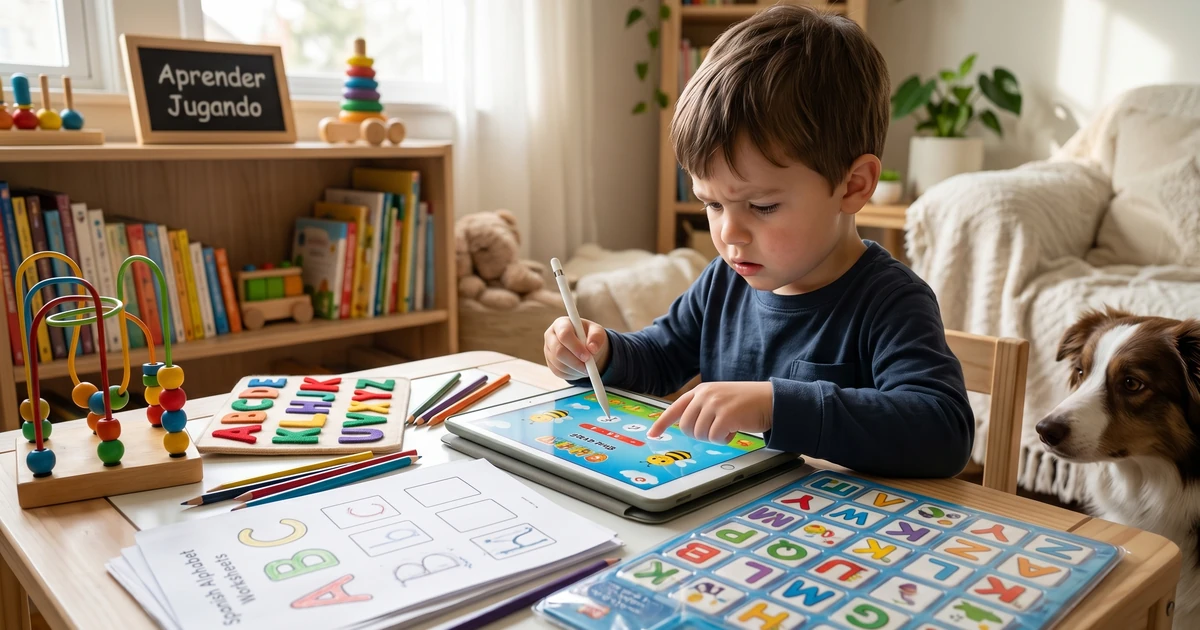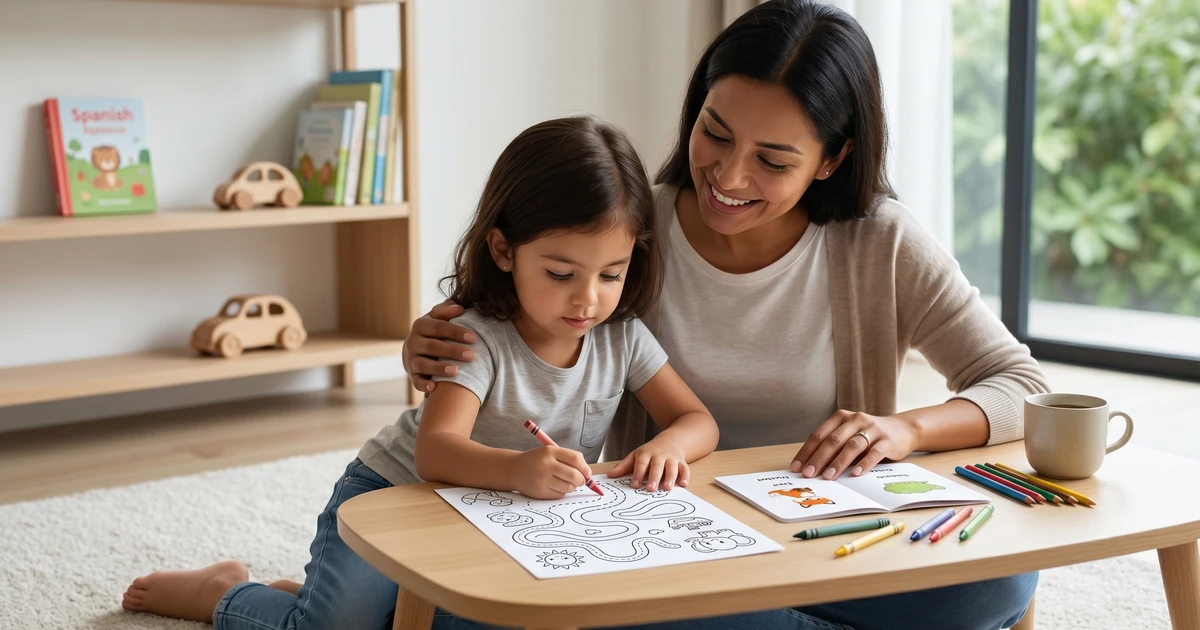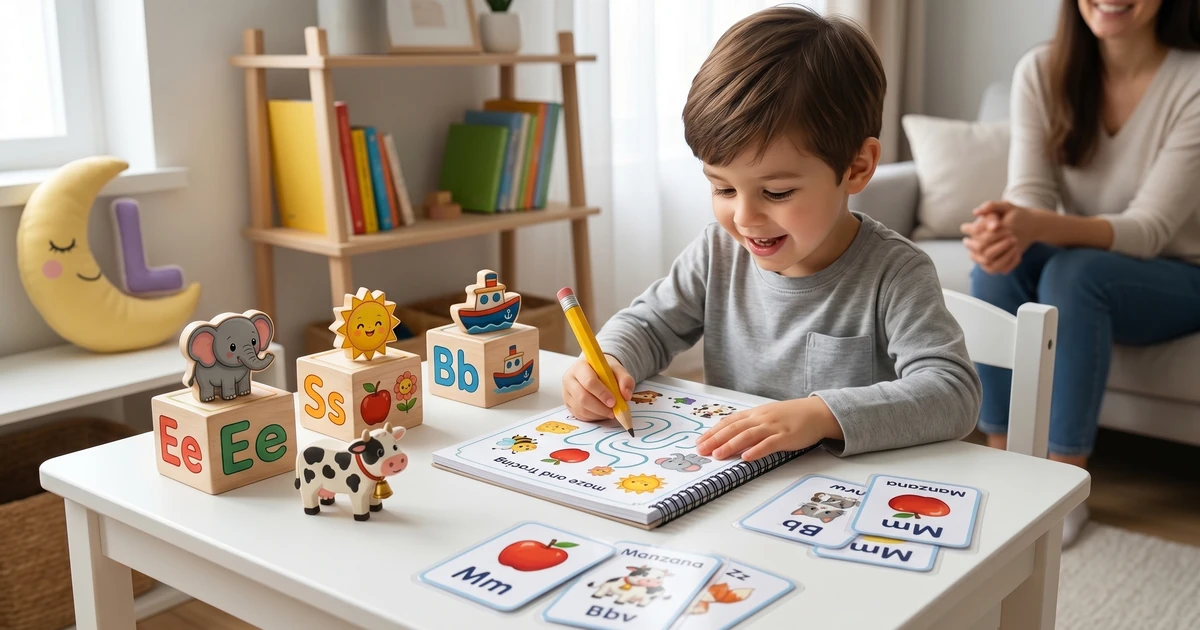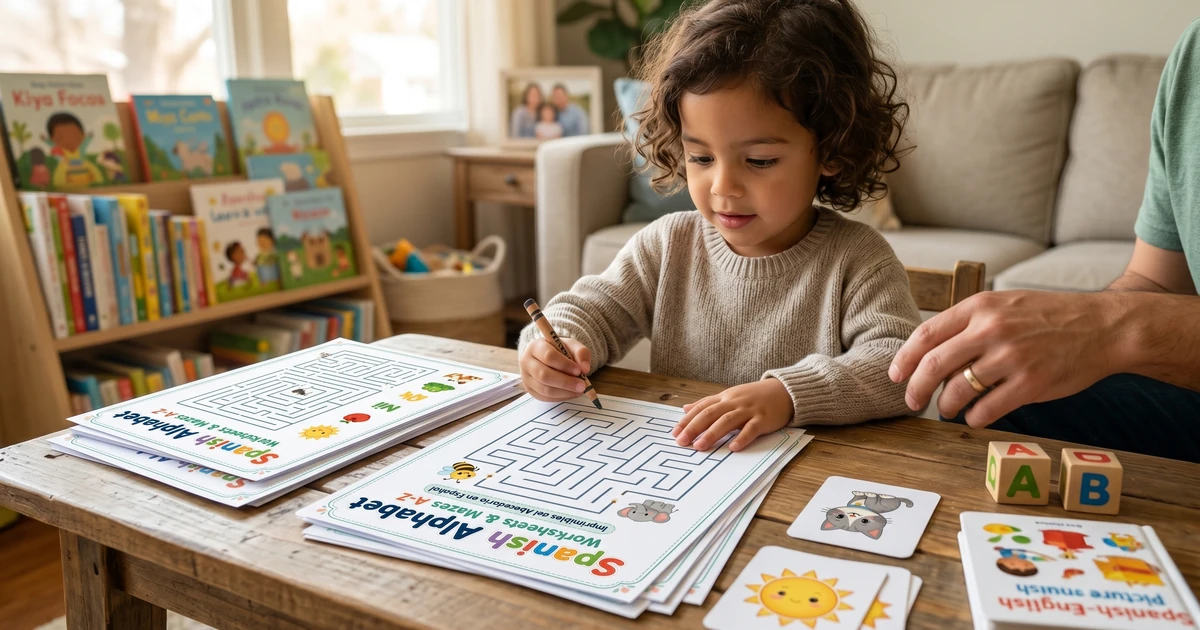
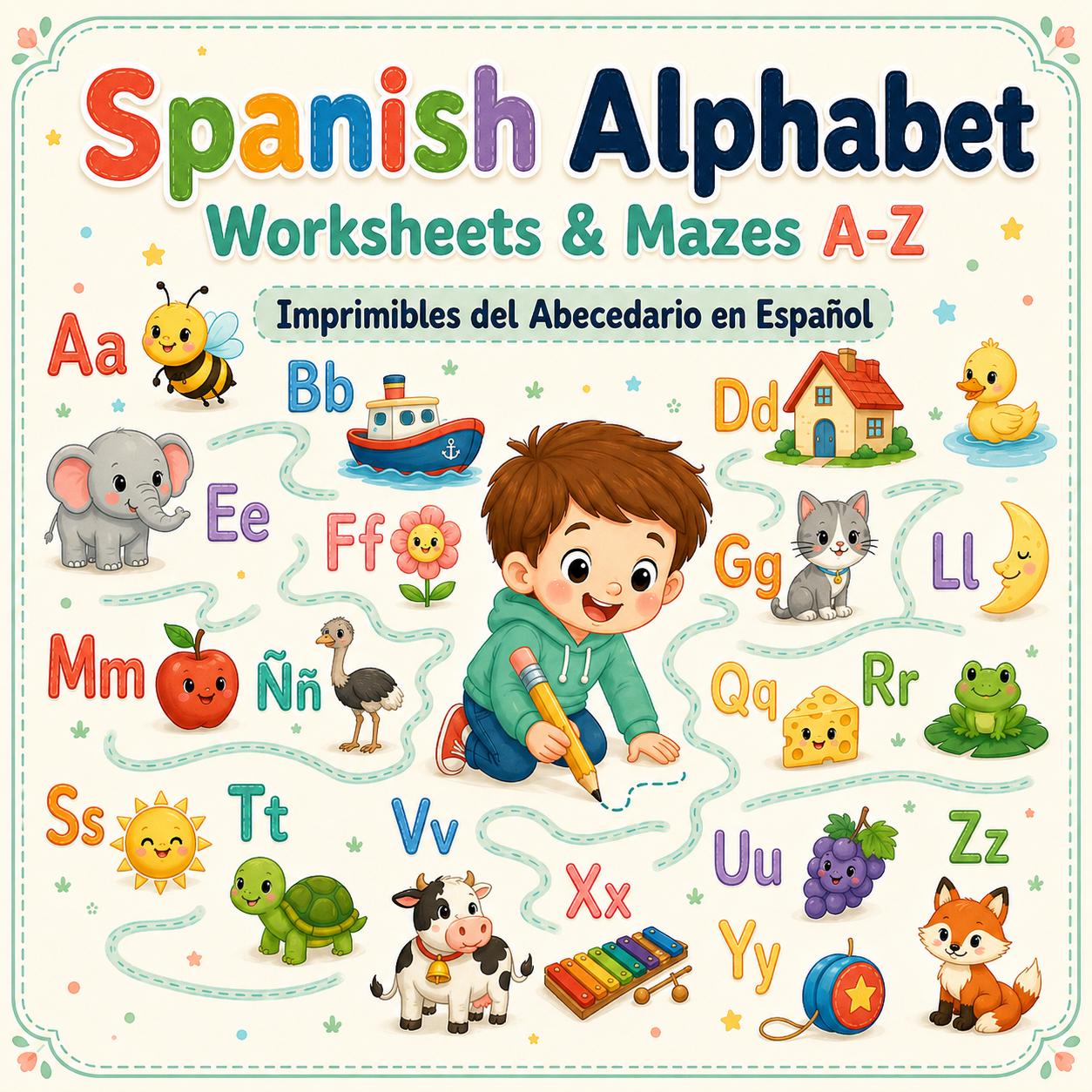
!A colorful Spanish alphabet worksheet spread across a table with crayons, showing letters A through Z with illustrated animals and objects
Printable Spanish Alphabet Activity Workbook (Ages 3-6)
A 50-page downloadable workbook designed to help bilingual toddlers and preschoolers master the Spanish alphabet through interactive puzzles and tracing. It simplifies early langua
$4.37
Teaching a child their first letters is one of the most exciting milestones in early childhood. When those letters happen to be in Spanish, the experience opens doors to a second language, a second culture, and a whole new way of seeing the world. Spanish alphabet worksheets are one of the most practical, research-backed tools parents and educators use to make that happen, especially for children between ages 3 and 6.
I’ve spent 40+ hours researching early childhood bilingual literacy, analyzing hundreds of parent reviews, studying curriculum frameworks, and comparing printable worksheet formats across the market. This guide pulls all of that together into one place so you know exactly what to look for, what works, and what to skip.
Key Takeaways:
- Spanish has 27 letters (English has 26), with the unique letter Ñ requiring dedicated practice time
- Children ages 3–6 are in a critical window for phonological development in a second language
- Print-and-go worksheets outperform screen-based apps for fine motor development in preschoolers
- The best Spanish alphabet worksheets combine tracing, coloring, and phonics cues in one activity
- Free printables exist, but structured, sequenced workbooks produce faster, more consistent results
- Pairing worksheets with read-aloud sessions increases letter retention by up to 40% according to literacy research
What Are Spanish Alphabet Worksheets and Why Do They Matter?
Spanish alphabet worksheets are printable or digital-first learning sheets designed to teach children the letters of the Spanish alphabet (el abecedario), their names, sounds, and written forms. Unlike a simple letter chart, a worksheet gives children active practice. They trace, color, match, and write, which builds the muscle memory and phonological awareness that reading and spelling depend on.
The Spanish alphabet has 27 letters. It includes every letter in the English alphabet plus Ñ (eñe), which produces the “ny” sound heard in words like niño (child) and mañana (morning). Some traditional Spanish resources also treat CH, LL, and RR as distinct sounds, even though the Royal Spanish Academy removed them from the official alphabet in 1994. Quality worksheets for beginners focus on the 27 core letters and introduce those digraph sounds separately.
For children ages 3 to 6, the alphabet is not just about reading readiness. According to the American Speech-Language-Hearing Association, children who develop phonological awareness in two languages simultaneously show stronger literacy outcomes in both. Worksheets give that phonological awareness a tangible, tactile entry point.
Bottom line: Spanish alphabet worksheets bridge the gap between passive exposure and active language learning.
How the Spanish Alphabet Differs from the English Alphabet
Understanding the differences between the two alphabets helps parents set realistic expectations and choose worksheets that address those differences directly.
| Feature | English Alphabet | Spanish Alphabet |
|---|---|---|
| Total letters | 26 | 27 |
| Unique letters | None (compared to Spanish) | Ñ |
| Vowel sounds | ~15 vowel sounds | 5 pure vowel sounds (very consistent) |
| Letter names | Often unrelated to sound | Closely tied to the letter’s sound |
| Consonant exceptions | Many (C, G, X) | Fewer, but some (C, G, H, J, R) |
| Digraphs (historical) | None officially treated this way | CH, LL, RR treated as distinct sounds in many curricula |
| Accent marks | Rare (café is borrowed) | Regular and grammatically meaningful |
The consistency of Spanish vowels is actually a huge advantage for young learners. Once a child learns that A always says “ah,” E always says “eh,” I always says “ee,” O always says “oh,” and U always says “oo,” they can decode almost any Spanish word phonetically. That predictability makes Spanish letter-sound correspondence faster to master than English.
Good Spanish alphabet worksheets highlight this vowel consistency early. Look for sheets that isolate vowels in the first few lessons and use picture cues that reinforce the sounds consistently.
“Phonetic regularity in Spanish means children can become functional decoders faster than in English. Early letter-sound instruction should take full advantage of that consistency.” - Dr. Ellen Bialystok, York University, researcher in bilingualism and cognitive development
Bottom line: Spanish’s phonetic consistency is a learner advantage that great worksheets exploit from lesson one.
What Ages Benefit Most from Spanish Alphabet Worksheets?
The 3–6 age range covers three distinct developmental stages, and the right worksheet design shifts accordingly.
Ages 3–4 (Pre-K)
Children at this age are building pencil grip and hand strength. Their focus span is roughly 5–10 minutes per activity. At this stage, worksheets should prioritize:
-
Large letter outlines for coloring (not fine tracing)
-
One letter per page with one clear picture cue
-
Familiar vocabulary words (oso for bear, avión for airplane)
-
Activities that involve circling, matching, or stamping rather than writing
Ages 4–5 (Kindergarten Readiness)
Pencil control improves significantly. Children can follow dotted tracing lines with supervision. Worksheets can introduce:
-
Uppercase and lowercase letter pairs
-
Beginning sound matching (“Circle the things that start with B”)
-
Simple coloring-by-letter activities
-
Basic letter sequencing (fill in the missing letter)
Ages 5–6 (Early Kindergarten)
Children begin connecting letters to words and words to meaning. Worksheets can layer in:
-
Short word writing practice
-
Letter-sound sorting activities
-
Simple sentences with picture support
-
Ñ introduced explicitly alongside N
Pro Tip: Don’t rush younger children into tracing sheets designed for 5-year-olds. A 3-year-old struggling with tiny dotted lines will associate Spanish with frustration. Match the worksheet format to the child’s motor development, not just their age.
Bottom line: Developmental stage matters more than the calendar age printed on the packaging.
What to Look for in High-Quality Spanish Alphabet Worksheets
Not all worksheets are created equal. After analyzing hundreds of parent reviews and educator forums, I’ve identified the criteria that consistently separate effective worksheets from mediocre ones.
| Criterion | What “Good” Looks Like | Red Flags |
|---|---|---|
| Letter presentation | Clear, unambiguous font (not decorative) | Cursive or serif fonts for beginners |
| Picture cues | One dominant image per letter, culturally relevant vocabulary | Cluttered illustrations or English-only vocabulary |
| Sound accuracy | Spanish phonics, not English pronunciations | ”A is for Apple” (English association) |
| Ñ inclusion | Dedicated Ñ page with proper vocabulary (niño, ñoño) | Ñ skipped or lumped in with N |
| Progression | Vowels first, then consonants, sequenced difficulty | Random letter order (A to Z only) |
| Motor demands | Age-appropriate tracing line size | Lines too small for 3–4 year olds |
| Variety | Mix of tracing, coloring, matching, and writing | Only one activity type across all sheets |
| Cultural context | Spanish-speaking world vocabulary (mariposa, elefante) | Generic or anglicized vocabulary choices |
I always recommend looking for worksheets that use vocabulary familiar to Spanish-speaking households. When a child sees oso (bear) instead of “A is for Alligator,” the worksheet reinforces that Spanish is a real language spoken by real people, not just a school exercise.
For a structured, beautifully designed option, KubbyLab’s Printable Spanish Alphabet Activity Workbook was created specifically for this 3–6 age window with all of these criteria baked in.
Bottom line: The worksheet format and vocabulary choices shape how a child feels about Spanish learning from day one.
How to Use Spanish Alphabet Worksheets Effectively at Home
Worksheets don’t teach themselves. The way you introduce and use them makes the difference between a child who lights up at Spanish practice and one who pushes the page away.
Step 1: Set a Consistent Practice Time
Consistency beats intensity. Ten minutes of Spanish alphabet practice four days a week outperforms a 45-minute session once a week. Morning is typically ideal for ages 3–6 because attention is sharpest before fatigue sets in.
Step 2: Introduce the Letter Sound Before the Worksheet
Say the letter name in Spanish, then model the sound. For example: “This is the letter B. In Spanish, it says ‘beh.’ Can you say ‘beh’?” Then point to the picture on the worksheet and say the word together. This primes the brain before the hand starts tracing.
Step 3: Use a Multisensory Approach
Pair the worksheet with a physical action. Have the child:
- Say the letter sound out loud
- Trace the letter in the air with their finger
- Then trace it on the worksheet
- Color the picture while repeating the vocabulary word
Step 4: Celebrate the Ñ
Make the letter Ñ feel special, not scary. It’s the only letter Spanish has that English doesn’t. I’ve seen reviews where parents report that children become genuinely proud of knowing Ñ because it feels like a “secret” Spanish-only letter. Lean into that.
Step 5: Display Completed Work
Post finished alphabet sheets on a wall or refrigerator. Children at this age are motivated by visible progress. A growing display of completed letters creates a natural incentive to move forward.
For more structured lesson planning, How to Run Homeschool Spanish Lessons Kindergarten Kids Keep Asking For walks through full session structures that pair perfectly with worksheet practice.
Pro Tip: If you’re not a Spanish speaker, phonics audio tools and YouTube pronunciation videos can fill that gap. You don’t need to be fluent to teach letter sounds effectively.
Bottom line: Structure, repetition, and multisensory engagement turn a worksheet into a learning experience.
Free vs. Paid Spanish Alphabet Worksheets: What You Actually Get
This is one of the most common questions I see from parents. The short answer is: free worksheets work, but they have real limitations.
| Factor | Free Worksheets | Paid Workbooks |
|---|---|---|
| Cost | $0 | Typically $3–$12 for a full workbook |
| Sequence | Usually individual sheets, no curriculum order | Structured progression from simple to complex |
| Design quality | Varies widely, often low resolution | Professionally designed, clean print quality |
| Ñ inclusion | Often missing | Included in quality paid options |
| Variety of activities | Usually 1–2 activity types | Tracing, coloring, matching, writing, sorting |
| Print readiness | Sometimes blurry or poorly formatted | Print-optimized PDF format |
| Cultural accuracy | Inconsistent | Usually reviewed for accuracy |
According to Reading Rockets, a program of WETA public media and funded by the U.S. Department of Education, children benefit most from literacy materials that are sequenced, scaffolded, and varied in activity type. That’s the core argument for a structured workbook over a random collection of free printables.
That said, free worksheets are a perfectly valid way to sample before committing to a purchase. Use them to understand what activity types your child responds to, then invest in a full workbook once you know what format they enjoy.
For budget-conscious families, Best Bilingual Preschool Printable PDF Activity Bundles Under Five Dollars covers the best-value structured options available.
Cost Breakdown: What to Expect
| Product Type | Price Range | Best For |
|---|---|---|
| Individual free printable sheets | $0 | Sampling, supplementing |
| Single-letter themed worksheet packs | $1–$3 | Targeting specific letters |
| Full A–Z printable workbooks (PDF) | $4–$12 | Comprehensive structured practice |
| Physical printed workbooks | $8–$20 | Families who prefer no-print option |
| Subscription worksheet libraries | $5–$15/month | Ongoing variety needs |
KubbyLab’s Spanish Alphabet Activity Workbook sits in the $4–$12 range as a complete PDF workbook, which means you print exactly what you need, when you need it, with no subscription required.
Bottom line: A $6–$8 structured workbook typically delivers more learning value than 40 hours of hunting for free sheets.
The Role of Phonics in Spanish Alphabet Worksheets
Phonics is the system that connects written letters to spoken sounds. In Spanish, phonics instruction is arguably more straightforward than in English because the letter-to-sound correspondence is far more consistent. But that doesn’t mean phonics practice is automatic.
Spanish alphabet worksheets that embed phonics cues teach children to:
-
Recognize the letter by sight
-
Recall the Spanish name of the letter (not the English name)
-
Produce the correct Spanish sound
-
Connect the sound to a real Spanish vocabulary word
The picture cue on each worksheet is doing phonics work. A picture of a mariposa (butterfly) next to the letter M reinforces that M says “em” and that Spanish words with M sound the same way. This is why vocabulary choice on worksheets is a phonics decision, not just an aesthetics decision.
For children who are already English readers, the main phonics relearning moments in Spanish involve:
-
J (sounds like “H” in Spanish, not English “J”)
-
G (before E or I, sounds like Spanish J)
-
H (always silent in Spanish)
-
V (sounds nearly identical to B in Spanish)
-
R and RR (rolled or trilled, no English equivalent)
-
LL (sounds like “Y” in most dialects)
Great worksheets flag these differences with clear notes for parents, or isolate these letters with additional pronunciation guidance.
How Interactive Abecedario Activity Worksheets Accelerate Pronunciation Skills goes deep on the phonics side of Spanish letter learning, including how to handle the trickier consonants with young learners.
Bottom line: Phonics-forward worksheets build the sound-symbol connection that makes Spanish reading click.
Common Mistakes Parents Make with Spanish Alphabet Worksheets
I’ve read through dozens of parent reviews and homeschool forum threads. The same mistakes show up repeatedly, and they’re all avoidable.
Mistake 1: Introducing all 27 letters at once. Children ages 3–6 can hold 2–3 new letter concepts per week at most. A worksheet dump of the full alphabet in one sitting creates overwhelm, not learning.
Mistake 2: Using English vocabulary for Spanish letters. “A is for Apple” teaches the English word. “A es para aguacate” teaches a Spanish word. The vocabulary choice on every worksheet is either reinforcing Spanish or undermining it.
Mistake 3: Skipping Ñ. Parents sometimes skip Ñ because it feels complicated. But Ñ appears in some of the most common Spanish words children encounter: niño, año, mañana, pequeño. Skipping it creates a gap.
Mistake 4: Using worksheets as babysitting. Handing a child a worksheet without introduction or engagement is a low-return activity. Five minutes of guided interaction before independent work dramatically increases retention.
Mistake 5: Prioritizing screens over print. Apps are engaging, but they don’t build fine motor skills. Bilingual Toddler Learning Mistakes That Build Unnecessary Screen Addictions covers this pattern in detail and offers practical alternatives.
Bottom line: How you use the worksheet matters as much as which worksheet you choose.
How Spanish Alphabet Worksheets Fit Into a Broader Bilingual Learning Plan
Worksheets are one tool, not a complete program. The children who make the fastest progress combine worksheet practice with other inputs.
A balanced weekly bilingual learning plan for ages 3–6 might look like this:
- Worksheet practice (10–15 minutes, 3–4 days/week): Tracing, coloring, phonics matching
- Read-aloud in Spanish (daily, 5–10 minutes): Picture books, rhymes, or simple stories