
Fine Motor Activities for Preschoolers: 6 Core Hand Skills
Part of: Kindergarten Readiness Worksheets: 8 Skills to Practice
By KubbyLab Team · Updated
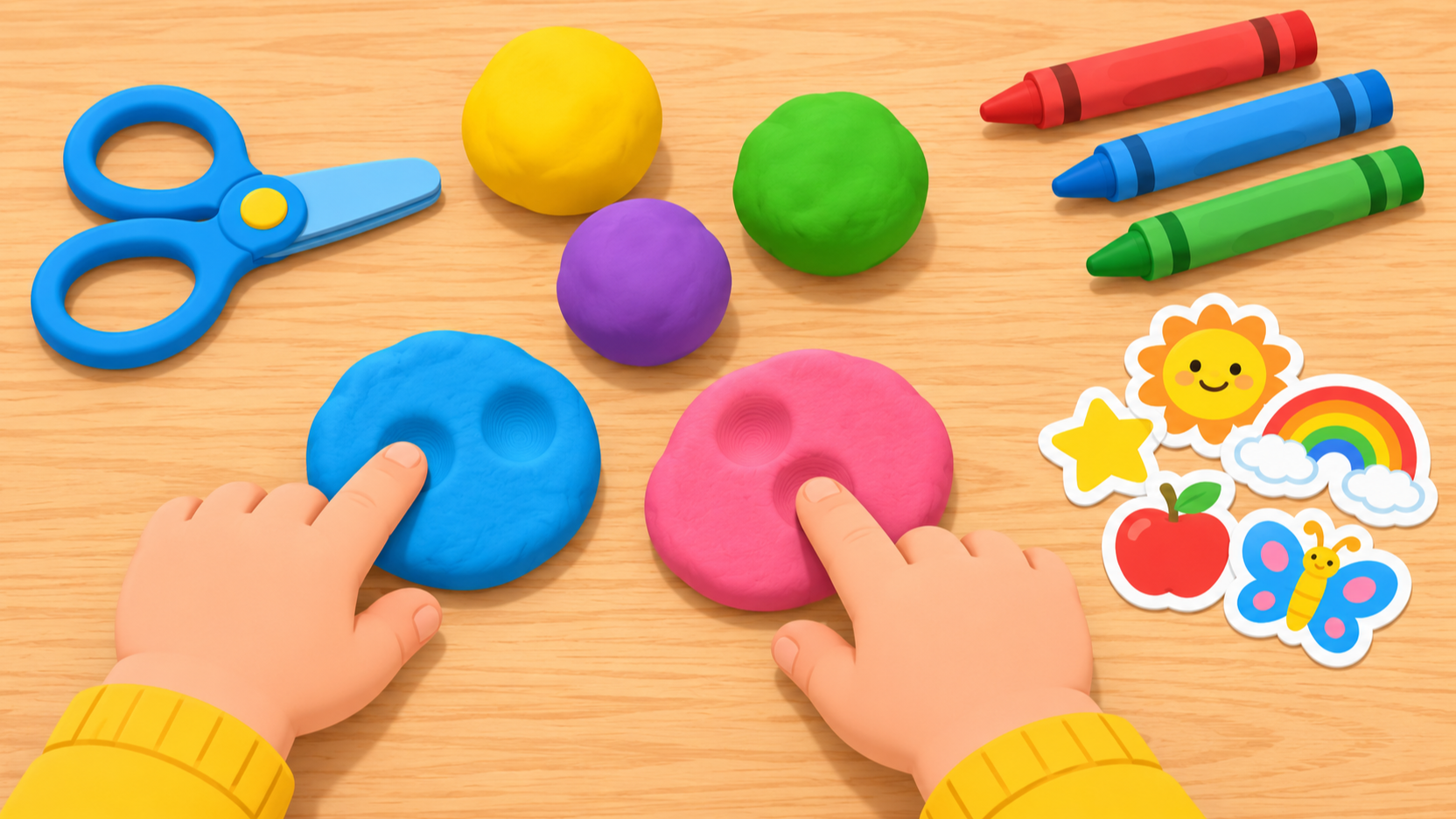
Effective fine motor activities for preschoolers train the small muscles of the thumb, fingers, palm, and wrist through five to ten minutes of daily resistance play paired with graduated paper tasks. Children ages 3 to 5 build lasting pencil and scissor control when they practice pinching playdough, squeezing clothespins, and threading large beads before tracing thick vertical lines or cutting short paper strips.
Parents and teachers searching for preschool hand exercises usually want to solve an immediate tabletop problem: a child who grips a crayon in a tight fist, tears through coloring paper, drops child-safe scissors, or avoids drawing altogether. Hand fatigue happens when a preschooler is asked to trace small letters before the arches of the palm and the thumb-to-index pincer grasp can support a writing tool. Pairing off-paper muscle warm-ups with the structured printables in our Kindergarten Readiness Worksheets: 8 Skills to Practice guide turns frustrating table sessions into predictable ten-minute daily routines.
Key Takeaways
- Short daily sessions of five to ten minutes build preschool hand endurance faster than long weekend coloring sessions.
- Hand strength and finger coordination develop together when children squeeze, pinch, twist, and thread physical objects before picking up a pencil.
- Scissor control follows a strict five-step sequence starting with empty open-and-close motions and fringe snips on heavy paper strips.
- Pre-writing worksheets work best when printed on standard US Letter (8.5 x 11 inches) or A4 (21 x 29.7 cm) paper with thick guide lines that move from vertical strokes to curves.
- Persistent fisted pencil grips past age 5 or intense emotional refusal during all hand tasks signal the need for a pediatric occupational therapy check.
What Are the Big 6 Fine Motor Skills in Fine Motor Activities for Preschoolers?
The big six fine motor skills for preschoolers are pincer grasp, palmar arch strength, thumb opposition, in-hand manipulation, bilateral coordination, and wrist stability for controlled mark-making. Each mechanical skill governs a specific classroom task, from pinching a short crayon between the thumb and index finger to stabilizing a sheet of paper while cutting with scissors.
Most parents treat handwriting and cutting as single skills. In practice, a four-year-old sitting at a table relies on six separate muscle actions working at the same time. If one component lags behind, the child compensates with large shoulder and elbow movements. That compensation looks like a white-knuckle fist grip, an elbow raised high off the table, or a worksheet spinning across the desk because the non-dominant hand never holds the corner down.
Understanding which mechanical skill each exercise targets helps you rotate tasks across the week instead of repeating the same coloring page every afternoon.
| Fine Motor Skill | Physical Action in the Hand | Classroom Task It Controls | Target Age Band | Daily 5-Minute Practice Task |
|---|---|---|---|---|
| Pincer grasp | Pad of thumb presses against pad of index finger | Picking up small items and holding a short crayon | Ages 3 to 5 | Peeling flat stickers off a backing sheet and placing them on dots |
| Palmar arch strength | Cupping the center of the palm to form a hollow space | Squeezing glue bottles and controlling pencil pressure | Ages 3 to 5 | Rolling stiff playdough or clay into one-inch balls inside one palm |
| Thumb opposition | Rotating the thumb across the palm to touch each fingertip | Fastening buttons, zipping coats, and opening jars | Ages 3.5 to 5 | Touching thumb to index, middle, ring, and little finger in rhythm |
| In-hand manipulation | Moving a small object from the palm to the fingertips with one hand | Adjusting a pencil closer to the tip without setting it down | Ages 4 to 5 | Picking up three dried beans one by one and storing them in the palm |
| Bilateral coordination | Dominant hand works while helper hand stabilizes the material | Turning paper while cutting shapes with child-safe scissors | Ages 3 to 5 | Threading one-inch wooden beads onto a stiff tipped shoelace |
| Wrist stability | Holding the wrist slightly extended while fingers move independently | Tracing lines and drawing shapes without whole-arm fatigue | Ages 3.5 to 5 | Drawing or tracing on a paper sheet taped to a vertical wall or easel |
When a preschooler struggles with a worksheet, check the table above to spot the missing building block. A child whose hand cramps after two minutes of coloring rarely needs another coloring book. That child needs palmar arch resistance and wrist extension work.
How Do Fine Motor Milestones Progress From Ages 3 to 5 Before Kindergarten?
Preschool fine motor milestones progress from whole-arm scribbles and stringing one-inch beads at age 3 to holding a crayon between the thumb and fingers at age 4, and copying letters or buttoning clothing by age 5. Tracking these physical markers helps parents match home tasks to a child’s current muscle control rather than chronological age alone.
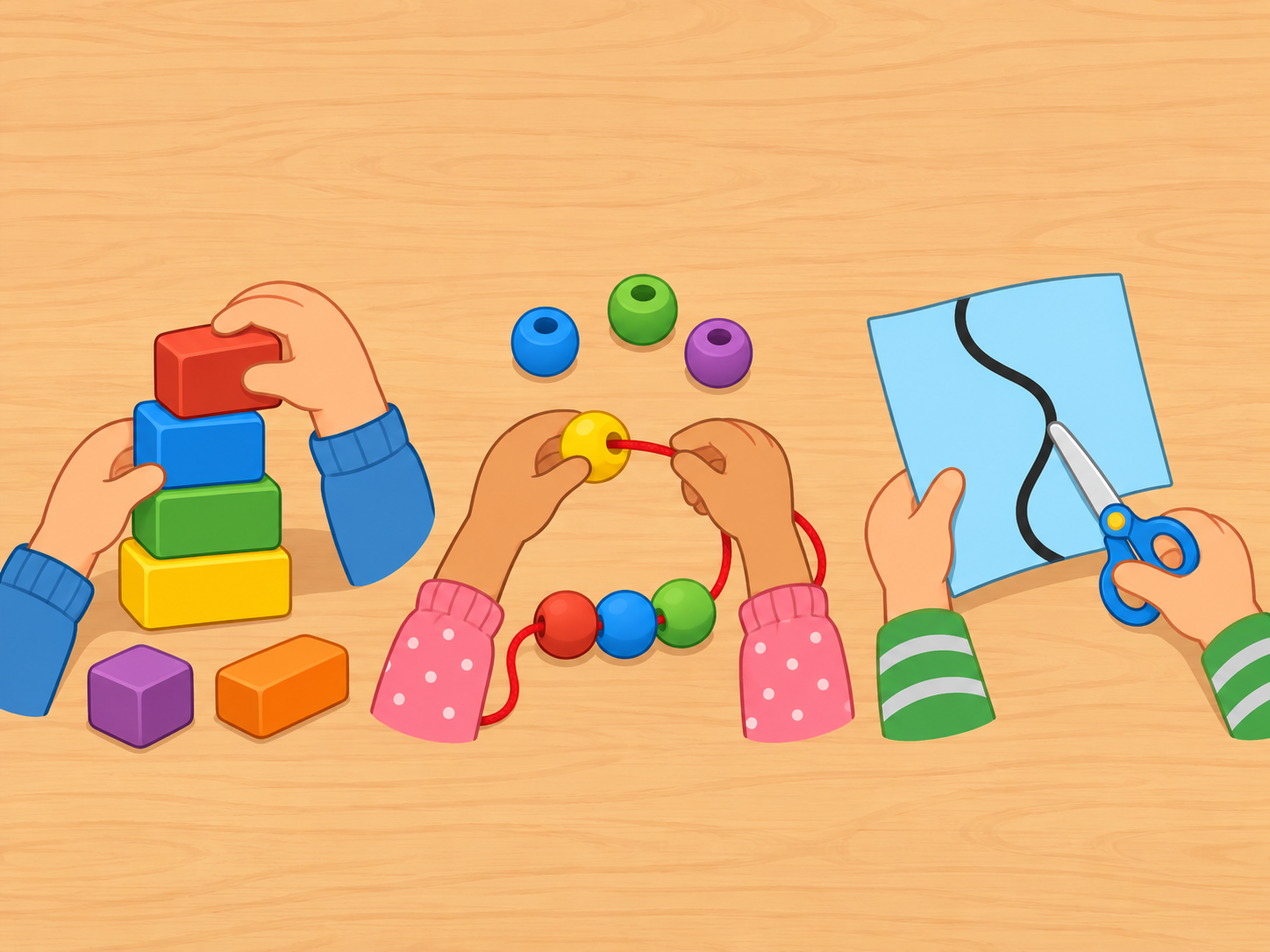
Hands mature from the center of the body outward. A toddler controls the shoulder first, then the elbow, then the wrist, and finally the small knuckles of the index and middle fingers. Asking a three-year-old to write lowercase letters inside narrow ruled lines forces joints that are still stabilizing to perform precision work.
According to the CDC, a typical three-year-old strings large items like macaroni or big beads together, puts on some loose clothes independently, and draws a circle after an adult demonstrates the motion. At this stage, children frequently use a digital pronate grasp, pointing their index finger down the shaft of the crayon while the wrist turns inward.
By age 4, finger isolation becomes much clearer. According to the CDC, a key four-year milestone is that a child “Holds a crayon or pencil between fingers and thumb (not a fist).” Four-year-olds also unbutton large buttons, pour liquid from a small pitcher with adult supervision, and use child-safe scissors to cut across paper.
Between ages 4.5 and 5, preschoolers develop a dynamic tripod grasp (thumb, index, and middle finger pinching the barrel while the ring and little fingers tuck into the palm for stability). They begin copying capital letters, drawing a person with three or more body parts, and fastening medium buttons on a shirt. Reviewing the broader skill checklist in Kindergarten Readiness Worksheets: 8 Skills to Practice shows how these physical hand milestones connect directly to early phonics, counting, and classroom self-care.
Why Does Hand Strength Come Before Pencil Tracing in Preschool Fine Motor Practice?
Hand strength must come before pencil tracing in preschool fine motor practice because weak intrinsic palm muscles force children to lock their fingers into a tight fist to control a crayon. Resistance exercises like rolling stiff clay and pinching wooden clothespins build the finger endurance needed to hold a pencil lightly without tearing paper.
Many parents respond to messy coloring by printing extra handwriting sheets. Without underlying muscle strength, extra pencil time backfires. The small intrinsic muscles inside the palm tire out within ninety seconds, the child switches back to a full fist grip to keep the crayon moving, and the paper rips under heavy downward shoulder pressure.
Picture a common afternoon at the kitchen table. Before changing your routine, an unfinished butterfly worksheet sits on the table with torn paper around the wings and a broken wax crayon rolled onto the floor. You put the worksheet aside for three minutes, hand your four-year-old a lump of firm playdough and five wooden pegs, and ask them to pinch a row of dinosaur spikes along the dough ridge before switching to a two-inch broken crayon stub. The short crayon stub makes a fist grip physically impossible, so their thumb and index finger naturally pinch the barrel and trace the four thick vertical lines on the page without ripping the paper.
According to NAEYC, preschoolers build essential pre-writing mechanics when adults pair daily drawing opportunities with hands-on physical materials like clay, tongs, and pegboards that strengthen finger dexterity. Think of resistance play as the warm-up and the printable tracing sheet as the short cooldown.
What Toys and Household Tools Are Good for Fine Motor Skills?
The most effective toys and household tools for preschool fine motor skills are stiff playdough, spring-loaded wooden clothespins, blunt plastic tweezers, one-inch wooden lacing beads, pegboards, and flat sticker sheets. Unlike passive glass screens, physical tools provide mechanical resistance against the thumb and index finger whenever a child squeezes, pulls, twists, or threads an object.
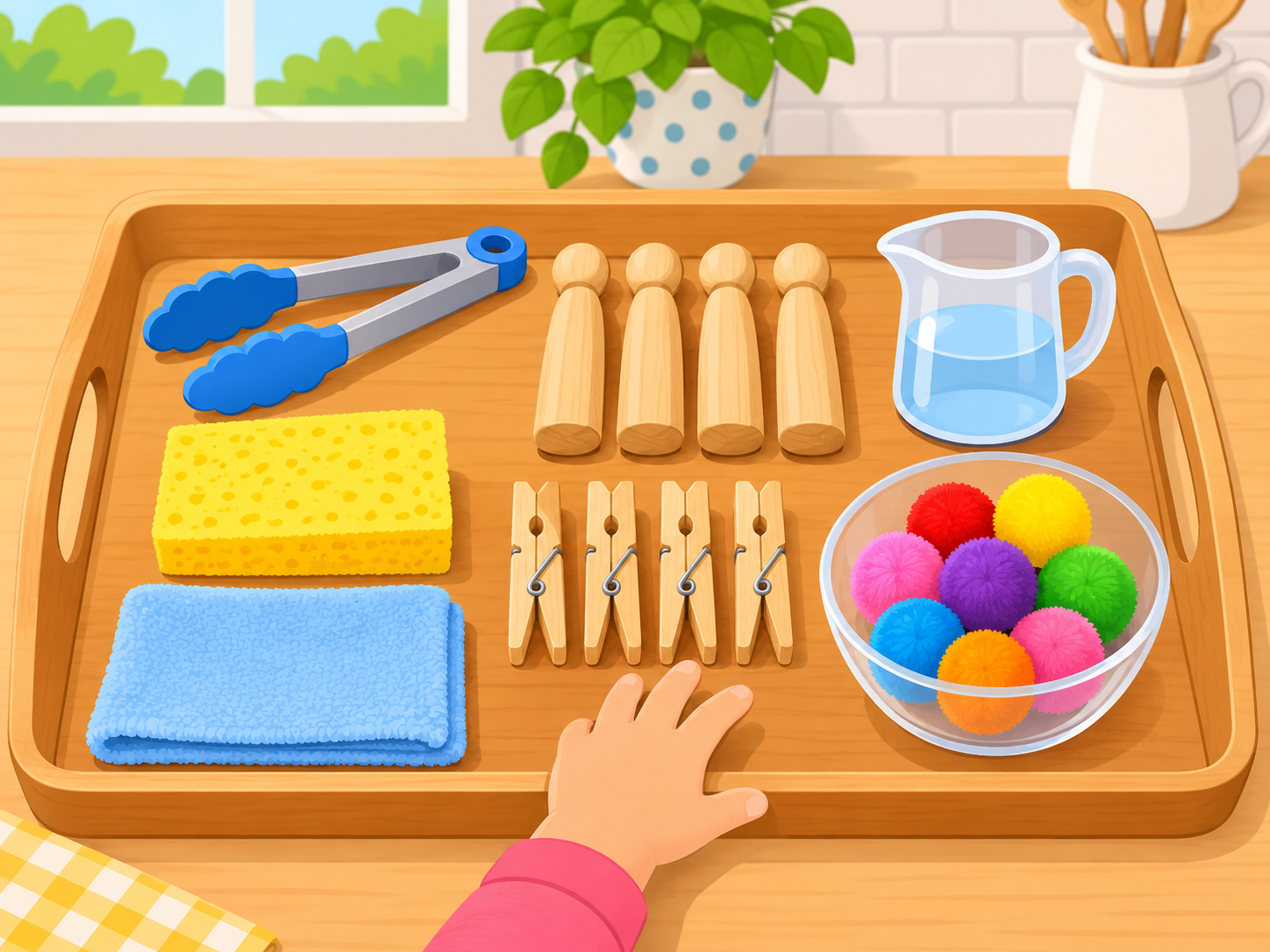
You do not need an expensive therapy catalog to stock a home fine motor bin. Everyday kitchen and craft items provide exact mechanical resistance for three- to five-year-old hands when grouped by the movement they demand.
- Pinch and pull tools train the thumb and index finger to isolate force. Stock a plastic storage box with flat dot-sticker sheets, wooden spring clothespins, mini strawberry hullers or child-safe tongs, and half-inch pom-poms. Peeling a sticker corner with a fingernail and pinching a clothespin open ten times builds the exact thumb-to-index web space required to hold a triangle pencil.
- Squeeze and resistance tools build the central palm arch and forearm endurance. Keep firm playdough, therapy putty, a small plant spray bottle, a kitchen turkey baster, and a two-inch cellulose sponge in your play bin. Squeezing water from a sponge or pressing playdough through a garlic press strengthens the whole palm.
- Thread and twist tools train both hands to cooperate across the body’s midline. Collect large wooden lacing beads, dry rigatoni pasta, clean plastic spice jars with screw-on lids, and thick cardstock punch cards with a blunt single-hole punch.
Many parents wonder whether tablet tracing apps count as fine motor activities for preschoolers. Sliding an index finger across frictionless glass gives zero resistance to the thumb web space and teaches a one-finger poke rather than a three-finger pinch. As we explain in Why ‘educational’ YouTube videos aren’t teaching your child to read, passive screen time and flat glass tapping cannot replace the physical friction of paper, wax crayons, and three-dimensional objects.
| Practice Method | Finger posture Used | Mechanical Resistance | Bilateral Hand Use | Transfer to Pencil & Scissors |
|---|---|---|---|---|
| Tablet tracing app on glass | Single extended index finger | None (frictionless glass surface) | Low (tablet rests on table or stand) | Minimal transfer to three-finger pencil grip |
| Physical tools (tongs, dough, beads) | Thumb opposed to index and middle fingers | High (spring tension and clay density) | High (one hand holds while other manipulates) | Direct muscle preparation for writing and cutting |
| Printed worksheet with 2-inch crayon | Three-finger tripod pinch on short barrel | Moderate (wax friction on paper grain) | High (helper hand anchors paper flat) | Exact physical rehearsal for classroom writing |
What Games and Step-by-Step Scissor Routines Help With Fine Motor Skills?
Tabletop transfer games, coin-slot races, and a five-step scissor cutting routine build preschool hand coordination by teaching both hands to work together on a clear physical target. Starting with air-snipping and short fringe cuts on cardstock prevents hand frustration before a child attempts straight lines, curved paths, or simple geometric paper shapes.
When practice feels like a timed game, three- and four-year-olds stay focused for a full eight-minute session. Try rotating three low-prep tabletop games during the week. In the bean rescue game, press ten dried lima beans into a flattened pancake of playdough and have your child extract each bean using only a thumb-and-index pinch or plastic tweezers. In the coin bank race, cut a narrow vertical slot into the plastic lid of an empty yogurt tub and challenge your child to pick up twenty large buttons or coins flat off the table without sliding them to the table edge. In the clothespin number wheel, draw twelve dots around a paper plate and ask your child to clip a wooden clothespin onto each dot using one hand while the helper hand rotates the plate.
Scissor practice requires an even clearer sequence. Handing a four-year-old a thin sheet of copy paper with a complex shape printed in the center almost always ends in folded paper and tears. Thin copy paper flops over unless the child holds their thumb pointing upward.
Follow this five-step scissor progression using heavy index cards or 65-pound cardstock strips before moving to standard printer paper:
- Open and close child-safe blunt scissors in the air, then snip soft playdough snakes into one-inch chunks so the child feels blade resistance without having to steer paper.
- Make single half-inch fringe snips along the edge of a two-inch-wide cardstock strip while keeping the thumb of the cutting hand pointed toward the ceiling.
- Cut all the way across a two-inch-wide paper strip in two consecutive forward blade strokes along a thick black marker line.
- Cut along a gently curved six-inch line printed on standard paper while the helper hand slowly pivots the bottom of the sheet.
- Cut out a four-inch square and a four-inch circle by turning the paper corner with the helper hand rather than twisting the scissor wrist.
Pre-writing pencil work follows a matching developmental stroke order. Occupational therapy checklists introduce strokes in the exact sequence young brains master spatial directions:
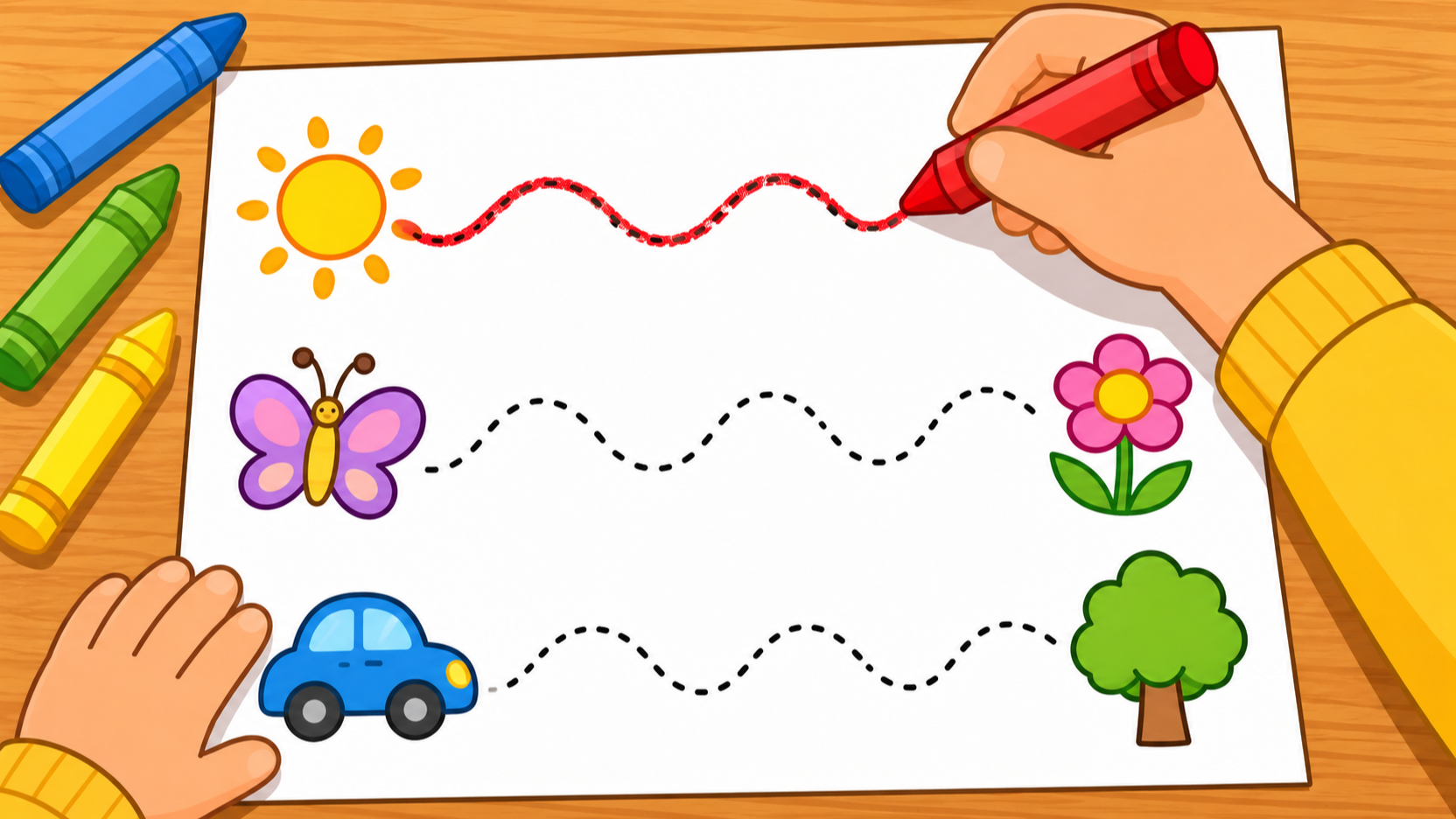
- Trace and imitate straight vertical lines from top to bottom, followed by horizontal lines from left to right.
- Trace and copy enclosed circles and intersecting plus signs (+), which require crossing the body’s midline.
- Trace diagonal lines, simple squares, and X shapes once straight vertical and horizontal strokes stay steady.
- Follow wide curved paths, gentle zigzags, and simple letter shapes. You can find the complete stroke-by-stroke progression in our guide on Tracing Sheets for Preschoolers: Where to Start.
How Do You Use a Printable PDF Routine for 3- to 4-Year-Old Fine Motor Activities?
A printable PDF routine for 3- to 4-year-old fine motor activities for preschoolers pairs five minutes of physical finger warm-ups with one single-page tracing, dot-to-dot, or cutting sheet five days a week. Printing pages on standard US Letter or A4 paper lets parents repeat the same stroke pattern across several weeks as pencil control improves.
Short daily sessions beat a thirty-minute weekend drill every time. A preschooler’s intrinsic hand muscles fatigue after eight to ten minutes of concentrated pinch work. Stopping while your child still feels confident makes them willing to sit down at the table the next morning.
According to NAEYC, integrating brief, playful writing and drawing routines into everyday family schedules builds early literacy confidence without pressuring young learners. The five-day schedule below balances off-paper muscle building with targeted printable PDF sheets.
| Day of Week | Primary Hand Skill | 4-Minute Physical Warm-Up | 4-Minute Printable PDF Task | Tools Needed at the Table |
|---|---|---|---|---|
| Monday | Pincer grasp | Peel 12 dot stickers and press onto paper | Straight vertical line tracing sheet | Dot stickers, printed PDF, 2-inch triangular crayon |
| Tuesday | Palmar arch strength | Roll firm playdough into 10 small balls | Wide single-path printable maze | 3 ounces playdough, printed PDF, washable thick marker |
| Wednesday | Scissor control | Pinch 8 wooden clothespins onto a box edge | Printable scissor fringe and strip cutting page | Clothespins, child-safe blunt scissors, printed PDF |
| Thursday | Bilateral coordination | Thread 10 one-inch wooden beads on a lace | Dot-to-dot shape connection worksheet | Wooden beads, tipped shoelace, printed PDF, short pencil |
| Friday | Wrist stability | Spray water target or crumple scrap paper balls | Curved path tracing sheet taped to wall or easel | Masking tape, printed PDF on vertical wall, short crayon |
| Weekend | Child choice review | Child chooses favorite bin tool from the week | Repeat one favorite printed PDF page | Selected bin tool and one extra copy of a printed sheet |
When choosing or printing fine motor PDF worksheets for three- and four-year-olds, check the physical layout of the file on screen before sending it to your home printer. Worksheets designed for first graders have narrow lines and crowded graphics that overwhelm preschool eyes and hands.
| Printable Worksheet Specification | Target Setup for Ages 3 to 4 | Target Setup for Ages 4.5 to 6 | Why the Specification Matters | |---|---|---|---|---|---| | Paper dimensions | US Letter (8.5 x 11 inches) or A4 (21 x 29.7 cm) | US Letter (8.5 x 11 inches) or A4 (21 x 29.7 cm) | Fits standard home printer trays with no scaling needed | | Tracing path thickness | 0.25 inch (6 mm) wide gray or dotted guide lines | 0.12 inch (3 mm) dashed guide lines | Wide paths forgive normal preschool wrist wobble | | Tasks per printed page | 3 to 5 distinct lines or 1 large shape per sheet | 6 to 10 lines or 4 smaller shapes per sheet | Prevents hand cramping and visual crowding on the page | | Starting and stopping cues | High-contrast start dot and clear finish icon | Simple directional arrows at stroke start | Teaches top-to-bottom and left-to-right stroke habits | | File format and reuse | Printable PDF file (print fresh copies or slip into dry-erase sleeve) | Printable PDF file (use directly with graphite pencil on paper) | Dry-erase markers slide easily; paper grain builds true pencil pressure |
If you want a ready-made set of graduated printables, the KubbyLab Preschool Learning Bundle includes 260+ printable PDF worksheets formatted for ages 3 to 5, covering thick-line vertical and horizontal tracing, progressive scissor cutting strips, wide-path mazes, and shape copying.
How Can Parents Fix Common Fine Motor Mistakes and Know When to Seek Occupational Therapy?
Parents can fix most home fine motor struggles by swapping full-length pencils for two-inch crayons, taping practice paper to a vertical easel, and starting with straight vertical strokes before curved letters. When a child past age 5 still uses a full palmar fist grip or refuses all hand tasks, parents should request a pediatric occupational therapy evaluation.
Even well-planned fine motor activities for preschoolers can stall if the tool size or table posture works against the child’s hand anatomy. When a worksheet session goes wrong, look at the physical evidence on the paper and in your child’s posture. Use the diagnostic guide below to match what you see at the kitchen table to an immediate mechanical adjustment.
| What You See at the Table | Mechanical Cause in the Hand or Arm | Immediate Home Fix |
|---|---|---|
| Child grips crayon in a closed fist | Long crayon barrel leaves space for all four fingers to wrap around | Break wax crayons in half to 2 inches or use golf-size pencils |
| Crayon tears through the worksheet | Weak shoulder and palm stabilization causes heavy downward pressing | Place a sheet of textured sandpaper or foam under the worksheet for tactile feedback |
| Marks are so faint they barely show | Low finger pinch strength and high friction from hard graphite | Switch to soft chubby wax crayons or broad washable markers first |
| Worksheet spins around while drawing | Bilateral coordination gap; helper hand forgets to anchor the page | Draw a small handprint outline in the top corner where the helper hand rests |
| Wrist curls inward like a hook | Weak wrist extensor muscles when working on a flat horizontal desk | Tape the printed worksheet at chest height on a wall, fridge, or angled binder |
| Scissor blades fold paper instead of cutting | Child rotates wrist sideways with thumb pointing toward the table | Stick a small star sticker on the child’s thumbnail as a reminder: “thumb looks up” |
Home practice resolves mild muscle fatigue and lack of exposure, yet some preschoolers need specialized guidance. According to the CDC, five-year-olds typically write some letters in their name, button some buttons, and use utensils and classroom tools with steady control. Consider asking your pediatrician or local school district for a pediatric occupational therapy (OT) evaluation if you observe any of these four consistent patterns:
- Your child is age 5 or older and still holds crayons, spoons, and pencils in a full palmar fist grip across all daily tasks.
- You notice a sharp difference between the left and right hands, such as one hand remaining tightly fisted or completely ignored during two-handed play.
- Tabletop drawing, cutting, or dressing tasks trigger frequent tears, task refusal, or physical hand shaking after one or two minutes.
- Fine motor difficulties appear alongside broader challenges with balance, speech clarity, or sensory sensitivity to common textures.
An occupational therapy assessment gives you an individualized map of your child’s shoulder, wrist, and finger mechanics so your ten-minute home activities support their exact developmental needs.
More in this series
Can YouTube Videos Teach a Child to Read at Home?
Can YouTube videos teach child to read at home? Choose a phonics clip, pause for practice, and try a simple off-screen word check.
Tracing Sheets for Preschoolers: Where to Start
Choose tracing sheets for preschoolers by the strokes your child can make, then try lines, shapes, letters, and names through play.
Keep reading
Tracing Sheets for Preschoolers: Where to Start
Choose tracing sheets for preschoolers by the strokes your child can make, then try lines, shapes, letters, and names through play.
Kindergarten Readiness Worksheets: 8 Skills to Practice
Choose kindergarten readiness worksheets for eight preschool skills. Use the printable checklist to pair each page with a hands-on activity.
Can YouTube Videos Teach a Child to Read at Home?
Can YouTube videos teach child to read at home? Choose a phonics clip, pause for practice, and try a simple off-screen word check.
Frequently asked questions
What are the big 6 fine motor skills?
The big six fine motor skills are pincer grasp, palmar arch strength, thumb opposition, in-hand manipulation, bilateral coordination, and wrist stability. Together, these six muscle mechanics allow a preschooler to pinch a crayon with three fingers, hold paper steady with the helper hand, manipulate buttons, and guide child-safe scissors along a printed line.
Can you provide a PDF with some ideas for fine motor skills activities for 3- to 4-year-olds?
Parents and teachers can print a five-day PDF routine on standard US Letter or A4 paper that pairs a five-minute physical warm-up with one structured worksheet per day. For ages 3 and 4, choose printable PDF pages featuring quarter-inch thick vertical and horizontal tracing paths, wide single-turn mazes, and straight scissor-snip strips around the outer border.
What toys are good for fine motor skills?
Toys that require pinching, pulling, squeezing, or threading build preschool hand muscles fastest. Top fine motor tools for ages 3 to 5 include firm playdough, spring-loaded wooden clothespins, child-safe plastic tweezers, one-inch wooden lacing beads, pegboards, interlocking building bricks, and flat sticker sheets that require a fingernail peel.
What games help with fine motor skills?
Simple kitchen-table games that use small targets and two-handed coordination build fine motor control without feeling like drill work. Effective games include timed tong-transfer races with dried beans, dropping coins into a narrow piggy-bank slot, clipping numbered clothespins onto a cardboard wheel, and rolling playdough snakes to match printed length lines.
At what age should a preschooler hold a pencil with fingers instead of a fist?
Most preschoolers transition from a whole-hand fist grip to holding a crayon or pencil between their thumb and fingers around age 4. By age 5, children typically use a three-finger tripod or four-finger quadrupod grasp with steady paper pressure. If a 5-year-old still relies on a full palmar fist grip daily, schedule a pediatric occupational therapy check.