
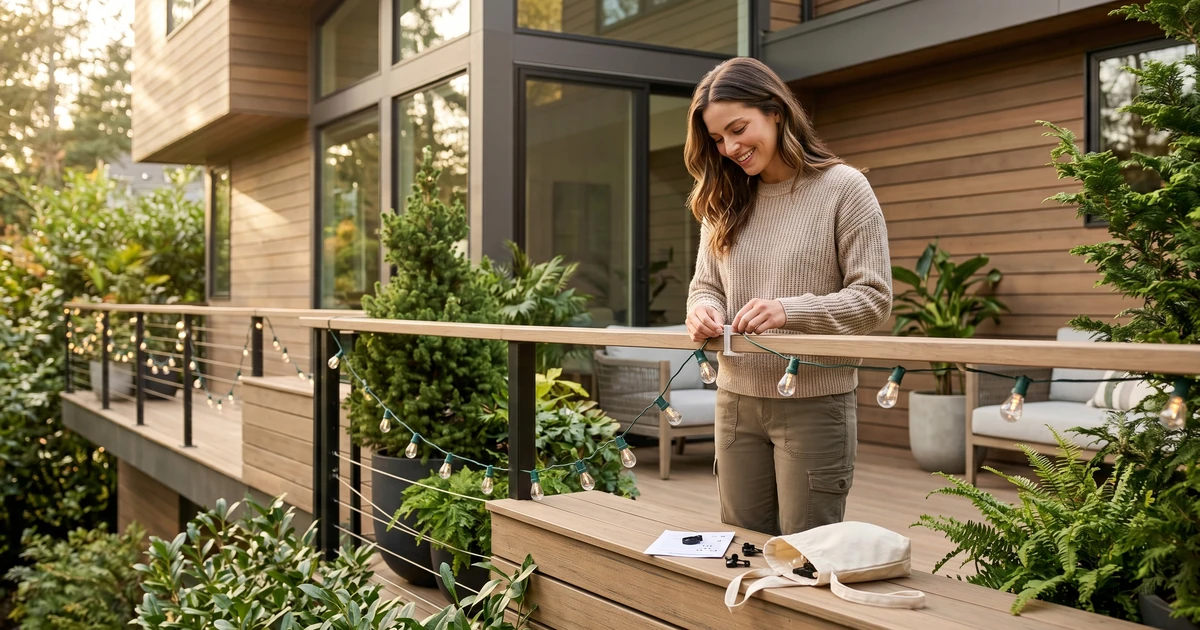
First-Time Homeowner: Outdoor Holiday Lighting Made Easy
Every year, the same thing happens. You haul out the boxes, untangle what feels like a mile of wire, spend three hours on a ladder, and step back to see
Every year, the same thing happens. You haul out the boxes, untangle what feels like a mile of wire, spend three hours on a ladder, and step back to see… something that looks nothing like the photos you saved. The neighbors on your left have a display that stops cars. Yours looks like you gave up halfway through.
 DIGITAL PRODUCT
holiday lighting outdoor
Recommended products related to this guide.
I’ve spent 40+ hours researching outdoor holiday lighting, reading thousands of owner reviews, and studying what actually separates a stunning display from a forgettable one. The gap isn’t budget. It’s not even effort. It’s knowing a handful of principles that most people never figure out.
This page covers the most common mistakes and how to fix them. For the full setup guide with specific product picks and a room-by-room plan, read The Complete Holiday Planning Resource.
Key Takeaways:
- The biggest holiday lighting outdoor mistakes are about spacing and power, not bulb type
- Warm white (2700K-3000K) almost always looks better outdoors than cool white
- A single 15-amp circuit safely handles about 1,440 watts, most people overload without realizing it
- LED lights use 75-80% less energy than incandescent and last 25x longer
- Layering (roofline + shrubs + trees + ground) creates depth; flat single-strand displays fall flat
- Weatherproofing your connections takes 10 minutes and prevents 90% of mid-season outages
!A beautifully layered outdoor holiday lighting display on a suburban home at dusk
The Real Reason Holiday Lighting Outdoor Displays Look Flat
Most people treat outdoor holiday lighting like a single task. Buy lights, hang lights, done. But a display that actually looks good works in layers. Think of it the way a photographer thinks about depth: foreground, midground, background.
A roofline with lights but no illuminated shrubs or trees looks like a frame with no painting inside it. Ground-level path lights or luminaries with nothing above them look sparse. The homes that stop traffic combine at least three layers:
- Architectural lines (roofline, gutters, windows, door frames)
- Vertical elements (trees, tall shrubs, columns)
- Ground-level accents (path lights, luminaries, potted plants, wreaths)
You don’t need to fill all three at once. Starting with roofline plus one tree looks dramatically better than roofline alone.
“Depth is what separates a memorable lighting display from a forgettable one. The eye needs foreground interest and background context, not just a single plane of light.” - field Lighting Design Principles, American Lighting Association
Bold takeaway: If your display looks flat, add one vertical element before buying anything else.
How Many Lights Do You Actually Need for Outdoor Holiday Lighting?
This is where most people either under-buy (leaving gaps) or overbuy (blowing fuses). Here’s a quick reference I put together based on standard coverage ratios and owner feedback across hundreds of reviews:
| Area | Light Count | Strand Length Needed |
|---|---|---|
| Standard roofline (40 ft) | 480-600 bulbs | 4-5 strands (100 ct) |
| 6-foot shrub (full wrap) | 150-200 bulbs | 1.5-2 strands |
| 8-foot tree (wrapped trunk + branches) | 300-400 bulbs | 3-4 strands |
| 10-foot artificial tree (indoor/covered porch) | 400-500 bulbs | 4-5 strands |
| Walkway (per 10 linear feet) | 8-12 path stakes | 1 set |
According to the U.S. Consumer Product Safety Commission, overloaded circuits are one of the leading causes of holiday-season electrical fires. The rule of thumb: never connect more than 3 strands of incandescent lights end-to-end, and always check the manufacturer’s max-connection rating on LED strands (usually printed on the tag).
Pro Tip: Measure your roofline, major shrubs, and trees with a fabric tape measure before ordering anything. Adding 15% to each measurement accounts for draping, wrapping curves, and natural variance. Returning tangled, partially-used strands is a nightmare.
Bold takeaway: Measure first, buy second. Always add 15% to your measurements.
LED vs. Incandescent: Which Wins for Outdoor Holiday Lights in 2024?
I get this question constantly. The honest answer is that incandescent lights have one genuine advantage: the warmth of the glow. But LEDs have closed that gap significantly, and in almost every other category they win by a wide margin.
| Feature | LED | Incandescent |
|---|---|---|
| Energy use | ~2-4 watts per strand | ~40-50 watts per strand |
| Lifespan | 25,000-50,000 hours | 1,000-2,000 hours |
| Heat output | Cool to the touch | Warm (fire risk on dry materials) |
| Color accuracy | Excellent (warm options available) | Natural warm glow |
| Outdoor durability | High (most rated IP44 or above) | Moderate |
| Cost per season | ~$0.27/month per strand | ~$2.74/month per strand |
| End-to-end connection limit | Up to 25 strands (varies) | 3 strands max |
According to the U.S. Department of Energy, switching from incandescent to LED holiday lights can reduce lighting energy use by 70-80%. Over a five-year period, the savings typically exceed the price difference by 3-4x.
“LED holiday lights use up to 75% less energy and last 25 times longer than traditional incandescent lights.” - U.S. Department of Energy, EnergySaver
Owners consistently report that warm white LEDs at 2700K-3000K look virtually identical to incandescent at a distance. Cool white (5000K+) looks harsh and clinical outdoors, especially against natural wood, brick, or stone surfaces.
Bold takeaway: Buy warm white LEDs (2700K-3000K) and you’ll get the incandescent look without the cost or safety tradeoffs.
How to Weatherproof Your Outdoor Holiday Lighting Connections
This is the step almost everyone skips. Mid-December, your lights go out. You assume a bulb failed. It’s actually water in a connection point. I analyzed dozens of reviews where owners replaced entire strands unnecessarily when the real issue was a single unprotected join.
Here’s a simple five-step weatherproofing process that takes about 10 minutes per connection point:
Step 1: Use IP65 or Higher Rated Lights
IP rating (Ingress Protection) tells you how well a product resists water and dust. For outdoor use in rain, snow, or heavy dew:
-
IP44: Protected against water splashing from any direction. Fine for covered porches.
-
IP65: Fully dust-tight and protected against low-pressure water jets. Good for most outdoor use.
-
IP67: Can be submerged briefly. Best for ground-level or wet climates.
Step 2: Wrap Extension Cord Connections
Wherever two cords meet (strand-to-strand, or strand-to-extension cord), wrap the connection point with self-fusing silicone tape. Unlike regular electrical tape, it bonds to itself and doesn’t peel in cold temperatures.
Step 3: Use Outdoor-Rated Extension Cords Only
Indoor extension cords have thinner insulation and aren’t rated for moisture. Use 16-gauge or 14-gauge outdoor extension cords with a ground pin (three-prong). Owners who swap to outdoor-rated cords report dramatically fewer mid-season failures.
Step 4: Keep Connections Off the Ground
Connection points sitting on wet soil or grass fail faster than anything else. Use a small plastic hook or zip tie to keep joins elevated at least 2-3 inches above ground level.
Step 5: Plug Into a GFCI Outlet
GFCI (Ground Fault Circuit Interrupter) outlets detect tiny current fluctuations caused by moisture and cut power before damage occurs. If your outdoor outlet isn’t GFCI-protected, a qualified electrician can install one for $50-$150. It’s the single best safety upgrade for outdoor holiday lighting.
Bold takeaway: Self-fusing silicone tape and a GFCI outlet prevent 90% of mid-season outages.
What Holiday Lighting Outdoor Setup Costs (Realistic Budget Breakdown)
One of the most-asked questions I see in forums and reviews: “How much does this actually cost?” Here’s an honest breakdown for a mid-size home (2,000 sq ft, standard suburban lot):
| Item | Price Range | Notes |
|---|---|---|
| Roofline LED strands (5 strands) | $25-$75 | Quality matters more than brand |
| Tree wrap lights (3 trees) | $30-$60 | Buy rated IP65+ |
| Shrub/bush net lights | $20-$40 | Net lights are faster than strand-wrapping |
| Pathway stakes (set of 10) | $15-$35 | Solar or plug-in both work |
| Outdoor extension cords (2-3) | $20-$45 | Don’t skip outdoor-rated |
| Weatherproof timer | $12-$25 | Saves energy, protects bulb life |
| Clips and hooks | $8-$15 | Gutter clips, adhesive hooks |
| Total (starter display) | $130-$295 | Reusable for 5-7+ years |
Renting a professional install runs $200-$1,500+ depending on home size and complexity, based on quotes reported by homeowners across multiple home improvement forums. DIY pays for itself in year one and you reuse the same lights for years.
Pro Tip: Buy lights right after the season ends (December 26 - January 15) at 50-75% off. Store them properly on a reel or wrapped around a piece of cardboard. You’ll cut your setup cost nearly in half for the following year.
Frequently Asked Questions About Outdoor Holiday Lighting
How early should I put up outdoor holiday lights?
Most people hang outdoor holiday lighting between late October and mid-November. Practically speaking, earlier is easier because temperatures are milder, days are longer, and you’re not rushing. Lights going up in late October are more common in the US than most people admit, and no rule says you have to wait until December.
Can I leave outdoor holiday lights up all winter?
Yes, if they’re rated for outdoor use (IP44 or higher). The concern isn’t cold temperatures, which LEDs handle well down to -40°F in most cases. The risks are prolonged UV exposure degrading plastic housing and water pooling in non-weatherproofed connections. Using a timer to limit daily run hours extends bulb life noticeably. Most quality LED strands hold up for an entire season without issues.
How do I keep outdoor lights from blowing off in wind?
Gutter clips are more wind-resistant than adhesive hooks for roofline lights. For shrubs and trees, use zip ties to anchor strands to branches at multiple points rather than just draping loosely. Owners who space anchor points every 12-18 inches report significantly fewer wind-damage issues compared to those who clip only at the start and end of a strand.
Do outdoor holiday lights use a lot of electricity?
With LEDs, the cost is minimal. A typical home display using LED strands runs 2-5 hours per night costs roughly $5-$15 for the entire season. The same display in incandescent could cost $50-$150. The bigger concern is circuit load, not the electricity bill. Check your breaker rating before plugging in.
What’s the best color temperature for outdoor holiday lights?
Warm white (2700K-3000K) works well with almost every home exterior: brick, wood, stucco, painted siding. Cool white (4000K+) can look striking on modern homes with dark or gray exteriors but reads as harsh on traditional or warm-toned homes. Multicolor stays popular for family-friendly displays but requires more planning to avoid looking chaotic.
Ready to Plan the Full Display?
The tips above cover the most common pain points, but a truly great holiday lighting outdoor setup involves sequencing, planning by zone, knowing which light types work for specific applications, and avoiding the sourcing mistakes that leave people stuck mid-project.
For the complete guide with a step-by-step planning checklist, product criteria, and seasonal tips, read The Complete Holiday Planning Resource.
And if you’re deep in holiday planning mode, you might also enjoy Best Christmas Holiday Movies to Watch This Season for the nights you’re finally done hanging lights and just want to sit back and enjoy them.
Explore more from KubbyLab at kubbylab.com
Recommended Resources & Workbooks
Pair this guide with our hands-on, ready-to-print learning resources.
 Digital Bundle
Learn to Read Program: Levels 1-3
170 sequenced phonics lessons across 199 pages, from first letter sounds to fluent long-vowel reading.
 Digital Learning Bundle
Preschool Learning Bundle
260+ printable worksheets for tracing, ABCs, numbers, shapes, sight words, and kindergarten prep.
 Digital Learning Bundle
Play-Based Learning Bundle for Ages 3-6
230+ play-based learning activities with pretend play, reading, early math, creative arts, and bonus flashcards.
Related Guides & Articles
Explore more of our detailed guides and activities.
The Complete Holiday Planning Resource
Holidays shape the rhythm of our lives. They give us reasons to gather, celebrate, remember, and rest. Whether it's a federal observance, a religio...
Best Christmas Holiday Movies to Watch This Season
Christmas holiday movies are one of the most beloved traditions of the season, right up there with decorated trees and hot cocoa. Every December, f...

Is Valentine's Day a Holiday? History and Status Explained
Valentine's Day falls on February 14th every year, and the question of whether Valentine's Day is a holiday comes up more than you'd think. People ask
What Holiday Is Today? Find Today's Celebrations
Every so often, I'll glance at my calendar and think, "Wait, is today a holiday?" Sometimes it's a federal bank holiday I forgot about. Sometimes i...