
Thanksgiving Alphabet Game: Print 26 ABC Cards for Kids
By KubbyLab Team · Updated
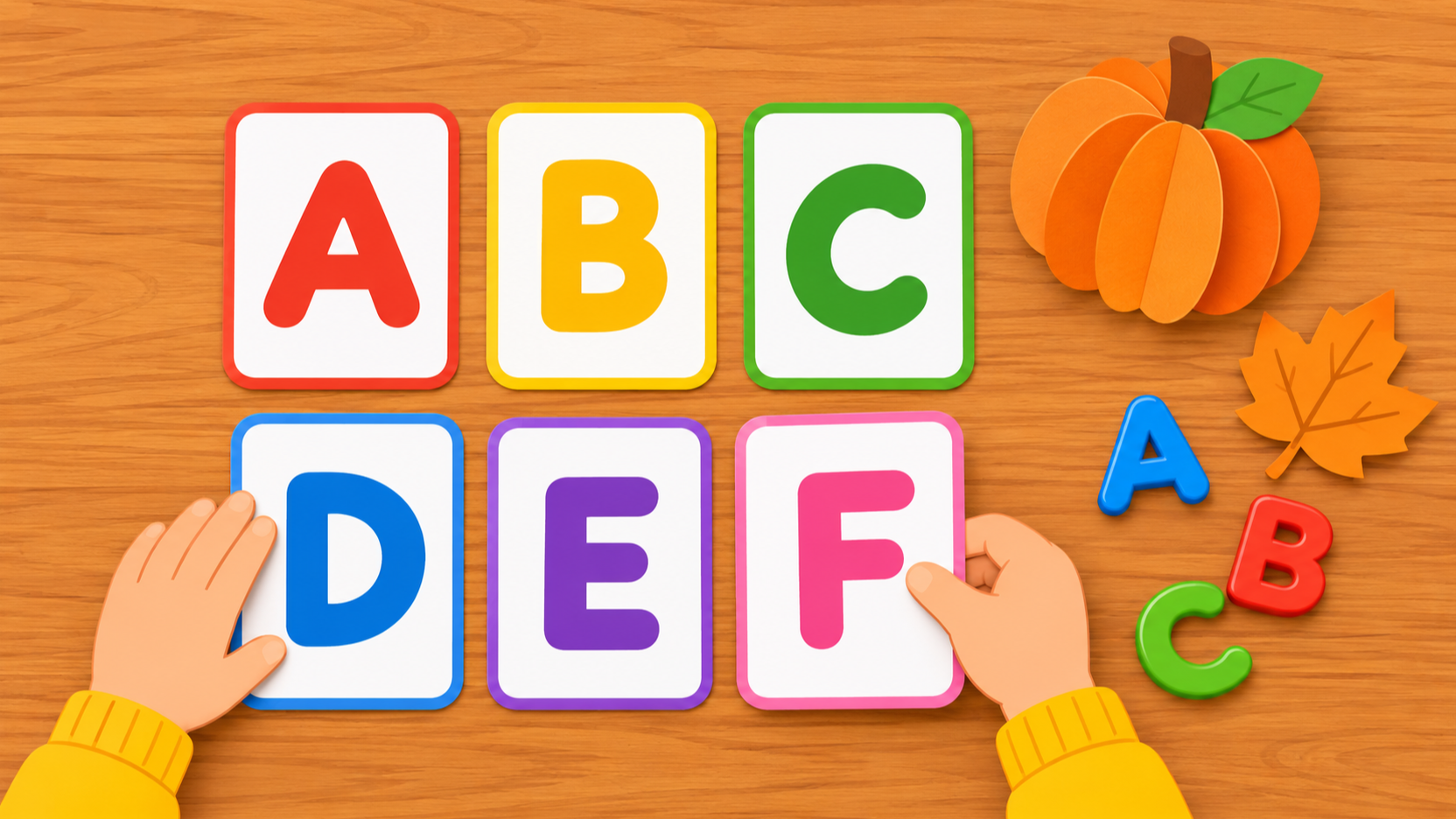
A Thanksgiving alphabet game is a 26-letter printable or spoken matching activity for children ages 3 to 6 that pairs uppercase and lowercase letters with autumn foods and gratitude words. You only need a standard home printer, US Letter or A4 paper, and a pair of scissors or a pencil to set up three quick rounds before dinner.
Key Takeaways
- Printable letter cards let preschoolers ages 3 to 4 match visual letter shapes before they can write words on lined paper.
- Kindergartners ages 5 to 6 can play the Thankful ABC challenge by connecting beginning sounds to real mealtime nouns from apple to zucchini.
- Pairing tricky letters like Q, X, and Z with concrete picture prompts prevents frustration during family table play.
- All printable sheets fit both US Letter and A4 paper in the same PDF file, so you can print directly at home with no page scaling.
Most holiday ABC sheets hand a four-year-old 26 blank lines and ask for written abstract nouns about gratitude. When a child cannot yet spell, that blank sheet stays empty on the kitchen counter while an adult ends up writing all 26 lines alone. Switching from a blank lined list to movable uppercase and lowercase letters alongside picture cues lets young children do the matching work themselves. We built this guide as part of our Thanksgiving Games for Kids: A Family Play Guide collection so parents and teachers can match the rules to a child’s exact reading stage.
How Do You Play a Thanksgiving Alphabet Game With Ages 3 to 6?
To play a Thanksgiving alphabet game with children ages 3 to 6, spread 26 letter cards face up on a table and have players match each uppercase letter to a lowercase partner or fall picture. Players say the letter name aloud, trace the printed shape, and mark the match with a token.
Early childhood teachers call this skill letter recognition, which is the ability to visually identify and name the 26 uppercase and 26 lowercase symbols of the English alphabet. A three-year-old does not need all 26 cards on the table at once. Too many loose pieces crowd the workspace. Follow these five steps to run a ten-minute round at home or in a classroom center:
- Pull out six to eight uppercase letter cards, starting with the letters found in your child’s own first name.
- Place the matching lowercase cards or beginning-sound picture tokens in a small bowl beside the tray.
- Invite your child to draw one token from the bowl, name the picture or letter aloud, and scan the table for its partner.
- Have your child trace the printed letter from top to bottom with one index finger before placing a dried corn kernel or wooden clothespin on the match.
- Clear the board after all six to eight pairs are covered, and swap in two unfamiliar letters for the next round.
Picture the table ten minutes before guests arrive. Before you set out the cards, an unsorted pile of blank paper and crayons sits by the placemats while hungry children ask when dinner starts. You deal six uppercase turkey cards in two rows of three and hand your four-year-old a cup of lowercase leaf tiles. Your child matches each leaf to its base card, calls out the letter names, and finishes the tray before the rolls come out of the oven.
Which Thanksgiving Alphabet Game Format Matches Your Child’s Age?
Choosing a Thanksgiving alphabet game format by age means pairing 3-year-olds with identical uppercase shape matching, 4-year-olds with uppercase-to-lowercase clip cards, and 5-to-6-year-olds with beginning-sound picture sorting or guided A-to-Z gratitude lists. Matching the game rules to a child’s developmental stage keeps play calm and prevents handwriting fatigue.
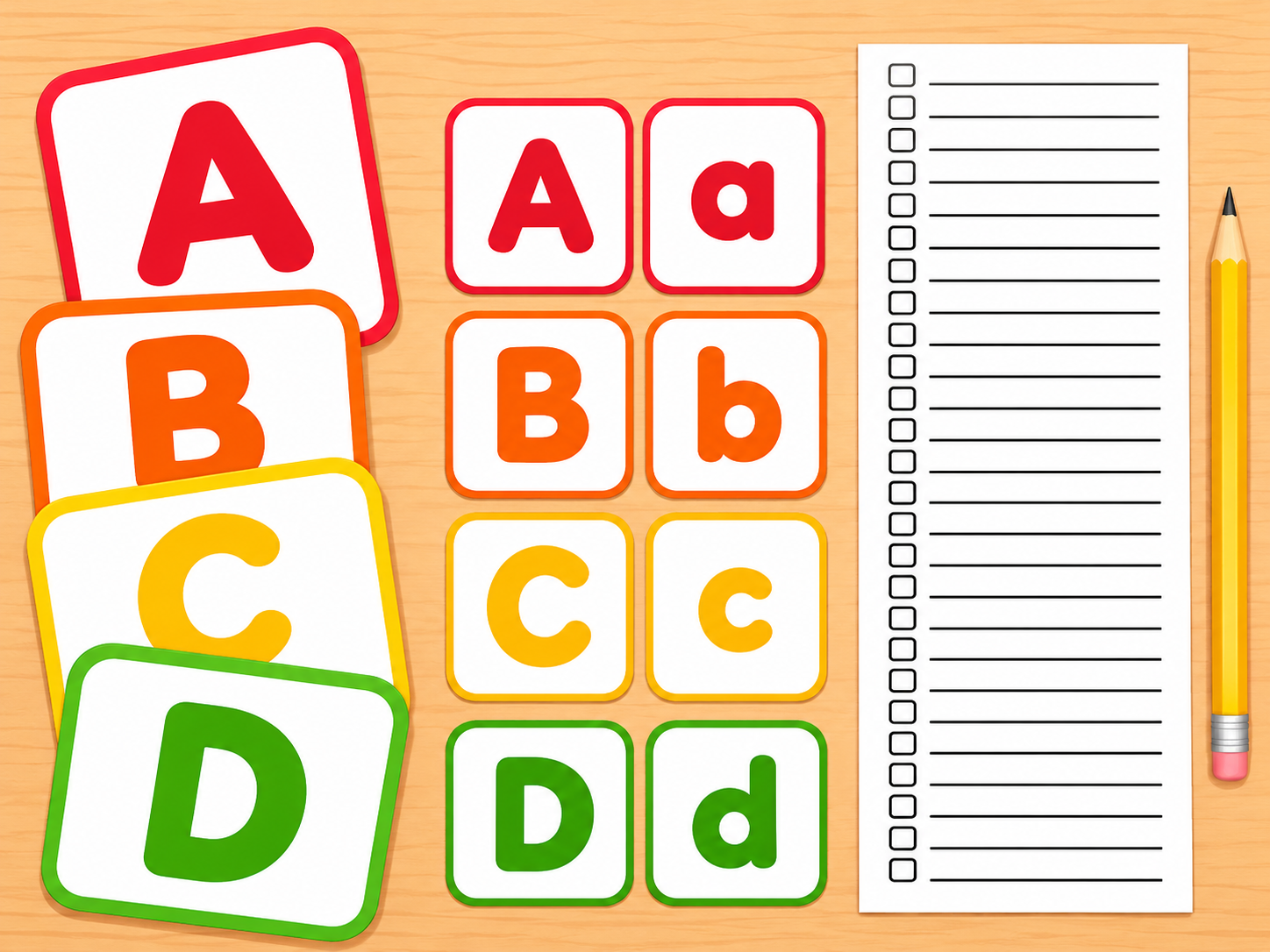
Younger preschoolers rely on visual discrimination, which is the ability to notice how curves, diagonal strokes, and straight lines differ between similar letters such as B, P, and R. Older preschoolers and kindergartners transition into phonemic awareness, which is the ability to hear and isolate individual speech sounds in spoken words. According to the CDC 5-year milestone checklist, a typical five-year-old “names some letters when you point to them” and “writes some letters in their name,” whereas a three-year-old is still learning to hold a crayon between thumb and fingers. According to Reading Rockets, alphabet knowledge develops across three distinct tasks: recognizing letter shapes, naming letters rapidly, and connecting each letter to its spoken phoneme.
| Game Format | Target Age Band | Core Literacy Skill | Materials Needed | Typical Round Length |
|---|---|---|---|---|
| Identical Letter Board | Ages 2.5 to 3.5 | Visual shape matching (uppercase A to uppercase A) | 1 printed base mat, 6 to 10 uppercase cutout tiles | 5 to 8 minutes |
| Turkey Feather Clip Cards | Ages 3.5 to 4.5 | Uppercase to lowercase pairing (A to a) | 26 printed clip cards on cardstock, 6 wooden clothespins | 8 to 12 minutes |
| Harvest Sound Sorting Tray | Ages 4.5 to 5.5 | Initial letter-sound matching (/p/ to pumpkin) | 26 letter cards, 26 picture tokens or kitchen items | 10 to 15 minutes |
| Guided Thankful ABC Sheet | Ages 5 to 6 | Invented spelling and dictating A-to-Z nouns | 1 single-page A-to-Z recording sheet, pencil, crayons | 12 to 20 minutes |
In KubbyLab’s printable design checklist for ages 3 to 6, every 26-letter deck separates visual shape matching from phonemic sound matching on distinct card sets. Mixing both demands on the same card often stalls four-year-olds who know a letter’s visual shape but cannot yet isolate the initial consonant sound of an unfamiliar seasonal noun.
What Is the Complete A to Z Word List for a Thankful ABC Game?
A complete A to Z word list for a Thankful ABC game pairs all 26 letters with concrete, touchable foods and family nouns that start with true single-letter sounds, such as apple for A, biscuit for B, corn for C, and dinner for D. Concrete nouns allow children ages 3 to 6 to isolate the initial phoneme.
Many seasonal word lists frustrate beginning readers because the suggested words start with consonant blends or digraphs, which are two-letter combinations that produce a single speech sound, such as th in thankful or ch in chestnut. If a kindergartner has learned that T makes the /t/ sound as in table, hearing an adult say “T is for thankful” contradicts their phonics instruction. Use the reference table below to give preschoolers concrete kitchen nouns and give kindergartners clear phonics prompts across all 26 letters.
| Letter | Concrete Object Word (Ages 3 to 4) | Gratitude or Family Word (Ages 5 to 6) | Phonetic Cue for Adults |
|---|---|---|---|
| A | Apple | Aunt or appetite | Use short /a/ in apple before long /a/ in acorn |
| B | Biscuit | Baking together | Emphasize the two-lip /b/ pop at the start |
| C | Corn | Cousins | Stick to hard /k/ sound; avoid cider (/s/) |
| D | Dinner roll | Dishes on the table | Tap tongue behind top teeth for /d/ |
| E | Eggplant | Eating together | Short /e/ in eggplant is clearer than ear of corn |
| F | Fork | Family | Top teeth rest on bottom lip for continuous /f/ |
| G | Gravy | Grandma or Grandpa | Use hard /g/ in gravy; avoid ginger (/j/) |
| H | Honey | Helping in the kitchen | Have children feel warm breath on their palm for /h/ |
| I | Ice water | Invitation | Use short /i/ in ink or igloo picture cue if needed |
| J | Jam | Jokes at the table | Contrast /j/ in jam with /g/ in gravy |
| K | Kettle | Kitchen | Pair with C to show both letters make the /k/ sound |
| L | Leaf | Laughter | Hold the continuous /l/ sound at the roof of the mouth |
| M | Masher | Music | Hum the closed-lip /m/ sound before opening to the vowel |
| N | Napkin | Neighbors | Contrast nose-hum /n/ with two-lip /m/ |
| O | Olive | Oven warmth | Short /o/ in olive avoids the schwa sound in oven |
| P | Pumpkin | Pie crust | Unvoiced puff of air /p/ paired with voiced /b/ |
| Q | Quilt | Quiet rest | Always teach Q and u together as the /kw/ team |
| R | Roll | Recipes | Avoid adding an “uh” sound; say /rrr/ cleanly |
| S | Spoon | Soup | Stretch the snake sound /sss/ without blends |
| T | Turkey | Table | Use clean /t/ words; save thankful (/th/) for digraphs |
| U | Utensils | Uncle | Point to short /u/ in uncle before long /u/ in utensils |
| V | Vegetables | Visiting | Feel the bottom lip vibrate on /vvv/ |
| W | Water pitcher | Warm socks | Round the lips for /w/ without saying “dub-uh-you” |
| X | Box of pie mix | Extra dessert | Listen for the /ks/ sound at the end of box and mix |
| Y | Yam | Yard leaves | Teach initial /y/ as in yam, distinct from letter name “why” |
| Z | Zucchini | Zipper on a jacket | Continuous buzzing /zzz/ behind closed teeth |
Keep a printed copy of this table beside the dining table. When a child stalls on J, O, or V, read the two concrete options aloud and let the child pick which one to draw or check off.
How Can You Adapt the Gratitude Alphabet Challenge for Pre-Readers?
Adapting the Gratitude Alphabet Challenge for pre-readers means replacing full-page lined handwriting sheets with oral turn-taking, drawing boxes, and movable picture stickers for all 26 letters. When adults transcribe a preschooler’s spoken words next to each capital letter, children ages 3 to 5 connect spoken language to print without pencil frustration.
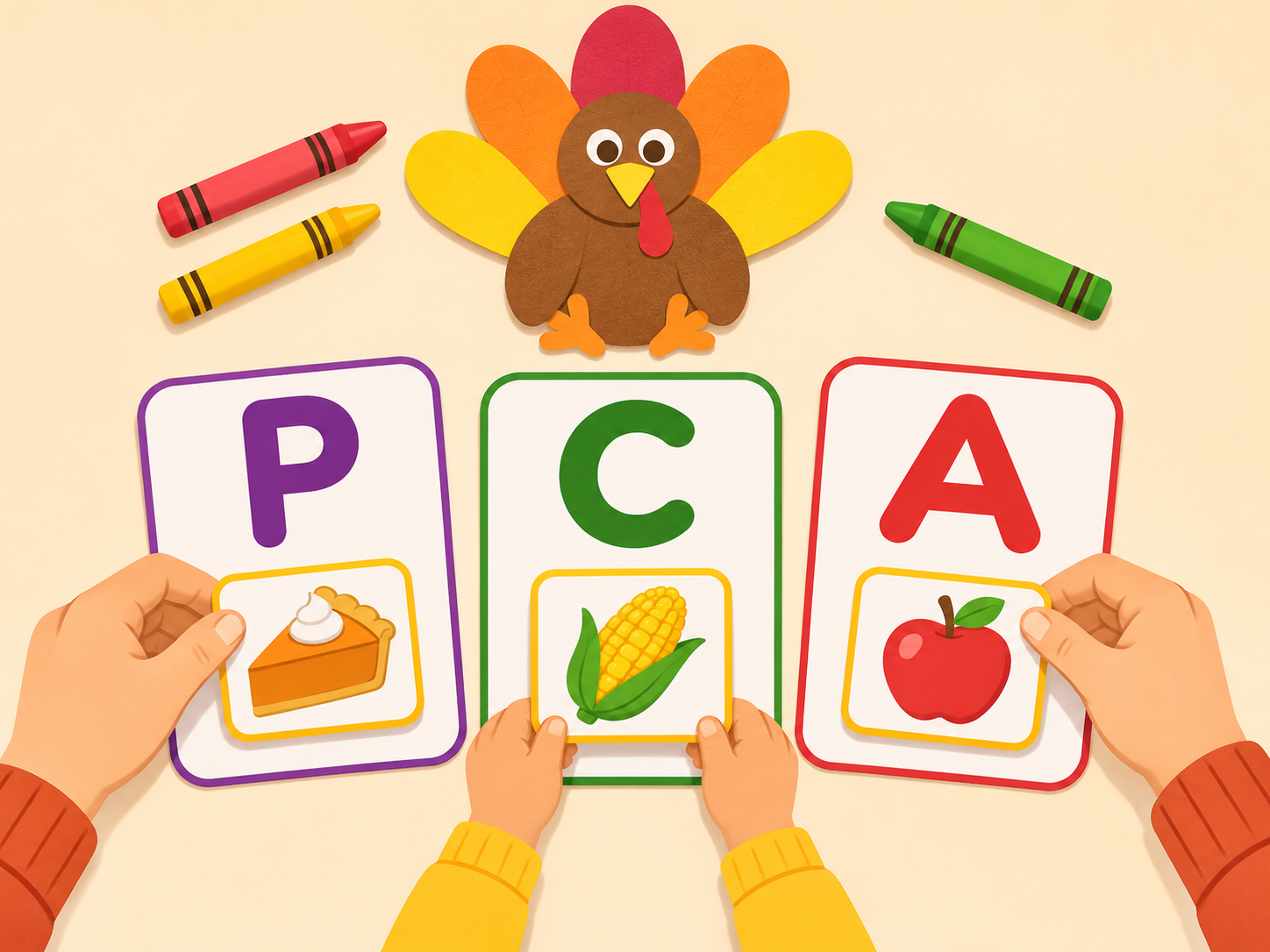
Many online Gratitude Alphabet printables give twenty-six narrow lines meant for third-grade cursive or print handwriting. A four-year-old who tries to copy twenty-six full words will quit by letter E. Instead, lean on environmental print (real labels, place cards, and food packages in the kitchen) alongside invented spelling, where a kindergartner writes the first and last consonant sounds they hear, such as PK for pumpkin or FK for fork. According to NAEYC, writing down a young child’s dictated words word-for-word and reading them back aloud shows children how spoken ideas turn into printed text.
When siblings or cousins of different ages share one single-page A-to-Z sheet, divide the task into three physical jobs so everyone participates at their own level. The three-year-old hunts for the matching letter card on the tray and stamps a dot marker over the letter box. The four-year-old names the food or family member for that letter and draws a quick sketch inside the margin. The five- or six-year-old writes the uppercase letter and sounds out the initial consonant with a pencil while an adult fills in the rest of the dictated word.
How Do You Teach Q, X, and Soft Consonants in an Autumn ABC Activity?
You teach Q, X, and soft consonants in an autumn ABC activity by pairing Q with u as /kw/ in quilt, framing X by its ending /ks/ sound in fox or mix, and swapping soft C or G words like cider for hard-sound words like corn and gravy. Explicit sound cues stop children ages 4 to 6 from guessing.
Strong letter-sound correspondence means a child reliably links a printed letter symbol to its primary phoneme. Three recurring phonics traps appear in standard fall alphabet worksheets, and each one takes thirty seconds to fix at the table.
First is the letter X trap. Commercial picture cards often pair X with xylophone (which begins with a /z/ sound) or x-ray (which says the letter name /eks/). Neither picture helps a child who just learned that X makes the /ks/ sound. On your printable card or recording sheet, write fo_, bo_, and mi_ with a blank line at the end. Say the word fox slowly, ask your child what sound lands at the tail of the word, and let them write or clip the X at the end.
Second is the soft C and soft G trap. Autumn vocabulary includes cider, celery, cinnamon, and ginger. When a four-year-old hears /s/ at the start of cider, they reach for the letter S. When they hear /j/ at the start of ginger, they reach for J. Save soft C and soft G for first-grade reading lessons. Use corn, cranberry, gravy, and gourd during preschool initial-sound games so the hard /k/ and /g/ sounds stay consistent.
Third is the vowel distortion trap on E and O. Words like ear of corn or oven change the vowel sound because the R in ear pulls the E into an R-controlled sound and the O in oven shifts into a short /uh/ schwa sound. Swap in eggplant for short /e/ and olive for short /o/ whenever you play an initial-sound sorting round.
How Do You Prep a Low-Mess Thanksgiving Letter Hunt at Home?
To prep a low-mess Thanksgiving letter hunt at home, print the 26 letter cards on 65-pound to 110-pound cardstock using US Letter or A4 paper, cut along the straight grid lines, and hide 10 cards at child eye level around one room. Give each player a single-page alphabet checklist on a clipboard.
Intricate die-cut turkey shapes take thirty minutes to trim by hand. Rectangular grid cards laid out six to a page take four straight cuts across the horizontal lines and vertical center line. You can trim a full 26-card uppercase deck in under three minutes with straight-blade scissors or a paper trimmer.
To build fine motor grip, which is the three-finger pinch of thumb, index, and middle fingers needed for pencil control, add six wooden clothespins to the clipboard. Instead of wandering through the house with an uncapped marker, your child walks from the sofa to the bookshelf, spots an uppercase card taped to a chair leg, clips a clothespin onto the matching lowercase letter along the edge of their board, and returns to the rug. If you are setting up a multi-station play table for several preschoolers, you can rotate this letter hunt with the visual matching boards in our Thanksgiving Printable Games for Kids: Play Guide or run a group call-and-cover round using Thanksgiving Bingo for Preschool: How to Play.
What Quiet Thanksgiving Alphabet Games Work at the Dinner Table?
Quiet Thanksgiving alphabet games that work at the dinner table include Alphabet I-Spy using dishes on the table, a magnetic baking-sheet letter match, and a pass-the-napkin A-to-Z gratitude chain. Each variation keeps children seated in their chairs without small loose pieces rolling onto the floor or interrupting meal conversation.
When ten or twelve relatives share one table, loose paper cutouts easily slip under serving bowls. Three low-footprint setups keep letter play contained within a child’s single place setting.
First, try Dish-by-Dish Sound Spy while everyone waits for plates to be passed. An adult or older cousin says, “I spy something on the tablecloth that starts with the /b/ sound, letter B.” A तीन- or four-year-old scans the serving dishes and points to the butter dish, bread basket, or green beans. For five- and six-year-olds, give an ending sound clue instead, such as “I spy a utensil that ends with the /k/ sound” for fork.
Second, set up a Cookie-Sheet Magnet Match for toddlers and young preschoolers. Lay the single-page A-to-Z recording sheet flat inside a rimmed metal baking pan and hand the child a small cup of ten magnetic plastic letters. The metal rim stops letters from sliding onto the floor, and the magnets hold each letter directly over its printed square.
Third, start a Round-the-Table Gratitude Chain between dinner and dessert. Place the printed 26-letter strip in the center of the table so early readers can track the alphabetical order with a salt shaker. The first person names an A word they appreciated that week, the person to their left names a B word, and the chain circles the table through Z. Families who want additional seated paper-and-pencil rounds can combine this chain with our Thanksgiving Table Games for Kids to Play Seated, add oral sound play from Thanksgiving Rhyming Games: What Can You Play?, or step up to early decoding with Thanksgiving Sight Word Games to Play Together.
What Can a Printable Thanksgiving Alphabet Activity Teach (and What Are Its Limits)?
A printable Thanksgiving alphabet activity teaches short-burst letter recognition, uppercase-to-lowercase matching, and initial consonant sound awareness during a 10-to-15-minute shared play session. A single themed printable cannot replace daily systematic phonics instruction, shared storybook reading, or back-and-forth conversation with a responsive adult.
At KubbyLab, we test our early-literacy printables around real kitchen timers and short attention spans. A holiday card deck works well because it gives an adult and a child a concrete object to point to, name, and manipulate together for ten minutes while the rest of the household is busy. According to NAEYC, literacy-rich play environments depend on responsive adult conversation around print rather than isolated worksheet drills. If a child loses interest after matching eight letters, stack the cards and stop. Five focused minutes of naming letters in your child’s name builds stronger memory than twenty forced minutes of tracing all twenty-six letters.
If you want a ready-to-print set so you do not have to draw twenty-six cards by hand, our KubbyLab printable pack is formatted for home printing with the following specifications:
- Digital PDF download delivered immediately in your browser and account email; nothing physical is shipped.
- US Letter (8.5 by 11 inches) by default, and A4 (21 by 29.7 cm) sits in the same file, so there is nothing to pick or resize.
- 9 printable pages per paper size: 26 uppercase letter cards (6 cards per page), 26 lowercase letter cards, 26 beginning-sound autumn picture tokens, and 1 single-page Thankful A-to-Z recording sheet.
- Opens in any standard PDF reader for printing on a home printer or at a local print shop on standard copy paper or 65-pound cardstock.
Shop the topic
-
Preschool Science Facts: Did You Know?
50 'Did You Know?' science pages: one concept per page, visual learning, zero prep.
$7
Get this product View details -
Animals Flashcards for Kids: 50 Cards
50 printable animal flashcards with cute illustrations: builds vocabulary, memory, and visual recognition.
$7
Get this product View details -
Fruits & Vegetables Discovery Activity Book
50 pages revealing what is inside fruits and vegetables: visual discovery, science vocabulary, healthy food facts.
$7
Get this product View details
Frequently asked questions
How do you play the Thanksgiving alphabet game with preschoolers who do not know all 26 letters?
Start by pulling out only the 5 to 8 letters found in your preschooler's first name instead of using the full 26-card deck. Lay the uppercase cards face up on the table and let your child match identical uppercase letters or familiar picture cards one at a time. Add two more letters once those first cards feel easy.
What can you use for the letters Q, X, and Z in a Thankful ABC game?
For Q, use concrete cozy words like quilt or quiet time so children hear the /kw/ sound clearly. For X, choose words that end with the true /ks/ sound, such as fox or box, or use extra dessert for older children. For Z, use zucchini bread, zipper on a warm coat, or zest from an orange.
What paper and materials do you need to print a Thanksgiving alphabet game at home?
You need a home inkjet or laser printer, 9 sheets of US Letter (8.5 by 11 inches) or A4 (21 by 29.7 cm) paper, and straight-blade scissors. Printing the 26 letter cards on 65-pound to 110-pound white cardstock keeps the cards stiff for little hands. You can also slip the single-page A-to-Z mat into a plastic dry-erase pocket.
How long does a round of the Thanksgiving alphabet game take for ages 3 to 6?
A single round takes 5 to 10 minutes for preschoolers ages 3 to 4 when you limit the deck to 8 or 10 target letters. Kindergartners ages 5 to 6 usually play for 12 to 15 minutes when sorting all 26 beginning-sound cards or filling in a shared Thankful ABC sheet. Stopping early prevents fatigue.
Should preschoolers practice uppercase or lowercase letters first in a Thanksgiving ABC game?
Preschoolers ages 3 to 4 should start with uppercase letters because capital letters have distinct straight lines and fewer mirror-image shapes like b, d, p, and q. Once a child recognizes at least 15 uppercase letters and the letters in their own first name, introduce lowercase partner cards so they can match both forms.